

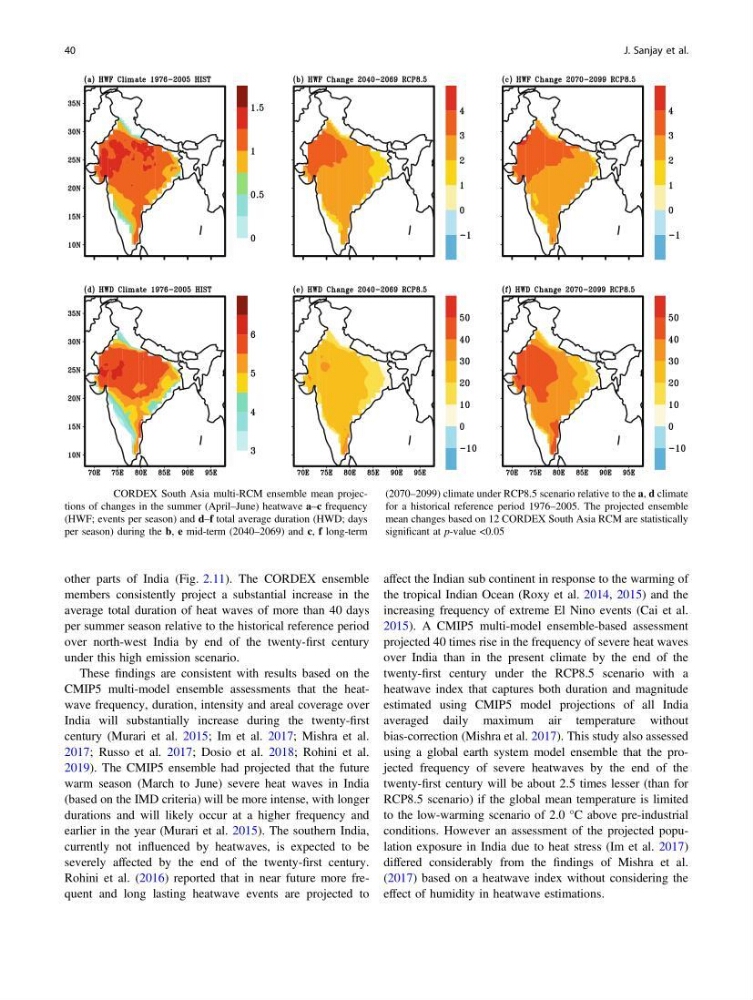
other parts of India (Fig. 2.11). The CORDEX ensemble
members consistently project a substantial increase in the
average total duration of heat waves of more than 40 days
per summer season relative to the historical reference period
over north-west India by end of the twenty-first century
under this high emission scenario.
These findings are consistent with results based on the
CMIP5 multi-model ensemble assessments that the heatwave frequency, duration, intensity and areal coverage over
India will substantially increase during the twenty-first
century (Murari et al. 2015; Im et al. 2017; Mishra et al.
2017; Russo et al. 2017; Dosio et al. 2018; Rohini et al.
2019). The CMIP5 ensemble had projected that the future
warm season (March to June) severe heat waves in India
(based on the IMD criteria) will be more intense, with longer
durations and will likely occur at a higher frequency and
earlier in the year (Murari et al. 2015). The southern India,
currently not influenced by heatwaves, is expected to be
severely affected by the end of the twenty-first century.
Rohini et al. (2016) reported that in near future more frequent and long lasting heatwave events are projected to
affect the Indian sub continent in response to the warming of
the tropical Indian Ocean (Roxy et al. 2014, 2015) and the
increasing frequency of extreme El Nino events (Cai et al.
2015). A CMIP5 multi-model ensemble-based assessment
projected 40 times rise in the frequency of severe heat waves
over India than in the present climate by the end of the
twenty-first century under the RCP8.5 scenario with a
heatwave index that captures both duration and magnitude
estimated using CMIP5 model projections of all India
averaged daily maximum air temperature without
bias-correction (Mishra et al. 2017). This study also assessed
using a global earth system model ensemble that the projected frequency of severe heatwaves by the end of the
twenty-first century will be about 2.5 times lesser (than for
RCP8.5 scenario) if the global mean temperature is limited
to the low-warming scenario of 2.0 °C above pre-industrial
conditions. However an assessment of the projected population exposure in India due to heat stress (Im et al. 2017)
differed considerably from the findings of Mishra et al.
(2017) based on a heatwave index without considering the
effect of humidity in heatwave estimations.
Fig. 2.11 CORDEX South Asia multi-RCM ensemble mean projections of changes in the summer (April–June) heatwave a–c frequency
(HWF; events per season) and d–f total average duration (HWD; days
per season) during the b, e mid-term (2040–2069) and c, f long-term
(2070–2099) climate under RCP8.5 scenario relative to the a, d climate
for a historical reference period 1976–2005. The projected ensemble
mean changes based on 12 CORDEX South Asia RCM are statistically
significant at p-value <0.05
40
J. Sanjay et al.
members consistently project a substantial increase in the
average total duration of heat waves of more than 40 days
per summer season relative to the historical reference period
over north-west India by end of the twenty-first century
under this high emission scenario.
These findings are consistent with results based on the
CMIP5 multi-model ensemble assessments that the heatwave frequency, duration, intensity and areal coverage over
India will substantially increase during the twenty-first
century (Murari et al. 2015; Im et al. 2017; Mishra et al.
2017; Russo et al. 2017; Dosio et al. 2018; Rohini et al.
2019). The CMIP5 ensemble had projected that the future
warm season (March to June) severe heat waves in India
(based on the IMD criteria) will be more intense, with longer
durations and will likely occur at a higher frequency and
earlier in the year (Murari et al. 2015). The southern India,
currently not influenced by heatwaves, is expected to be
severely affected by the end of the twenty-first century.
Rohini et al. (2016) reported that in near future more frequent and long lasting heatwave events are projected to
affect the Indian sub continent in response to the warming of
the tropical Indian Ocean (Roxy et al. 2014, 2015) and the
increasing frequency of extreme El Nino events (Cai et al.
2015). A CMIP5 multi-model ensemble-based assessment
projected 40 times rise in the frequency of severe heat waves
over India than in the present climate by the end of the
twenty-first century under the RCP8.5 scenario with a
heatwave index that captures both duration and magnitude
estimated using CMIP5 model projections of all India
averaged daily maximum air temperature without
bias-correction (Mishra et al. 2017). This study also assessed
using a global earth system model ensemble that the projected frequency of severe heatwaves by the end of the
twenty-first century will be about 2.5 times lesser (than for
RCP8.5 scenario) if the global mean temperature is limited
to the low-warming scenario of 2.0 °C above pre-industrial
conditions. However an assessment of the projected population exposure in India due to heat stress (Im et al. 2017)
differed considerably from the findings of Mishra et al.
(2017) based on a heatwave index without considering the
effect of humidity in heatwave estimations.
Fig. 2.11 CORDEX South Asia multi-RCM ensemble mean projections of changes in the summer (April–June) heatwave a–c frequency
(HWF; events per season) and d–f total average duration (HWD; days
per season) during the b, e mid-term (2040–2069) and c, f long-term
(2070–2099) climate under RCP8.5 scenario relative to the a, d climate
for a historical reference period 1976–2005. The projected ensemble
mean changes based on 12 CORDEX South Asia RCM are statistically
significant at p-value <0.05
40
J. Sanjay et al.