

Meehl and Hibbard 2007; Taylor et al. 2012; Eyring et al.
2016) and become a central element of national and international assessments of climate change.
The IITM—Earth System Model (IITM-ESM) has contributed to the CMIP6 and IPCC AR6 assessments, the first
time from India. The philosophy behind the development of
the IITM-ESM is to create capabilities in global modelling,
with special emphasis on the South Asian monsoon, to address
the science of climate change, including detection, attribution
and future projections of global and regional climate.
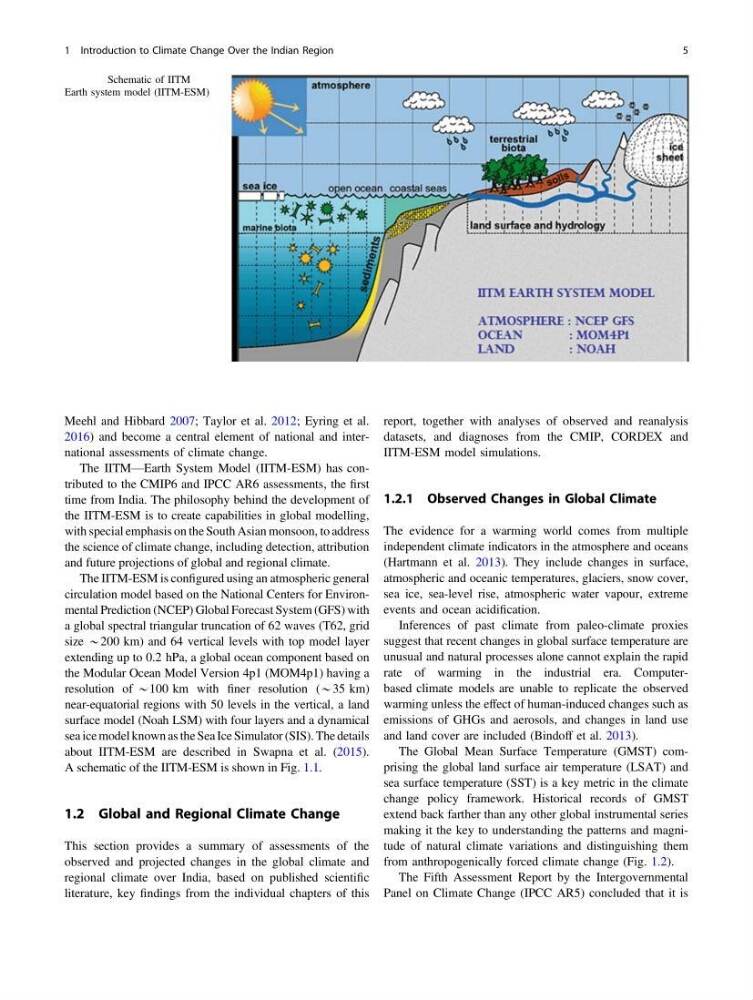
The IITM-ESM is configured using an atmospheric general
circulation model based on the National Centers for Environmental Prediction (NCEP) Global Forecast System (GFS) with
a global spectral triangular truncation of 62 waves (T62, grid
size *200 km) and 64 vertical levels with top model layer
extending up to 0.2 hPa, a global ocean component based on
the Modular Ocean Model Version 4p1 (MOM4p1) having a
resolution of *100 km with finer resolution (*35 km)
near-equatorial regions with 50 levels in the vertical, a land
surface model (Noah LSM) with four layers and a dynamical
sea ice model known as the Sea Ice Simulator (SIS). The details
about IITM-ESM are described in Swapna et al. (2015).
A schematic of the IITM-ESM is shown in Fig. 1.1.
1.2 Global and Regional Climate Change
This section provides a summary of assessments of the
observed and projected changes in the global climate and
regional climate over India, based on published scientific
literature, key findings from the individual chapters of this
report, together with analyses of observed and reanalysis
datasets, and diagnoses from the CMIP, CORDEX and
IITM-ESM model simulations.
1.2.1 Observed Changes in Global Climate
The evidence for a warming world comes from multiple
independent climate indicators in the atmosphere and oceans
(Hartmann et al. 2013). They include changes in surface,
atmospheric and oceanic temperatures, glaciers, snow cover,
sea ice, sea-level rise, atmospheric water vapour, extreme
events and ocean acidification.
Inferences of past climate from paleo-climate proxies
suggest that recent changes in global surface temperature are
unusual and natural processes alone cannot explain the rapid
rate of warming in the industrial era. Computerbased climate models are unable to replicate the observed
warming unless the effect of human-induced changes such as
emissions of GHGs and aerosols, and changes in land use
and land cover are included (Bindoff et al. 2013).
The Global Mean Surface Temperature (GMST) comprising the global land surface air temperature (LSAT) and
sea surface temperature (SST) is a key metric in the climate
change policy framework. Historical records of GMST
extend back farther than any other global instrumental series
making it the key to understanding the patterns and magnitude of natural climate variations and distinguishing them
from anthropogenically forced climate change (Fig. 1.2).
The Fifth Assessment Report by the Intergovernmental
Panel on Climate Change (IPCC AR5) concluded that it is
Fig. 1.1 Schematic of IITM
Earth system model (IITM-ESM)
1 Introduction to Climate Change Over the Indian Region
5
2016) and become a central element of national and international assessments of climate change.
The IITM—Earth System Model (IITM-ESM) has contributed to the CMIP6 and IPCC AR6 assessments, the first
time from India. The philosophy behind the development of
the IITM-ESM is to create capabilities in global modelling,
with special emphasis on the South Asian monsoon, to address
the science of climate change, including detection, attribution
and future projections of global and regional climate.
The IITM-ESM is configured using an atmospheric general
circulation model based on the National Centers for Environmental Prediction (NCEP) Global Forecast System (GFS) with
a global spectral triangular truncation of 62 waves (T62, grid
size *200 km) and 64 vertical levels with top model layer
extending up to 0.2 hPa, a global ocean component based on
the Modular Ocean Model Version 4p1 (MOM4p1) having a
resolution of *100 km with finer resolution (*35 km)
near-equatorial regions with 50 levels in the vertical, a land
surface model (Noah LSM) with four layers and a dynamical
sea ice model known as the Sea Ice Simulator (SIS). The details
about IITM-ESM are described in Swapna et al. (2015).
A schematic of the IITM-ESM is shown in Fig. 1.1.
1.2 Global and Regional Climate Change
This section provides a summary of assessments of the
observed and projected changes in the global climate and
regional climate over India, based on published scientific
literature, key findings from the individual chapters of this
report, together with analyses of observed and reanalysis
datasets, and diagnoses from the CMIP, CORDEX and
IITM-ESM model simulations.
1.2.1 Observed Changes in Global Climate
The evidence for a warming world comes from multiple
independent climate indicators in the atmosphere and oceans
(Hartmann et al. 2013). They include changes in surface,
atmospheric and oceanic temperatures, glaciers, snow cover,
sea ice, sea-level rise, atmospheric water vapour, extreme
events and ocean acidification.
Inferences of past climate from paleo-climate proxies
suggest that recent changes in global surface temperature are
unusual and natural processes alone cannot explain the rapid
rate of warming in the industrial era. Computerbased climate models are unable to replicate the observed
warming unless the effect of human-induced changes such as
emissions of GHGs and aerosols, and changes in land use
and land cover are included (Bindoff et al. 2013).
The Global Mean Surface Temperature (GMST) comprising the global land surface air temperature (LSAT) and
sea surface temperature (SST) is a key metric in the climate
change policy framework. Historical records of GMST
extend back farther than any other global instrumental series
making it the key to understanding the patterns and magnitude of natural climate variations and distinguishing them
from anthropogenically forced climate change (Fig. 1.2).
The Fifth Assessment Report by the Intergovernmental
Panel on Climate Change (IPCC AR5) concluded that it is
Fig. 1.1 Schematic of IITM
Earth system model (IITM-ESM)
1 Introduction to Climate Change Over the Indian Region
5