

Also, internal variability induced by the intraseasonal
oscillations of monsoon could lead to seasonal droughts that
are not connected to the known external forcing (Goswami
1998; Kripalani et al. 2004). Monsoon droughts are generally associated with at least one very long break with a
duration of more than ten days (Joseph et al. 2010). The
ocean-atmosphere dynamical coupling, between the monsoon flow and thermocline depth on intraseasonal timescales, in the equatorial Indian Ocean, plays an important
role in forcing extended monsoon breaks and causes
droughts over the Indian subcontinent (Krishnan et al. 2006).
Complex thermodynamical interactions among equatorial
Indo-Pacific and off-equatorial northern Indian Ocean (between 10° N—25° N) convective systems on intraseasonal
timescale as well as the ocean-atmosphere coupling on
interannual timescale can also trigger the occurrence of very
long breaks (Joseph et al. 2010). Moreover, the initiation of
extended breaks resulting in drought conditions could be
influenced by the extratropical systems as well (Krishnan
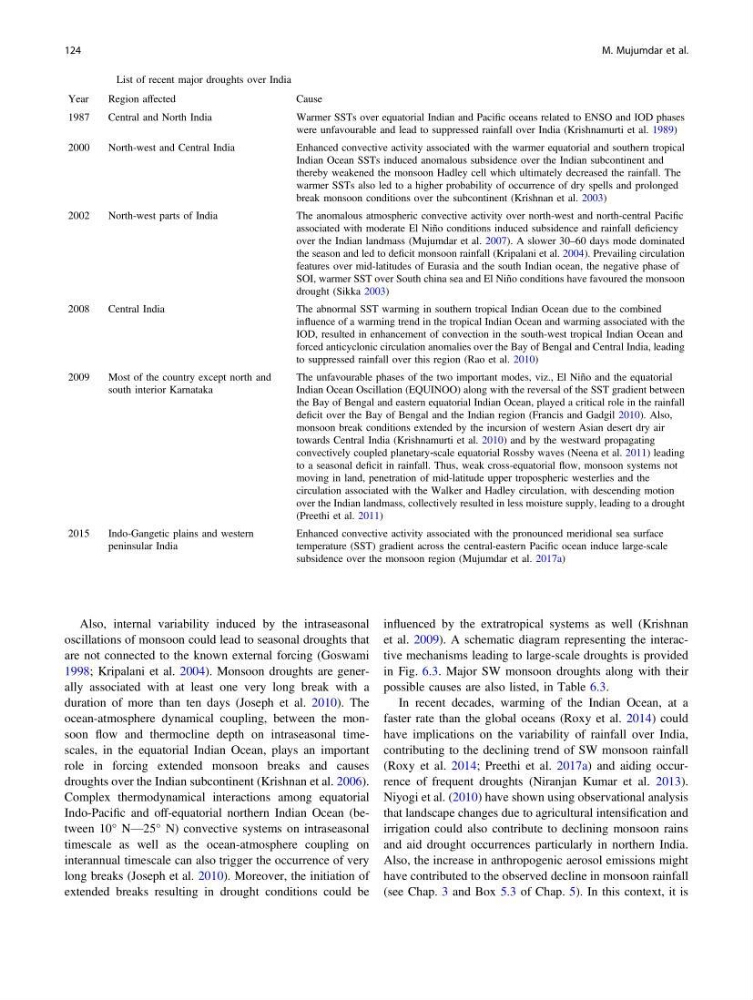
et al. 2009). A schematic diagram representing the interactive mechanisms leading to large-scale droughts is provided
in Fig. 6.3. Major SW monsoon droughts along with their
possible causes are also listed, in Table 6.3.
In recent decades, warming of the Indian Ocean, at a
faster rate than the global oceans (Roxy et al. 2014) could
have implications on the variability of rainfall over India,
contributing to the declining trend of SW monsoon rainfall
(Roxy et al. 2014; Preethi et al. 2017a) and aiding occurrence of frequent droughts (Niranjan Kumar et al. 2013).
Niyogi et al. (2010) have shown using observational analysis
that landscape changes due to agricultural intensification and
irrigation could also contribute to declining monsoon rains
and aid drought occurrences particularly in northern India.
Also, the increase in anthropogenic aerosol emissions might
have contributed to the observed decline in monsoon rainfall
(see Chap. 3 and Box 5.3 of Chap. 5). In this context, it is
Table 6.3 List of recent major droughts over India
Year
Region affected
Cause
1987
Central and North India
Warmer SSTs over equatorial Indian and Pacific oceans related to ENSO and IOD phases
were unfavourable and lead to suppressed rainfall over India (Krishnamurti et al. 1989)
2000
North-west and Central India
Enhanced convective activity associated with the warmer equatorial and southern tropical
Indian Ocean SSTs induced anomalous subsidence over the Indian subcontinent and
thereby weakened the monsoon Hadley cell which ultimately decreased the rainfall. The
warmer SSTs also led to a higher probability of occurrence of dry spells and prolonged
break monsoon conditions over the subcontinent (Krishnan et al. 2003)
2002
North-west parts of India
The anomalous atmospheric convective activity over north-west and north-central Pacific
associated with moderate El Niño conditions induced subsidence and rainfall deficiency
over the Indian landmass (Mujumdar et al. 2007). A slower 30–60 days mode dominated
the season and led to deficit monsoon rainfall (Kripalani et al. 2004). Prevailing circulation
features over mid-latitudes of Eurasia and the south Indian ocean, the negative phase of
SOI, warmer SST over South china sea and El Niño conditions have favoured the monsoon
drought (Sikka 2003)
2008
Central India
The abnormal SST warming in southern tropical Indian Ocean due to the combined
influence of a warming trend in the tropical Indian Ocean and warming associated with the
IOD, resulted in enhancement of convection in the south-west tropical Indian Ocean and
forced anticyclonic circulation anomalies over the Bay of Bengal and Central India, leading
to suppressed rainfall over this region (Rao et al. 2010)
2009
Most of the country except north and
south interior Karnataka
The unfavourable phases of the two important modes, viz., El Niño and the equatorial
Indian Ocean Oscillation (EQUINOO) along with the reversal of the SST gradient between
the Bay of Bengal and eastern equatorial Indian Ocean, played a critical role in the rainfall
deficit over the Bay of Bengal and the Indian region (Francis and Gadgil 2010). Also,
monsoon break conditions extended by the incursion of western Asian desert dry air
towards Central India (Krishnamurti et al. 2010) and by the westward propagating
convectively coupled planetary‐scale equatorial Rossby waves (Neena et al. 2011) leading
to a seasonal deficit in rainfall. Thus, weak cross-equatorial flow, monsoon systems not
moving in land, penetration of mid-latitude upper tropospheric westerlies and the
circulation associated with the Walker and Hadley circulation, with descending motion
over the Indian landmass, collectively resulted in less moisture supply, leading to a drought
(Preethi et al. 2011)
2015
Indo-Gangetic plains and western
peninsular India
Enhanced convective activity associated with the pronounced meridional sea surface
temperature (SST) gradient across the central-eastern Pacific ocean induce large-scale
subsidence over the monsoon region (Mujumdar et al. 2017a)
124
M. Mujumdar et al.
oscillations of monsoon could lead to seasonal droughts that
are not connected to the known external forcing (Goswami
1998; Kripalani et al. 2004). Monsoon droughts are generally associated with at least one very long break with a
duration of more than ten days (Joseph et al. 2010). The
ocean-atmosphere dynamical coupling, between the monsoon flow and thermocline depth on intraseasonal timescales, in the equatorial Indian Ocean, plays an important
role in forcing extended monsoon breaks and causes
droughts over the Indian subcontinent (Krishnan et al. 2006).
Complex thermodynamical interactions among equatorial
Indo-Pacific and off-equatorial northern Indian Ocean (between 10° N—25° N) convective systems on intraseasonal
timescale as well as the ocean-atmosphere coupling on
interannual timescale can also trigger the occurrence of very
long breaks (Joseph et al. 2010). Moreover, the initiation of
extended breaks resulting in drought conditions could be
influenced by the extratropical systems as well (Krishnan
et al. 2009). A schematic diagram representing the interactive mechanisms leading to large-scale droughts is provided
in Fig. 6.3. Major SW monsoon droughts along with their
possible causes are also listed, in Table 6.3.
In recent decades, warming of the Indian Ocean, at a
faster rate than the global oceans (Roxy et al. 2014) could
have implications on the variability of rainfall over India,
contributing to the declining trend of SW monsoon rainfall
(Roxy et al. 2014; Preethi et al. 2017a) and aiding occurrence of frequent droughts (Niranjan Kumar et al. 2013).
Niyogi et al. (2010) have shown using observational analysis
that landscape changes due to agricultural intensification and
irrigation could also contribute to declining monsoon rains
and aid drought occurrences particularly in northern India.
Also, the increase in anthropogenic aerosol emissions might
have contributed to the observed decline in monsoon rainfall
(see Chap. 3 and Box 5.3 of Chap. 5). In this context, it is
Table 6.3 List of recent major droughts over India
Year
Region affected
Cause
1987
Central and North India
Warmer SSTs over equatorial Indian and Pacific oceans related to ENSO and IOD phases
were unfavourable and lead to suppressed rainfall over India (Krishnamurti et al. 1989)
2000
North-west and Central India
Enhanced convective activity associated with the warmer equatorial and southern tropical
Indian Ocean SSTs induced anomalous subsidence over the Indian subcontinent and
thereby weakened the monsoon Hadley cell which ultimately decreased the rainfall. The
warmer SSTs also led to a higher probability of occurrence of dry spells and prolonged
break monsoon conditions over the subcontinent (Krishnan et al. 2003)
2002
North-west parts of India
The anomalous atmospheric convective activity over north-west and north-central Pacific
associated with moderate El Niño conditions induced subsidence and rainfall deficiency
over the Indian landmass (Mujumdar et al. 2007). A slower 30–60 days mode dominated
the season and led to deficit monsoon rainfall (Kripalani et al. 2004). Prevailing circulation
features over mid-latitudes of Eurasia and the south Indian ocean, the negative phase of
SOI, warmer SST over South china sea and El Niño conditions have favoured the monsoon
drought (Sikka 2003)
2008
Central India
The abnormal SST warming in southern tropical Indian Ocean due to the combined
influence of a warming trend in the tropical Indian Ocean and warming associated with the
IOD, resulted in enhancement of convection in the south-west tropical Indian Ocean and
forced anticyclonic circulation anomalies over the Bay of Bengal and Central India, leading
to suppressed rainfall over this region (Rao et al. 2010)
2009
Most of the country except north and
south interior Karnataka
The unfavourable phases of the two important modes, viz., El Niño and the equatorial
Indian Ocean Oscillation (EQUINOO) along with the reversal of the SST gradient between
the Bay of Bengal and eastern equatorial Indian Ocean, played a critical role in the rainfall
deficit over the Bay of Bengal and the Indian region (Francis and Gadgil 2010). Also,
monsoon break conditions extended by the incursion of western Asian desert dry air
towards Central India (Krishnamurti et al. 2010) and by the westward propagating
convectively coupled planetary‐scale equatorial Rossby waves (Neena et al. 2011) leading
to a seasonal deficit in rainfall. Thus, weak cross-equatorial flow, monsoon systems not
moving in land, penetration of mid-latitude upper tropospheric westerlies and the
circulation associated with the Walker and Hadley circulation, with descending motion
over the Indian landmass, collectively resulted in less moisture supply, leading to a drought
(Preethi et al. 2011)
2015
Indo-Gangetic plains and western
peninsular India
Enhanced convective activity associated with the pronounced meridional sea surface
temperature (SST) gradient across the central-eastern Pacific ocean induce large-scale
subsidence over the monsoon region (Mujumdar et al. 2017a)
124
M. Mujumdar et al.