

Rajeevan et al. 2012; Jayasankar et al. 2015; Preethi et al.
2010, 2017b). Large uncertainties are also found in reconstructing agricultural drought events for the period 1951–
2015 based on simulated soil moisture from three different
land surface models (Mishra et al. 2018). These uncertainties
are mainly due to differences in model parameterizations and
hence the study highlighted the importance of considering the
multi-model ensemble for real-time monitoring and prediction of soil moisture drought over India.
6.2.1 Drought Mechanism
General features associated with SW monsoon droughts are
weaker meridional pressure gradient, a larger northward
seasonal shift of the monsoon trough, more break days,
reduction in the frequency of depressions and shorter westward extent of depression tracks (Mooley 1976; Parthasarathy et al. 1987; Raman and Rao 1981; Sikka 1999).
Droughts during the SW monsoon are, in general, significantly related to external forcings such as sea surface temperature (SST) variations in the tropical oceans, particularly
with the warm phase of El Niño–Southern Oscillation
(ENSO; Sikka 1980, 1999; Pant and Parthasarathy 1981; Pai
et al. 2011, 2017; Mishra et al. 2012b; Preethi et al. 2017a
and the references therein) events in the eastern equatorial
Pacific, central Pacific El Niño (Kumar et al. 2006) or El
Niño Modoki events (Ashok et al. 2007) and also the negative Indian Ocean Dipole (IOD) events (Saji et al. 1999;
Ashok et al. 2001). Apart from the tropical teleconnections,
impacts on SW monsoon droughts from extra-tropics are
evident from negative phase of the North Atlantic Oscillation (NAO; Goswami et al. 2006) on interannual timescale,
negative phase of Atlantic Multidecadal Oscillation (AMO;
Goswami et al. 2006) and positive phase of Pacific Decadal
Oscillation (PDO; Krishnan and Sugi 2003) on multidecadal
timescales. On the other hand, NE monsoon droughts are
associated with a negative phase of ENSO (La Niña) and
negative phase of IOD (Kripalani and Kumar 2004). In
addition to the tropical influence, extratropical influence is
evident as a relationship between the positive phase of the
NAO and NE monsoon drought (Balachandran et al. 2006).
Further details can be obtained from Box 3.2 in Chap. 3. It is
to be noted that these teleconnections exhibit a secular
variation, with epochs of strong and weak relationship with
SW as well as NE monsoon rainfall (Kripalani and Kulkarni
1997; Kumar et al. 1999; Pankaj Kumar et al. 2007; Yadav
2012; Rajeevan et al. 2012).
MONSOONAL DROUGHTS
Land Surface
Eurasian Snow
Surface Boundary Conditions
Processes
Cover
SST
Other Possible Causes
Cycle
ENSO / IOD
Volcanic
Solar
Anthropogenic
Stratospheric ?
Symoptic Scale
Interacive Dynamics
Low frequency
Intraseaonal
30-60 day scale
Northward
Eastward
< One Week
Moving Episodes
Moving Episodes
S. H. mid
Indian and West
N. H. mid
Latitudes
Pacific Oceans
Latitudes
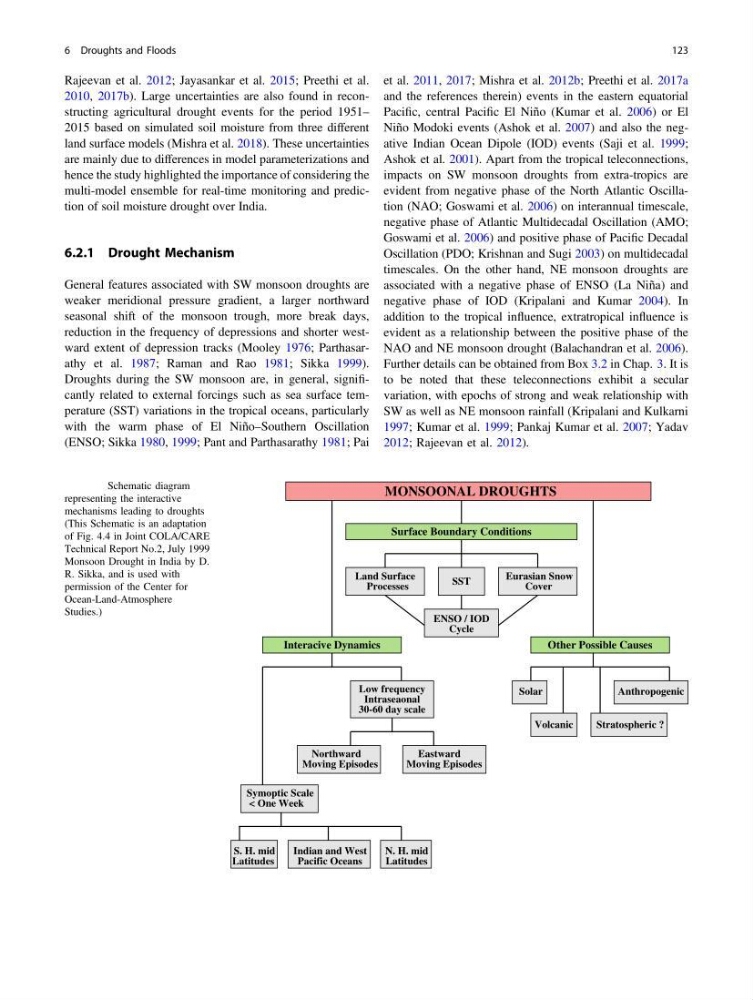
Fig. 6.3 Schematic diagram
representing the interactive
mechanisms leading to droughts
(This Schematic is an adaptation
of Fig. 4.4 in Joint COLA/CARE
Technical Report No.2, July 1999
Monsoon Drought in India by D.
R. Sikka, and is used with
permission of the Center for
Ocean-Land-Atmosphere
Studies.)
6 Droughts and Floods
123
2010, 2017b). Large uncertainties are also found in reconstructing agricultural drought events for the period 1951–
2015 based on simulated soil moisture from three different
land surface models (Mishra et al. 2018). These uncertainties
are mainly due to differences in model parameterizations and
hence the study highlighted the importance of considering the
multi-model ensemble for real-time monitoring and prediction of soil moisture drought over India.
6.2.1 Drought Mechanism
General features associated with SW monsoon droughts are
weaker meridional pressure gradient, a larger northward
seasonal shift of the monsoon trough, more break days,
reduction in the frequency of depressions and shorter westward extent of depression tracks (Mooley 1976; Parthasarathy et al. 1987; Raman and Rao 1981; Sikka 1999).
Droughts during the SW monsoon are, in general, significantly related to external forcings such as sea surface temperature (SST) variations in the tropical oceans, particularly
with the warm phase of El Niño–Southern Oscillation
(ENSO; Sikka 1980, 1999; Pant and Parthasarathy 1981; Pai
et al. 2011, 2017; Mishra et al. 2012b; Preethi et al. 2017a
and the references therein) events in the eastern equatorial
Pacific, central Pacific El Niño (Kumar et al. 2006) or El
Niño Modoki events (Ashok et al. 2007) and also the negative Indian Ocean Dipole (IOD) events (Saji et al. 1999;
Ashok et al. 2001). Apart from the tropical teleconnections,
impacts on SW monsoon droughts from extra-tropics are
evident from negative phase of the North Atlantic Oscillation (NAO; Goswami et al. 2006) on interannual timescale,
negative phase of Atlantic Multidecadal Oscillation (AMO;
Goswami et al. 2006) and positive phase of Pacific Decadal
Oscillation (PDO; Krishnan and Sugi 2003) on multidecadal
timescales. On the other hand, NE monsoon droughts are
associated with a negative phase of ENSO (La Niña) and
negative phase of IOD (Kripalani and Kumar 2004). In
addition to the tropical influence, extratropical influence is
evident as a relationship between the positive phase of the
NAO and NE monsoon drought (Balachandran et al. 2006).
Further details can be obtained from Box 3.2 in Chap. 3. It is
to be noted that these teleconnections exhibit a secular
variation, with epochs of strong and weak relationship with
SW as well as NE monsoon rainfall (Kripalani and Kulkarni
1997; Kumar et al. 1999; Pankaj Kumar et al. 2007; Yadav
2012; Rajeevan et al. 2012).
MONSOONAL DROUGHTS
Land Surface
Eurasian Snow
Surface Boundary Conditions
Processes
Cover
SST
Other Possible Causes
Cycle
ENSO / IOD
Volcanic
Solar
Anthropogenic
Stratospheric ?
Symoptic Scale
Interacive Dynamics
Low frequency
Intraseaonal
30-60 day scale
Northward
Eastward
< One Week
Moving Episodes
Moving Episodes
S. H. mid
Indian and West
N. H. mid
Latitudes
Pacific Oceans
Latitudes
Fig. 6.3 Schematic diagram
representing the interactive
mechanisms leading to droughts
(This Schematic is an adaptation
of Fig. 4.4 in Joint COLA/CARE
Technical Report No.2, July 1999
Monsoon Drought in India by D.
R. Sikka, and is used with
permission of the Center for
Ocean-Land-Atmosphere
Studies.)
6 Droughts and Floods
123