

86
7 Regression Models and Hypothesis Testing
f =
(χ
2
p − χ
2
q )/(q − p)
χ 2
q /(N − q)
.
(7.37)
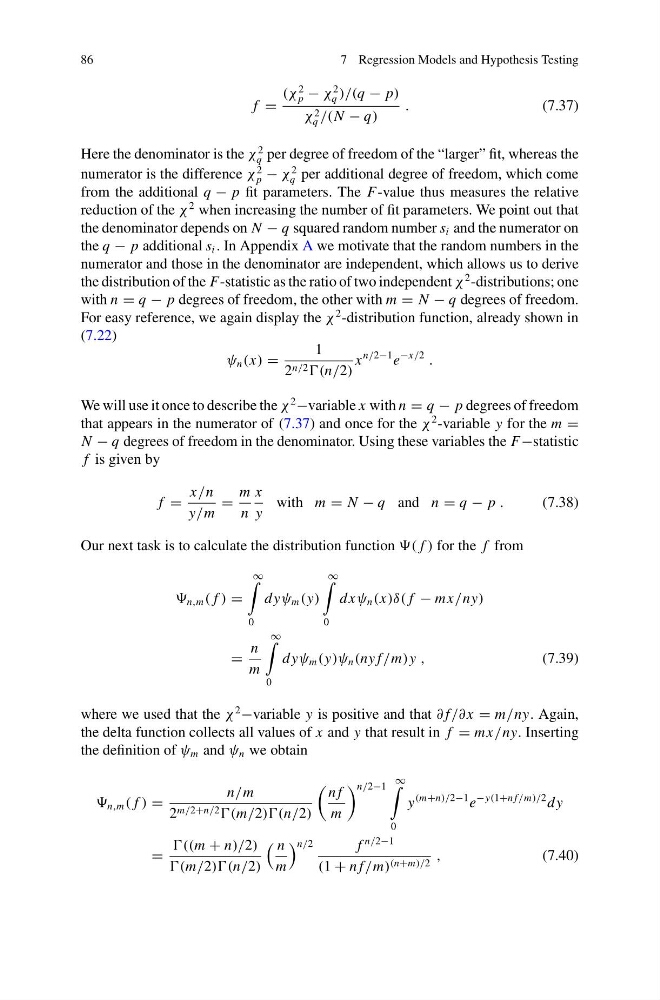
Here the denominator is the χ
2
q per degree of freedom of the “larger” fit, whereas the
numerator is the difference χ
2
p − χ
2
q per additional degree of freedom, which come
from the additional q − p fit parameters. The F-value thus measures the relative
reduction of the χ
2 when increasing the number of fit parameters. We point out that
the denominator depends on N − q squared random number s i and the numerator on
the q − p additional s i . In Appendix A we motivate that the random numbers in the
numerator and those in the denominator are independent, which allows us to derive
the distribution of the F-statistic as the ratio of two independent χ
2 -distributions; one
with n = q − p degrees of freedom, the other with m = N − q degrees of freedom.
For easy reference, we again display the χ
2 -distribution function, already shown in
(7.22)
ψ n (x) =
1
2 n/2 (n/2)
x
n/2−1 e
−x/2
.
We will use it once to describe the χ
2
−variable x with n = q − p degrees of freedom
that appears in the numerator of (7.37) and once for the χ
2 -variable y for the m =
N − q degrees of freedom in the denominator. Using these variables the F−statistic
f is given by
f =
x/n
y/m
=
m
n
x
y
with m = N − q and n = q − p .
(7.38)
Our next task is to calculate the distribution function ( f ) for the f from
n,m ( f ) =
∞
0
dyψ m (y)
∞
0
dxψ n (x)δ( f − mx/ny)
=
n
m
∞
0
dyψ m (y)ψ n (ny f /m)y ,
(7.39)
where we used that the χ
2
−variable y is positive and that ∂ f /∂ x = m/ny. Again,
the delta function collects all values of x and y that result in f = mx/ny. Inserting
the definition of ψ m and ψ n we obtain
n,m ( f ) =
n/m
2 m/2+n/2 (m/2))(n/2)
n f
m
n/2−1
∞
0
y
(m+n)/2−1 e
−y(1+n f/m)/2 dy
=
((m + n)/2)
(m/2))(n/2)
n
m
n/2
f
n/2−1
(1 + n f/m) (n+m)/2 ,
(7.40)
7 Regression Models and Hypothesis Testing
f =
(χ
2
p − χ
2
q )/(q − p)
χ 2
q /(N − q)
.
(7.37)
Here the denominator is the χ
2
q per degree of freedom of the “larger” fit, whereas the
numerator is the difference χ
2
p − χ
2
q per additional degree of freedom, which come
from the additional q − p fit parameters. The F-value thus measures the relative
reduction of the χ
2 when increasing the number of fit parameters. We point out that
the denominator depends on N − q squared random number s i and the numerator on
the q − p additional s i . In Appendix A we motivate that the random numbers in the
numerator and those in the denominator are independent, which allows us to derive
the distribution of the F-statistic as the ratio of two independent χ
2 -distributions; one
with n = q − p degrees of freedom, the other with m = N − q degrees of freedom.
For easy reference, we again display the χ
2 -distribution function, already shown in
(7.22)
ψ n (x) =
1
2 n/2 (n/2)
x
n/2−1 e
−x/2
.
We will use it once to describe the χ
2
−variable x with n = q − p degrees of freedom
that appears in the numerator of (7.37) and once for the χ
2 -variable y for the m =
N − q degrees of freedom in the denominator. Using these variables the F−statistic
f is given by
f =
x/n
y/m
=
m
n
x
y
with m = N − q and n = q − p .
(7.38)
Our next task is to calculate the distribution function ( f ) for the f from
n,m ( f ) =
∞
0
dyψ m (y)
∞
0
dxψ n (x)δ( f − mx/ny)
=
n
m
∞
0
dyψ m (y)ψ n (ny f /m)y ,
(7.39)
where we used that the χ
2
−variable y is positive and that ∂ f /∂ x = m/ny. Again,
the delta function collects all values of x and y that result in f = mx/ny. Inserting
the definition of ψ m and ψ n we obtain
n,m ( f ) =
n/m
2 m/2+n/2 (m/2))(n/2)
n f
m
n/2−1
∞
0
y
(m+n)/2−1 e
−y(1+n f/m)/2 dy
=
((m + n)/2)
(m/2))(n/2)
n
m
n/2
f
n/2−1
(1 + n f/m) (n+m)/2 ,
(7.40)