

60
6 The Greeks and Risk Management
Delta can be calculated from the valuation equation for the corresponding option,
for example (4.40) or (5.17), by differentiation, which is how we derived (5.22).
The delta is specific to the type of option, the underlying share price, and the time
until maturity of the option. If we calculate the option value, or its delta, again at a
later time, the value may have changed, because both the share value and the time
to maturity have changed. This implies that the hedge is compromised, unless the
fraction of shares and options is repeatedly balanced. In practice this re-balancing
is typically done on a daily basis. The reason is that new information about the share
value S is added from one day to the next and updating the hedge takes this additional
information into account.
Apart from the dependence on time t and stock price S, the option price also
depends on the risk-free rate r f and the volatility σ . In Chaps. 4 and 5 we assumed
the latter to be constant, while in real life they vary. Their dependence on external
influences is perceived as an additional risk and we therefore investigate how much
they actually influence the value of an option, or, more generally, of a portfolio.
We first consider the variation of with that of the underlying shares, which is
addressed by the quantity Gamma, denoted by , and defined by the rate of change,
the derivative, of
=
∂∂
∂ S
=
∂
2 c
∂ S 2 .
(6.2)
indicates how quickly the hedging needs to be re-balanced. Here we defined for
the option c alone, but often it is also calculated for a portfolio . The dependence
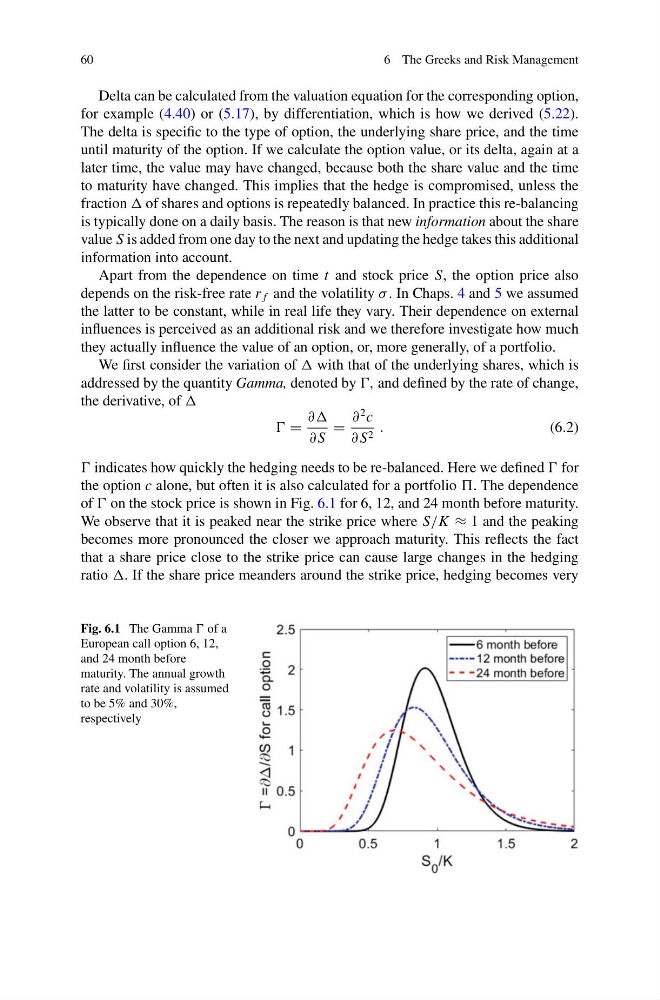
of on the stock price is shown in Fig. 6.1 for 6, 12, and 24 month before maturity.
We observe that it is peaked near the strike price where S/K ≈ 1 and the peaking
becomes more pronounced the closer we approach maturity. This reflects the fact
that a share price close to the strike price can cause large changes in the hedging
ratio . If the share price meanders around the strike price, hedging becomes very
Fig. 6.1 The Gamma of a
European call option 6, 12,
and 24 month before
maturity. The annual growth
rate and volatility is assumed
to be 5% and 30%,
respectively
6 The Greeks and Risk Management
Delta can be calculated from the valuation equation for the corresponding option,
for example (4.40) or (5.17), by differentiation, which is how we derived (5.22).
The delta is specific to the type of option, the underlying share price, and the time
until maturity of the option. If we calculate the option value, or its delta, again at a
later time, the value may have changed, because both the share value and the time
to maturity have changed. This implies that the hedge is compromised, unless the
fraction of shares and options is repeatedly balanced. In practice this re-balancing
is typically done on a daily basis. The reason is that new information about the share
value S is added from one day to the next and updating the hedge takes this additional
information into account.
Apart from the dependence on time t and stock price S, the option price also
depends on the risk-free rate r f and the volatility σ . In Chaps. 4 and 5 we assumed
the latter to be constant, while in real life they vary. Their dependence on external
influences is perceived as an additional risk and we therefore investigate how much
they actually influence the value of an option, or, more generally, of a portfolio.
We first consider the variation of with that of the underlying shares, which is
addressed by the quantity Gamma, denoted by , and defined by the rate of change,
the derivative, of
=
∂∂
∂ S
=
∂
2 c
∂ S 2 .
(6.2)
indicates how quickly the hedging needs to be re-balanced. Here we defined for
the option c alone, but often it is also calculated for a portfolio . The dependence
of on the stock price is shown in Fig. 6.1 for 6, 12, and 24 month before maturity.
We observe that it is peaked near the strike price where S/K ≈ 1 and the peaking
becomes more pronounced the closer we approach maturity. This reflects the fact
that a share price close to the strike price can cause large changes in the hedging
ratio . If the share price meanders around the strike price, hedging becomes very
Fig. 6.1 The Gamma of a
European call option 6, 12,
and 24 month before
maturity. The annual growth
rate and volatility is assumed
to be 5% and 30%,
respectively