

5.5 Other Examples
57
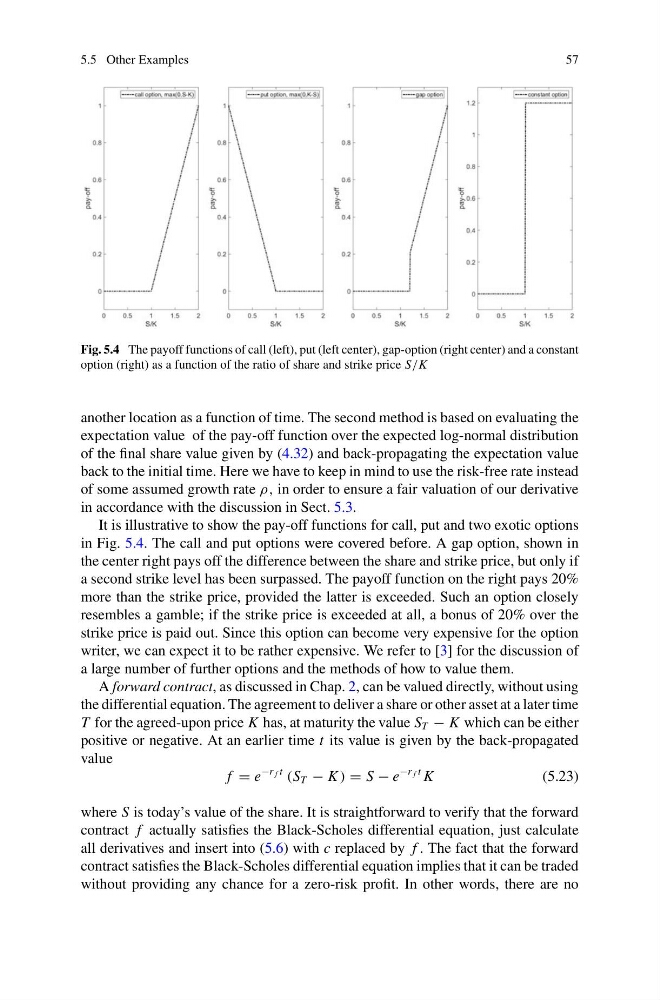
Fig. 5.4 The payoff functions of call (left), put (left center), gap-option (right center) and a constant
option (right) as a function of the ratio of share and strike price S/K
another location as a function of time. The second method is based on evaluating the
expectation value of the pay-off function over the expected log-normal distribution
of the final share value given by (4.32) and back-propagating the expectation value
back to the initial time. Here we have to keep in mind to use the risk-free rate instead
of some assumed growth rate ρ, in order to ensure a fair valuation of our derivative
in accordance with the discussion in Sect. 5.3.
It is illustrative to show the pay-off functions for call, put and two exotic options
in Fig. 5.4. The call and put options were covered before. A gap option, shown in
the center right pays off the difference between the share and strike price, but only if
a second strike level has been surpassed. The payoff function on the right pays 20%
more than the strike price, provided the latter is exceeded. Such an option closely
resembles a gamble; if the strike price is exceeded at all, a bonus of 20% over the
strike price is paid out. Since this option can become very expensive for the option
writer, we can expect it to be rather expensive. We refer to [3] for the discussion of
a large number of further options and the methods of how to value them.
A forward contract, as discussed in Chap. 2, can be valued directly, without using
the differential equation. The agreement to deliver a share or other asset at a later time
T for the agreed-upon price K has, at maturity the value S T − K which can be either
positive or negative. At an earlier time t its value is given by the back-propagated
value
f = e
−r f t
(S T − K ) = S − e
−r f t K
(5.23)
where S is today’s value of the share. It is straightforward to verify that the forward
contract f actually satisfies the Black-Scholes differential equation, just calculate
all derivatives and insert into (5.6) with c replaced by f . The fact that the forward
contract satisfies the Black-Scholes differential equation implies that it can be traded
without providing any chance for a zero-risk profit. In other words, there are no
57
Fig. 5.4 The payoff functions of call (left), put (left center), gap-option (right center) and a constant
option (right) as a function of the ratio of share and strike price S/K
another location as a function of time. The second method is based on evaluating the
expectation value of the pay-off function over the expected log-normal distribution
of the final share value given by (4.32) and back-propagating the expectation value
back to the initial time. Here we have to keep in mind to use the risk-free rate instead
of some assumed growth rate ρ, in order to ensure a fair valuation of our derivative
in accordance with the discussion in Sect. 5.3.
It is illustrative to show the pay-off functions for call, put and two exotic options
in Fig. 5.4. The call and put options were covered before. A gap option, shown in
the center right pays off the difference between the share and strike price, but only if
a second strike level has been surpassed. The payoff function on the right pays 20%
more than the strike price, provided the latter is exceeded. Such an option closely
resembles a gamble; if the strike price is exceeded at all, a bonus of 20% over the
strike price is paid out. Since this option can become very expensive for the option
writer, we can expect it to be rather expensive. We refer to [3] for the discussion of
a large number of further options and the methods of how to value them.
A forward contract, as discussed in Chap. 2, can be valued directly, without using
the differential equation. The agreement to deliver a share or other asset at a later time
T for the agreed-upon price K has, at maturity the value S T − K which can be either
positive or negative. At an earlier time t its value is given by the back-propagated
value
f = e
−r f t
(S T − K ) = S − e
−r f t K
(5.23)
where S is today’s value of the share. It is straightforward to verify that the forward
contract f actually satisfies the Black-Scholes differential equation, just calculate
all derivatives and insert into (5.6) with c replaced by f . The fact that the forward
contract satisfies the Black-Scholes differential equation implies that it can be traded
without providing any chance for a zero-risk profit. In other words, there are no