

56
5 Black-Scholes Differential Equation
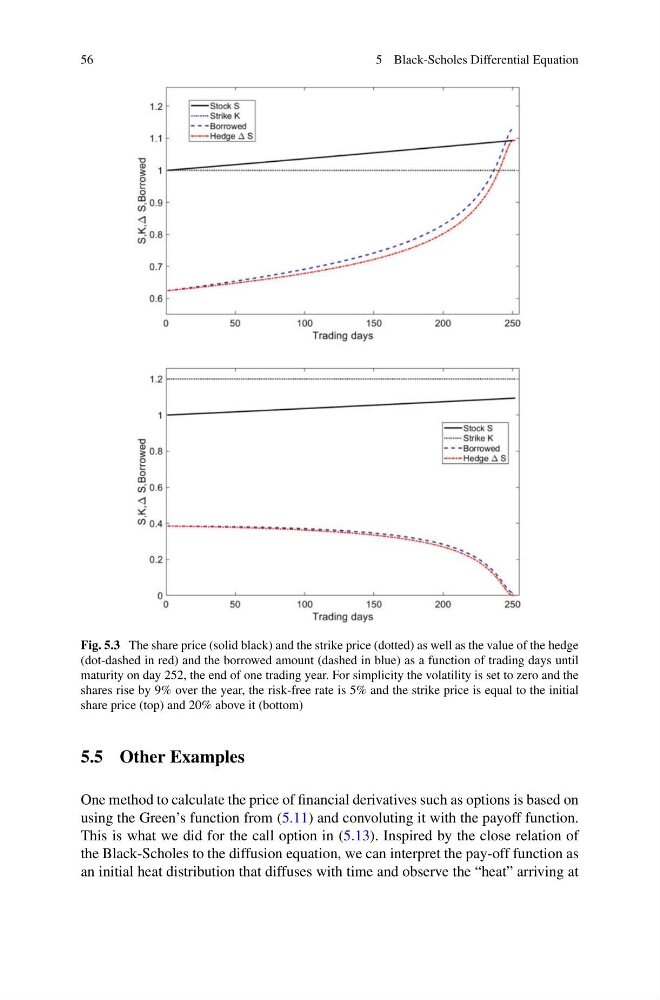
Fig. 5.3 The share price (solid black) and the strike price (dotted) as well as the value of the hedge
(dot-dashed in red) and the borrowed amount (dashed in blue) as a function of trading days until
maturity on day 252, the end of one trading year. For simplicity the volatility is set to zero and the
shares rise by 9% over the year, the risk-free rate is 5% and the strike price is equal to the initial
share price (top) and 20% above it (bottom)
5.5 Other Examples
One method to calculate the price of financial derivatives such as options is based on
using the Green’s function from (5.11) and convoluting it with the payoff function.
This is what we did for the call option in (5.13). Inspired by the close relation of
the Black-Scholes to the diffusion equation, we can interpret the pay-off function as
an initial heat distribution that diffuses with time and observe the “heat” arriving at
5 Black-Scholes Differential Equation
Fig. 5.3 The share price (solid black) and the strike price (dotted) as well as the value of the hedge
(dot-dashed in red) and the borrowed amount (dashed in blue) as a function of trading days until
maturity on day 252, the end of one trading year. For simplicity the volatility is set to zero and the
shares rise by 9% over the year, the risk-free rate is 5% and the strike price is equal to the initial
share price (top) and 20% above it (bottom)
5.5 Other Examples
One method to calculate the price of financial derivatives such as options is based on
using the Green’s function from (5.11) and convoluting it with the payoff function.
This is what we did for the call option in (5.13). Inspired by the close relation of
the Black-Scholes to the diffusion equation, we can interpret the pay-off function as
an initial heat distribution that diffuses with time and observe the “heat” arriving at