

262
Appendix A: On the Independence of Certain Random Variables
ψ(x 1 , . . . , x n ) =
1
(2π) n/2 exp
−
1
2
n
i=1
x
2
i
(A.3)
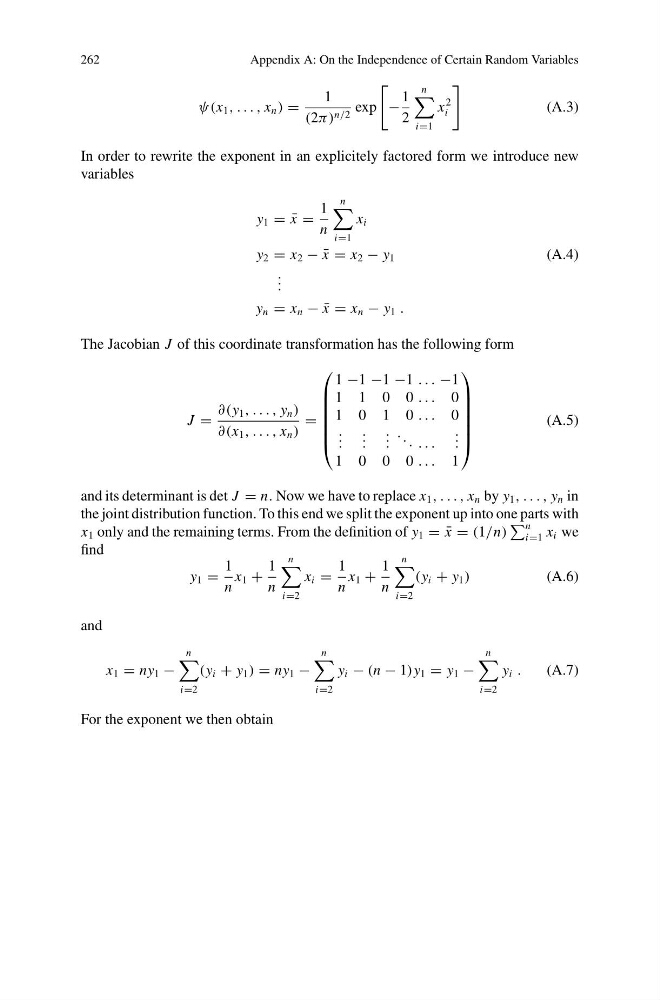
In order to rewrite the exponent in an explicitely factored form we introduce new
variables
y 1 = ¯
x =
1
n
n
i=1
x i
y 2 = x 2 − ¯
x = x 2 − y 1
(A.4)
. . .
y n = x n − ¯
x = x n − y 1 .
The Jacobian J of this coordinate transformation has the following form
J =
∂(y 1 , . . . , y n )
∂(x 1 , . . . , x n )
=
⎛
⎜
⎜
⎜
⎜
⎜
⎝
1 −1 −1 −1 . . . −1
1 1 0 0 . . . 0
1 0 1 0 . . . 0
. . .
. . .
. . .
. . . . . .
. . .
1 0 0 0 . . . 1
⎞
⎟
⎟
⎟
⎟
⎟
⎠
(A.5)
and its determinant is det J = n. Now we have to replace x 1 , . . . , x n by y 1 , . . . , y n in
the joint distribution function. To this end we split the exponent up into one parts with
x 1 only and the remaining terms. From the definition of y 1 = ¯
x = (1/n)
n
i=1 x i we
find
y 1 =
1
n
x 1 +
1
n
n
i=2
x i =
1
n
x 1 +
1
n
n
i=2
(y i + y 1 )
(A.6)
and
x 1 = ny 1 −
n
i=2
(y i + y 1 ) = ny 1 −
n
i=2
y i − (n − 1)y 1 = y 1 −
n
i=2
y i .
(A.7)
For the exponent we then obtain
Appendix A: On the Independence of Certain Random Variables
ψ(x 1 , . . . , x n ) =
1
(2π) n/2 exp
−
1
2
n
i=1
x
2
i
(A.3)
In order to rewrite the exponent in an explicitely factored form we introduce new
variables
y 1 = ¯
x =
1
n
n
i=1
x i
y 2 = x 2 − ¯
x = x 2 − y 1
(A.4)
. . .
y n = x n − ¯
x = x n − y 1 .
The Jacobian J of this coordinate transformation has the following form
J =
∂(y 1 , . . . , y n )
∂(x 1 , . . . , x n )
=
⎛
⎜
⎜
⎜
⎜
⎜
⎝
1 −1 −1 −1 . . . −1
1 1 0 0 . . . 0
1 0 1 0 . . . 0
. . .
. . .
. . .
. . . . . .
. . .
1 0 0 0 . . . 1
⎞
⎟
⎟
⎟
⎟
⎟
⎠
(A.5)
and its determinant is det J = n. Now we have to replace x 1 , . . . , x n by y 1 , . . . , y n in
the joint distribution function. To this end we split the exponent up into one parts with
x 1 only and the remaining terms. From the definition of y 1 = ¯
x = (1/n)
n
i=1 x i we
find
y 1 =
1
n
x 1 +
1
n
n
i=2
x i =
1
n
x 1 +
1
n
n
i=2
(y i + y 1 )
(A.6)
and
x 1 = ny 1 −
n
i=2
(y i + y 1 ) = ny 1 −
n
i=2
y i − (n − 1)y 1 = y 1 −
n
i=2
y i .
(A.7)
For the exponent we then obtain