

Appendix A
On the Independence of Certain Random
Variables
In the derivation of student’s t-distribution in Chap. 7 we used the fact that for n
normal-distributed random variables x 1 , . . . , x n with mean zero, the average ¯
x =
(x 1 + · · · + x n )/n and the variance S
2
=
(x 1 − ¯
x)
2
+ · · · + (x n − ¯
x)
2
/(n − 1)
are statistically independent. The latter is equivalent to the ability to factor the joint
distribution function in two factors, one for the average and one for the rest. We start
by showing that the variance S
2 can be rewritten such that the first random variable
x 1 is replaced by the average ¯
x. In the following argument, we follow Casella and
Berger’s Statistical Inference and write
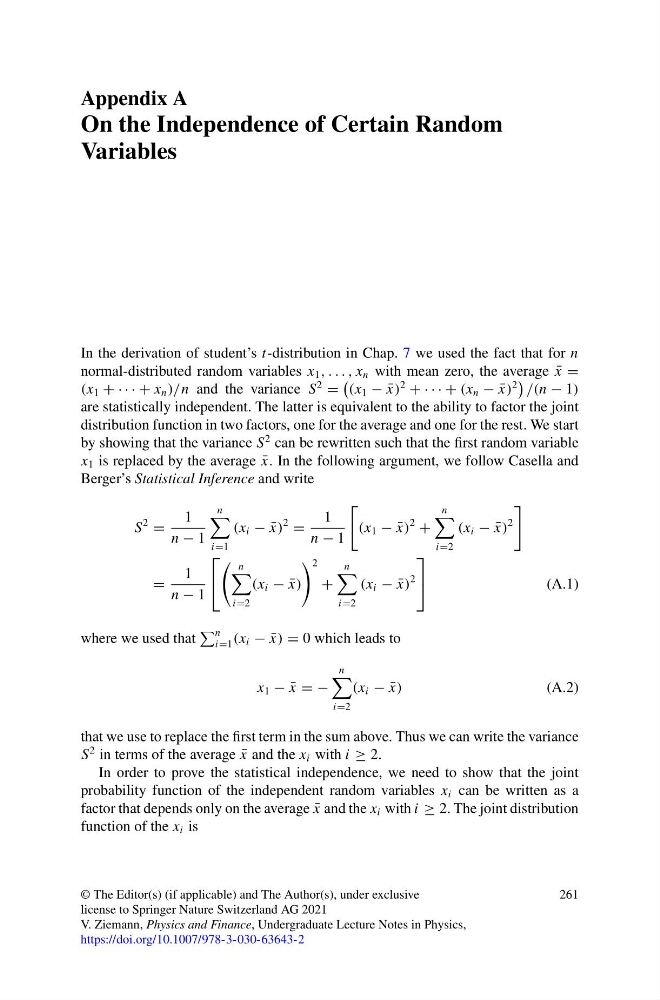
S
2
=
1
n − 1
n
i=1
(x i − ¯
x)
2
=
1
n − 1
(x 1 − ¯
x)
2
+
n
i=2
(x i − ¯
x)
2
=
1
n − 1
⎡
⎣
n
i=2
(x i − ¯
x)
2
+
n
i=2
(x i − ¯
x)
2
⎤
⎦
(A.1)
where we used that
n
i=1 (x i − ¯
x) = 0 which leads to
x 1 − ¯
x = −
n
i=2
(x i − ¯
x)
(A.2)
that we use to replace the first term in the sum above. Thus we can write the variance
S
2 in terms of the average ¯
x and the x i with i ≥ 2.
In order to prove the statistical independence, we need to show that the joint
probability function of the independent random variables x i can be written as a
factor that depends only on the average ¯
x and the x i with i ≥ 2. The joint distribution
function of the x i is
© The Editor(s) (if applicable) and The Author(s), under exclusive
license to Springer Nature Switzerland AG 2021
V. Ziemann, Physics and Finance, Undergraduate Lecture Notes in Physics,
https://doi.org/10.1007/978-3-030-63643-2
261
On the Independence of Certain Random
Variables
In the derivation of student’s t-distribution in Chap. 7 we used the fact that for n
normal-distributed random variables x 1 , . . . , x n with mean zero, the average ¯
x =
(x 1 + · · · + x n )/n and the variance S
2
=
(x 1 − ¯
x)
2
+ · · · + (x n − ¯
x)
2
/(n − 1)
are statistically independent. The latter is equivalent to the ability to factor the joint
distribution function in two factors, one for the average and one for the rest. We start
by showing that the variance S
2 can be rewritten such that the first random variable
x 1 is replaced by the average ¯
x. In the following argument, we follow Casella and
Berger’s Statistical Inference and write
S
2
=
1
n − 1
n
i=1
(x i − ¯
x)
2
=
1
n − 1
(x 1 − ¯
x)
2
+
n
i=2
(x i − ¯
x)
2
=
1
n − 1
⎡
⎣
n
i=2
(x i − ¯
x)
2
+
n
i=2
(x i − ¯
x)
2
⎤
⎦
(A.1)
where we used that
n
i=1 (x i − ¯
x) = 0 which leads to
x 1 − ¯
x = −
n
i=2
(x i − ¯
x)
(A.2)
that we use to replace the first term in the sum above. Thus we can write the variance
S
2 in terms of the average ¯
x and the x i with i ≥ 2.
In order to prove the statistical independence, we need to show that the joint
probability function of the independent random variables x i can be written as a
factor that depends only on the average ¯
x and the x i with i ≥ 2. The joint distribution
function of the x i is
© The Editor(s) (if applicable) and The Author(s), under exclusive
license to Springer Nature Switzerland AG 2021
V. Ziemann, Physics and Finance, Undergraduate Lecture Notes in Physics,
https://doi.org/10.1007/978-3-030-63643-2
261