

252
13 Solutions for Selected Exercises
such that the average maximum value is given by
x n =
nν
(1/ν)
∞
0
x P
1
ν
, x
ν
n−1
e
−x
ν dx .
(13.58)
Choosing ν = 1/2 in the MATLAB script ex9_6.m from the ESM produces
Fig. 13.8, which shows the average maximum values, suitably scaled to show a
linear behavior, for D ν , a Gaussian, and an exponential distribution. Note that the
arguments in MATLAB’s incomplete gamma function betainc() are reversed
with respect to the convention used in Abramowitz and Stegun’s Handbook of mathematical functions.
Exercise 9.7
The solution N (t) strives towards an equilibrium defined by d N/dt = 0, which
leads to the equilibrium level N ∞ = δ/β. Consequently, there is no divergence and
τ c → ∞.
Exercise 10.1
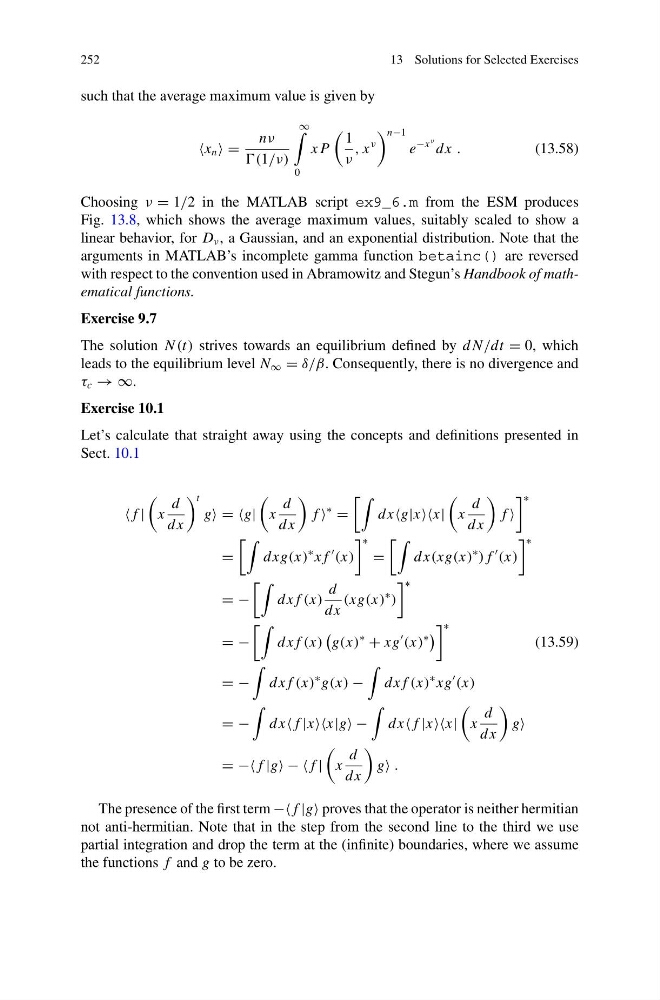
Let’s calculate that straight away using the concepts and definitions presented in
Sect. 10.1
f |
x
d
dx
t
g = =g|
x
d
dx
f
∗
=
dxg|xx|
x
d
dx
f
∗
=
dxg(x)
∗ x f
(x)
∗
=
dx(xg(x)
∗
) f
(x)
∗
= −
dx f (x)
d
dx
(xg(x)
∗
)
∗
= −
dx f (x)
g(x)
∗
+ xg
(x)
∗
∗
(13.59)
= −
dx f (x)
∗ g(x) −
dx f (x)
∗ xg
(x)
= −
dx f |xx|g −
dx f |xx|
x
d
dx
g
= −− f |g − − f |
x
d
dx
g .
The presence of the first term −− f |g proves that the operator is neither hermitian
not anti-hermitian. Note that in the step from the second line to the third we use
partial integration and drop the term at the (infinite) boundaries, where we assume
the functions f and g to be zero.
13 Solutions for Selected Exercises
such that the average maximum value is given by
x n =
nν
(1/ν)
∞
0
x P
1
ν
, x
ν
n−1
e
−x
ν dx .
(13.58)
Choosing ν = 1/2 in the MATLAB script ex9_6.m from the ESM produces
Fig. 13.8, which shows the average maximum values, suitably scaled to show a
linear behavior, for D ν , a Gaussian, and an exponential distribution. Note that the
arguments in MATLAB’s incomplete gamma function betainc() are reversed
with respect to the convention used in Abramowitz and Stegun’s Handbook of mathematical functions.
Exercise 9.7
The solution N (t) strives towards an equilibrium defined by d N/dt = 0, which
leads to the equilibrium level N ∞ = δ/β. Consequently, there is no divergence and
τ c → ∞.
Exercise 10.1
Let’s calculate that straight away using the concepts and definitions presented in
Sect. 10.1
f |
x
d
dx
t
g = =g|
x
d
dx
f
∗
=
dxg|xx|
x
d
dx
f
∗
=
dxg(x)
∗ x f
(x)
∗
=
dx(xg(x)
∗
) f
(x)
∗
= −
dx f (x)
d
dx
(xg(x)
∗
)
∗
= −
dx f (x)
g(x)
∗
+ xg
(x)
∗
∗
(13.59)
= −
dx f (x)
∗ g(x) −
dx f (x)
∗ xg
(x)
= −
dx f |xx|g −
dx f |xx|
x
d
dx
g
= −− f |g − − f |
x
d
dx
g .
The presence of the first term −− f |g proves that the operator is neither hermitian
not anti-hermitian. Note that in the step from the second line to the third we use
partial integration and drop the term at the (infinite) boundaries, where we assume
the functions f and g to be zero.