

13 Solutions for Selected Exercises
251
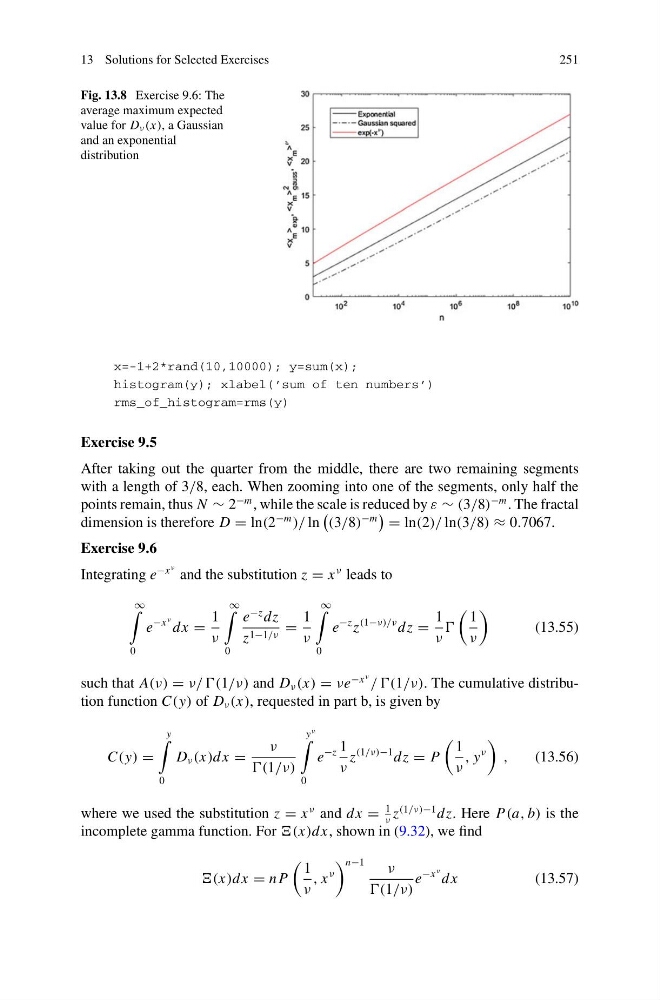
Fig. 13.8 Exercise 9.6: The
average maximum expected
value for D ν (x), a Gaussian
and an exponential
distribution
x=-1+2*rand(10,10000); y=sum(x);
histogram(y); xlabel(’sum of ten numbers’)
rms_of_histogram=rms(y)
Exercise 9.5
After taking out the quarter from the middle, there are two remaining segments
with a length of 3/8, each. When zooming into one of the segments, only half the
points remain, thus N ∼ 2
−m , while the scale is reduced by ε ∼ (3/8)
−m . The fractal
dimension is therefore D = ln(2
−m
)/ ln
(3/8)
−m
= ln(2)/ ln(3/8) ≈ 0.7067.
Exercise 9.6
Integrating e
−x
ν and the substitution z = x
ν leads to
∞
0
e
−x
ν dx =
1
ν
∞
0
e
−z dz
z 1−1/ν =
1
ν
∞
0
e
−z z
(1−ν)/ν dz =
1
ν
1
ν
(13.55)
such that A(ν) = ν/ /(1/ν) and D ν (x) = νe
−x
ν / /(1/ν). The cumulative distribution function C(y) of D ν (x), requested in part b, is given by
C(y) =
y
0
D ν (x)dx =
ν
(1/ν)
y
ν
0
e
−z 1
ν
z
(1/ν)−1 dz = P
1
ν
, y
ν
,
(13.56)
where we used the substitution z = x
ν and dx =
1
ν
z
(1/ν)−1 dz. Here P(a, b) is the
incomplete gamma function. For (x)dx, shown in (9.32), we find
(x)dx = n P
1
ν
, x
ν
n−1
ν
(1/ν)
e
−x
ν dx
(13.57)
251
Fig. 13.8 Exercise 9.6: The
average maximum expected
value for D ν (x), a Gaussian
and an exponential
distribution
x=-1+2*rand(10,10000); y=sum(x);
histogram(y); xlabel(’sum of ten numbers’)
rms_of_histogram=rms(y)
Exercise 9.5
After taking out the quarter from the middle, there are two remaining segments
with a length of 3/8, each. When zooming into one of the segments, only half the
points remain, thus N ∼ 2
−m , while the scale is reduced by ε ∼ (3/8)
−m . The fractal
dimension is therefore D = ln(2
−m
)/ ln
(3/8)
−m
= ln(2)/ ln(3/8) ≈ 0.7067.
Exercise 9.6
Integrating e
−x
ν and the substitution z = x
ν leads to
∞
0
e
−x
ν dx =
1
ν
∞
0
e
−z dz
z 1−1/ν =
1
ν
∞
0
e
−z z
(1−ν)/ν dz =
1
ν
1
ν
(13.55)
such that A(ν) = ν/ /(1/ν) and D ν (x) = νe
−x
ν / /(1/ν). The cumulative distribution function C(y) of D ν (x), requested in part b, is given by
C(y) =
y
0
D ν (x)dx =
ν
(1/ν)
y
ν
0
e
−z 1
ν
z
(1/ν)−1 dz = P
1
ν
, y
ν
,
(13.56)
where we used the substitution z = x
ν and dx =
1
ν
z
(1/ν)−1 dz. Here P(a, b) is the
incomplete gamma function. For (x)dx, shown in (9.32), we find
(x)dx = n P
1
ν
, x
ν
n−1
ν
(1/ν)
e
−x
ν dx
(13.57)