

13 Solutions for Selected Exercises
235
Exercise 3.4
Reading and preparing the daily returns is done with the code already used in
Exercise 3.3. In the following code snippet, we illustrate the calculation of the covariance matrix ˆ
C, which gives us the volatilities σ 1 and σ M , and the beta β of the stocks.
These quantities are used to evaluate the left and right-hand side of (3.38).
C=[rp1’*rp1, rp1’*rp2; rp1’*rp2, rp2’*rp2]/N
sig1=sqrt(C(1,1)) % volatility Apple
sigM=sqrt(C(2,2)) % volatility SP500
beta=C(1,2)/sigMˆ2
rf=0.05/N; % per trading day
lhs=rm1
% of (3.38)
% 6.9e-4
rhs=rf+beta*(rm2-rf)
% 3.9e-4
The left-hand side of (3.38) is larger than the right-hand side, which implies that the
Apple stock is undervalued. The full solution is available as ex3_4.m in the ESM.
Exercise 3.5
After initializing all variables with the values stated in the text of the exercise, we
first calculate the W ACC and then use it in the sum to determine the discounted cash
flow D.
k=1:6
% years
WACC=(V-B)*re/V+B*rd*(1-t)/V
D=sum(C./(1+WACC).ˆk) % 7.79E6
D turns out to be 7.8 Me, which is less than the asking price of 8.1 Me, which
indicates that it will be difficult to recover the initial investment. See ex3_5.m,
available in the ESM, for the full solution.
Exercise 4.1
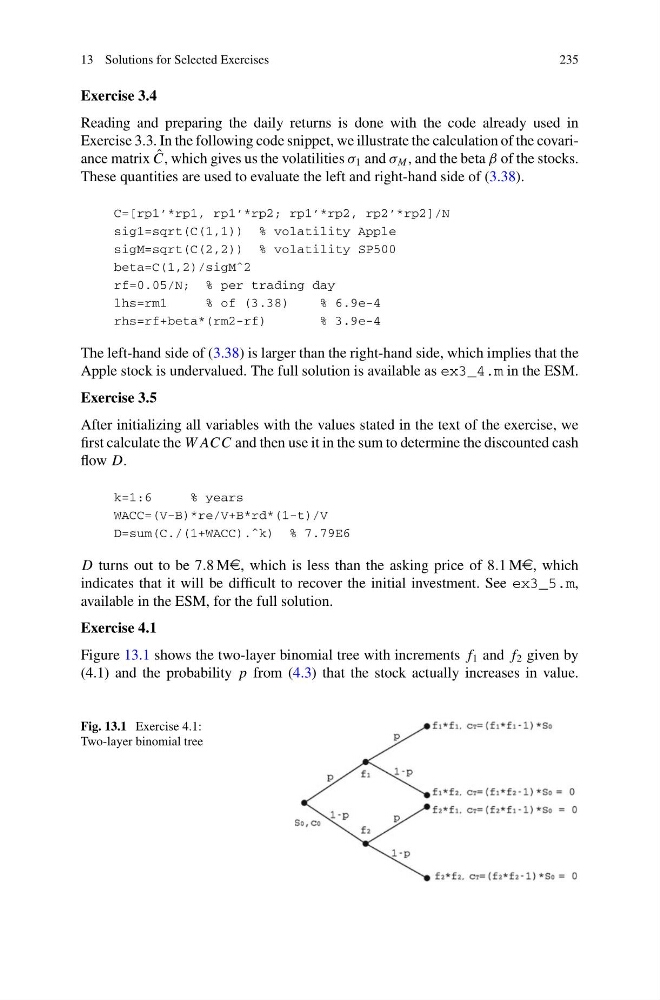
Figure 13.1 shows the two-layer binomial tree with increments f 1 and f 2 given by
(4.1) and the probability p from (4.3) that the stock actually increases in value.
Fig. 13.1 Exercise 4.1:
Two-layer binomial tree
235
Exercise 3.4
Reading and preparing the daily returns is done with the code already used in
Exercise 3.3. In the following code snippet, we illustrate the calculation of the covariance matrix ˆ
C, which gives us the volatilities σ 1 and σ M , and the beta β of the stocks.
These quantities are used to evaluate the left and right-hand side of (3.38).
C=[rp1’*rp1, rp1’*rp2; rp1’*rp2, rp2’*rp2]/N
sig1=sqrt(C(1,1)) % volatility Apple
sigM=sqrt(C(2,2)) % volatility SP500
beta=C(1,2)/sigMˆ2
rf=0.05/N; % per trading day
lhs=rm1
% of (3.38)
% 6.9e-4
rhs=rf+beta*(rm2-rf)
% 3.9e-4
The left-hand side of (3.38) is larger than the right-hand side, which implies that the
Apple stock is undervalued. The full solution is available as ex3_4.m in the ESM.
Exercise 3.5
After initializing all variables with the values stated in the text of the exercise, we
first calculate the W ACC and then use it in the sum to determine the discounted cash
flow D.
k=1:6
% years
WACC=(V-B)*re/V+B*rd*(1-t)/V
D=sum(C./(1+WACC).ˆk) % 7.79E6
D turns out to be 7.8 Me, which is less than the asking price of 8.1 Me, which
indicates that it will be difficult to recover the initial investment. See ex3_5.m,
available in the ESM, for the full solution.
Exercise 4.1
Figure 13.1 shows the two-layer binomial tree with increments f 1 and f 2 given by
(4.1) and the probability p from (4.3) that the stock actually increases in value.
Fig. 13.1 Exercise 4.1:
Two-layer binomial tree