

10.6 Path Integrals in Finance
163
N terms y
2
i in the exponent, but only N − 1 integrals to solve. Moreover, we have
to fulfill the constraints to satisfy the boundary conditions, namely that we need to
reach x N at the end. We accommodate this constraint by observing that the sum of
the y i must be
κ =
N
i=1
y i = x N − x 0 + N ε(r f − σ
2
/2) = x N − x 0 + τ (r f − σ
2
/2) (10.66)
because in the sum the factors y i for i = 1, . . . , N − 1 appear once with positive and
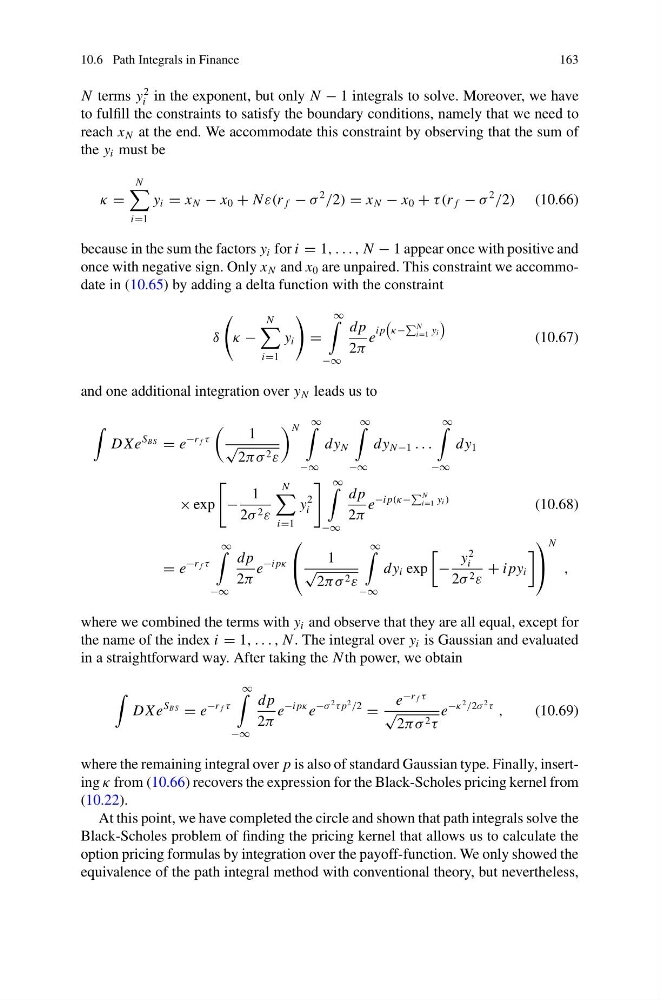
once with negative sign. Only x N and x 0 are unpaired. This constraint we accommodate in (10.65) by adding a delta function with the constraint
δ
κ −
N
i=1
y i
=
∞
−∞
dp
2π
e
i p
κ−
N
i=1 y i
(10.67)
and one additional integration over y N leads us to
D Xe
S BS = e
−r f τ
1
√
2πσ 2 ε
N
∞
−∞
dy N
∞
−∞
dy N −1 . . .
∞
−∞
dy 1
× exp
−
1
2σ 2 ε
N
i=1
y
2
i
∞
−∞
dp
2π
e
−i p(κ−
N
i=1 y i )
(10.68)
= e
−r f τ
∞
−∞
dp
2π
e
−i pκ
⎛
⎝
1
√
2πσ 2 ε
∞
−∞
dy i exp
−
y
2
i
2σ 2 ε
+ i py i
⎞
⎠
N
,
where we combined the terms with y i and observe that they are all equal, except for
the name of the index i = 1, . . . , N . The integral over y i is Gaussian and evaluated
in a straightforward way. After taking the N th power, we obtain
D Xe
S BS = e
−r f τ
∞
−∞
dp
2π
e
−i pκ e
−σ
2 τ p
2 /2
=
e
−r f τ
√
2πσ 2 τ
e
−κ
2 /2σ
2 τ
,
(10.69)
where the remaining integral over p is also of standard Gaussian type. Finally, inserting κ from (10.66) recovers the expression for the Black-Scholes pricing kernel from
(10.22).
At this point, we have completed the circle and shown that path integrals solve the
Black-Scholes problem of finding the pricing kernel that allows us to calculate the
option pricing formulas by integration over the payoff-function. We only showed the
equivalence of the path integral method with conventional theory, but nevertheless,
163
N terms y
2
i in the exponent, but only N − 1 integrals to solve. Moreover, we have
to fulfill the constraints to satisfy the boundary conditions, namely that we need to
reach x N at the end. We accommodate this constraint by observing that the sum of
the y i must be
κ =
N
i=1
y i = x N − x 0 + N ε(r f − σ
2
/2) = x N − x 0 + τ (r f − σ
2
/2) (10.66)
because in the sum the factors y i for i = 1, . . . , N − 1 appear once with positive and
once with negative sign. Only x N and x 0 are unpaired. This constraint we accommodate in (10.65) by adding a delta function with the constraint
δ
κ −
N
i=1
y i
=
∞
−∞
dp
2π
e
i p
κ−
N
i=1 y i
(10.67)
and one additional integration over y N leads us to
D Xe
S BS = e
−r f τ
1
√
2πσ 2 ε
N
∞
−∞
dy N
∞
−∞
dy N −1 . . .
∞
−∞
dy 1
× exp
−
1
2σ 2 ε
N
i=1
y
2
i
∞
−∞
dp
2π
e
−i p(κ−
N
i=1 y i )
(10.68)
= e
−r f τ
∞
−∞
dp
2π
e
−i pκ
⎛
⎝
1
√
2πσ 2 ε
∞
−∞
dy i exp
−
y
2
i
2σ 2 ε
+ i py i
⎞
⎠
N
,
where we combined the terms with y i and observe that they are all equal, except for
the name of the index i = 1, . . . , N . The integral over y i is Gaussian and evaluated
in a straightforward way. After taking the N th power, we obtain
D Xe
S BS = e
−r f τ
∞
−∞
dp
2π
e
−i pκ e
−σ
2 τ p
2 /2
=
e
−r f τ
√
2πσ 2 τ
e
−κ
2 /2σ
2 τ
,
(10.69)
where the remaining integral over p is also of standard Gaussian type. Finally, inserting κ from (10.66) recovers the expression for the Black-Scholes pricing kernel from
(10.22).
At this point, we have completed the circle and shown that path integrals solve the
Black-Scholes problem of finding the pricing kernel that allows us to calculate the
option pricing formulas by integration over the payoff-function. We only showed the
equivalence of the path integral method with conventional theory, but nevertheless,