

10.4 Barrier Options
153
E|E
=
∞
B
dxE|xx|E
= 4
∞
B
dx sin( p(x − B)) sin( p
(x − B))
= 4
∞
0
dx sin( px) sin( p
x) = 2πδ( p − p
) = 2π
δ(E − E
)
|dp/d E|
(10.30)
= 2πσ
2
2E/σ 2 − γ 2 δ(E − E
) ,
where we used (10.28) to write dp/d E =
σ
2
2E/σ 2 − γ 2
−1 . The normalization
permits us to calculate the unit operator, expressed through the energy eigenstates
1 =
∞
σ 2 γ 2 /2
d E
2πσ 2
2E/σ 2 − γ 2
|EE| ,
(10.31)
which we can prove by choosing the basis |x to calculate
Q(x, x
) =
∞
σ 2 γ 2 /2
x|EE|x
d E
2πσ 2
2E/σ 2 − γ 2
.
(10.32)
Inserting the functions x|E = ψ E (x) and E|x
from (10.24) and (10.29), respectively, and changing the integration variable from E to p =
2E/σ 2 − γ 2 , we obtain
Q(x, x
) = e
α(x−x
)
∞
0
dp
2π
e
i p(x−B
− e
−i p(x−B)
e
−i p(x
−B
− e
i p(x
−B)
= e
α(x−x
)
∞
0
dp
2π
e
i p(x−x
)
+ e
−i p(x−x
)
− e
i p(x+x
−2B)
− e
−i p(x+x
−2B)
= e
α(x−x
)
∞
−∞
dp
2π
e
i p(x−x
)
− e
i p(x+x
−2B)
(10.33)
= e
α(x−x
)
δ(x − x
) − e
α(x−x
)
δ(x + x
− 2B)
= δ(x − x
) .
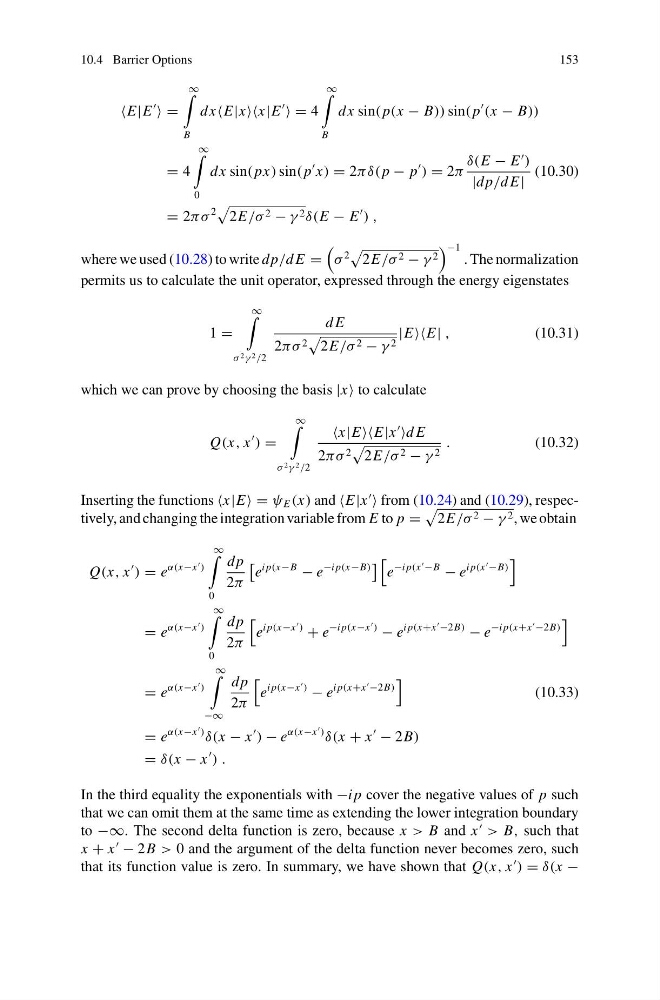
In the third equality the exponentials with −i p cover the negative values of p such
that we can omit them at the same time as extending the lower integration boundary
to −∞. The second delta function is zero, because x > B and x
> B, such that
x + x
− 2B > 0 and the argument of the delta function never becomes zero, such
that its function value is zero. In summary, we have shown that Q(x, x
) = δ(x −
153
E|E
=
∞
B
dxE|xx|E
= 4
∞
B
dx sin( p(x − B)) sin( p
(x − B))
= 4
∞
0
dx sin( px) sin( p
x) = 2πδ( p − p
) = 2π
δ(E − E
)
|dp/d E|
(10.30)
= 2πσ
2
2E/σ 2 − γ 2 δ(E − E
) ,
where we used (10.28) to write dp/d E =
σ
2
2E/σ 2 − γ 2
−1 . The normalization
permits us to calculate the unit operator, expressed through the energy eigenstates
1 =
∞
σ 2 γ 2 /2
d E
2πσ 2
2E/σ 2 − γ 2
|EE| ,
(10.31)
which we can prove by choosing the basis |x to calculate
Q(x, x
) =
∞
σ 2 γ 2 /2
x|EE|x
d E
2πσ 2
2E/σ 2 − γ 2
.
(10.32)
Inserting the functions x|E = ψ E (x) and E|x
from (10.24) and (10.29), respectively, and changing the integration variable from E to p =
2E/σ 2 − γ 2 , we obtain
Q(x, x
) = e
α(x−x
)
∞
0
dp
2π
e
i p(x−B
− e
−i p(x−B)
e
−i p(x
−B
− e
i p(x
−B)
= e
α(x−x
)
∞
0
dp
2π
e
i p(x−x
)
+ e
−i p(x−x
)
− e
i p(x+x
−2B)
− e
−i p(x+x
−2B)
= e
α(x−x
)
∞
−∞
dp
2π
e
i p(x−x
)
− e
i p(x+x
−2B)
(10.33)
= e
α(x−x
)
δ(x − x
) − e
α(x−x
)
δ(x + x
− 2B)
= δ(x − x
) .
In the third equality the exponentials with −i p cover the negative values of p such
that we can omit them at the same time as extending the lower integration boundary
to −∞. The second delta function is zero, because x > B and x
> B, such that
x + x
− 2B > 0 and the argument of the delta function never becomes zero, such
that its function value is zero. In summary, we have shown that Q(x, x
) = δ(x −