

152
10 Quantum Finance and Path Integrals
ψ
E (x) = 2ie
α(x−B) [α sin( p(x − B)) + p cos( p(x − B))]
(10.25)
ψ
E (x) = 2ie
α(x−B)
(α
2
− p
2
) sin( p(x − B)) + 2αp cos( p(x − B))
,
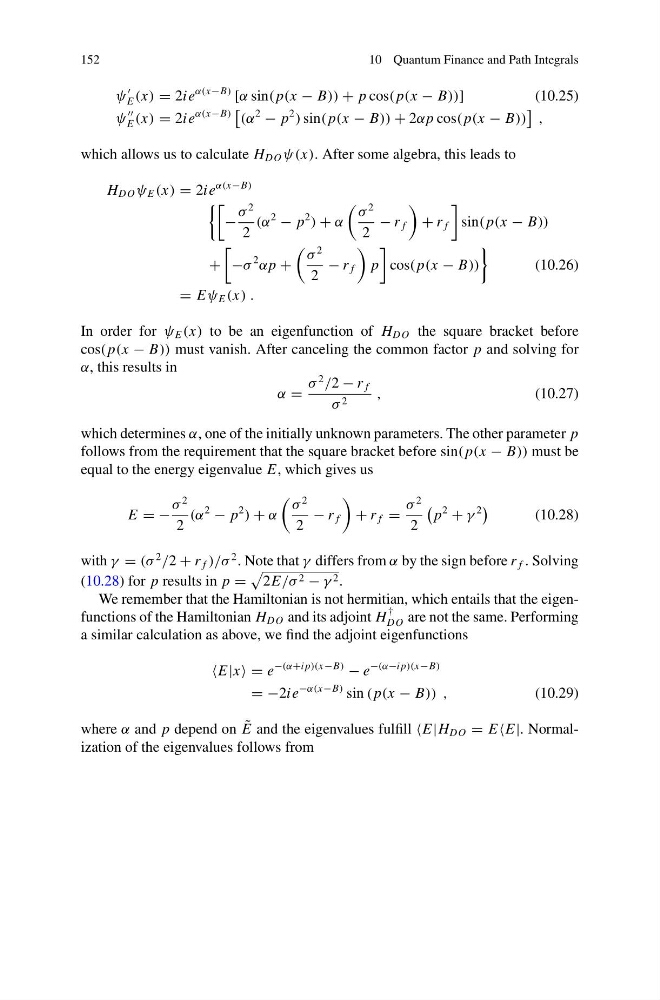
which allows us to calculate H DO ψ(x). After some algebra, this leads to
H DO ψ E (x) = 2ie
α(x−B)
−
σ
2
2
(α
2
− p
2
) + α
σ
2
2
− r f
+ r f
sin( p(x − B))
+
−σ
2
αp +
σ
2
2
− r f
p
cos( p(x − B))
(10.26)
= Eψ E (x) .
In order for ψ E (x) to be an eigenfunction of H DO the square bracket before
cos( p(x − B)) must vanish. After canceling the common factor p and solving for
α, this results in
α =
σ
2
/2 − r f
σ 2
,
(10.27)
which determines α, one of the initially unknown parameters. The other parameter p
follows from the requirement that the square bracket before sin( p(x − B)) must be
equal to the energy eigenvalue E, which gives us
E = −
σ
2
2
(α
2
− p
2
) + α
σ
2
2
− r f
+ r f =
σ
2
2
p
2
+ γ
2
(10.28)
with γ = (σ
2
/2 + r f )/σ
2
. Note that γ differs from α by the sign before r f . Solving
(10.28) for p results in p =
2E/σ 2 − γ 2 .
We remember that the Hamiltonian is not hermitian, which entails that the eigenfunctions of the Hamiltonian H DO and its adjoint H
†
DO are not the same. Performing
a similar calculation as above, we find the adjoint eigenfunctions
E|x = e
−(α+i p)(x−B)
− e
−(α−i p)(x−B)
= −2ie
−α(x−B) sin ( p(x − B)) ,
(10.29)
where α and p depend on ˜
E and the eigenvalues fulfill E|H DO = EE|. Normalization of the eigenvalues follows from
10 Quantum Finance and Path Integrals
ψ
E (x) = 2ie
α(x−B) [α sin( p(x − B)) + p cos( p(x − B))]
(10.25)
ψ
E (x) = 2ie
α(x−B)
(α
2
− p
2
) sin( p(x − B)) + 2αp cos( p(x − B))
,
which allows us to calculate H DO ψ(x). After some algebra, this leads to
H DO ψ E (x) = 2ie
α(x−B)
−
σ
2
2
(α
2
− p
2
) + α
σ
2
2
− r f
+ r f
sin( p(x − B))
+
−σ
2
αp +
σ
2
2
− r f
p
cos( p(x − B))
(10.26)
= Eψ E (x) .
In order for ψ E (x) to be an eigenfunction of H DO the square bracket before
cos( p(x − B)) must vanish. After canceling the common factor p and solving for
α, this results in
α =
σ
2
/2 − r f
σ 2
,
(10.27)
which determines α, one of the initially unknown parameters. The other parameter p
follows from the requirement that the square bracket before sin( p(x − B)) must be
equal to the energy eigenvalue E, which gives us
E = −
σ
2
2
(α
2
− p
2
) + α
σ
2
2
− r f
+ r f =
σ
2
2
p
2
+ γ
2
(10.28)
with γ = (σ
2
/2 + r f )/σ
2
. Note that γ differs from α by the sign before r f . Solving
(10.28) for p results in p =
2E/σ 2 − γ 2 .
We remember that the Hamiltonian is not hermitian, which entails that the eigenfunctions of the Hamiltonian H DO and its adjoint H
†
DO are not the same. Performing
a similar calculation as above, we find the adjoint eigenfunctions
E|x = e
−(α+i p)(x−B)
− e
−(α−i p)(x−B)
= −2ie
−α(x−B) sin ( p(x − B)) ,
(10.29)
where α and p depend on ˜
E and the eigenvalues fulfill E|H DO = EE|. Normalization of the eigenvalues follows from