

9.9 Extreme-Value Theory
137
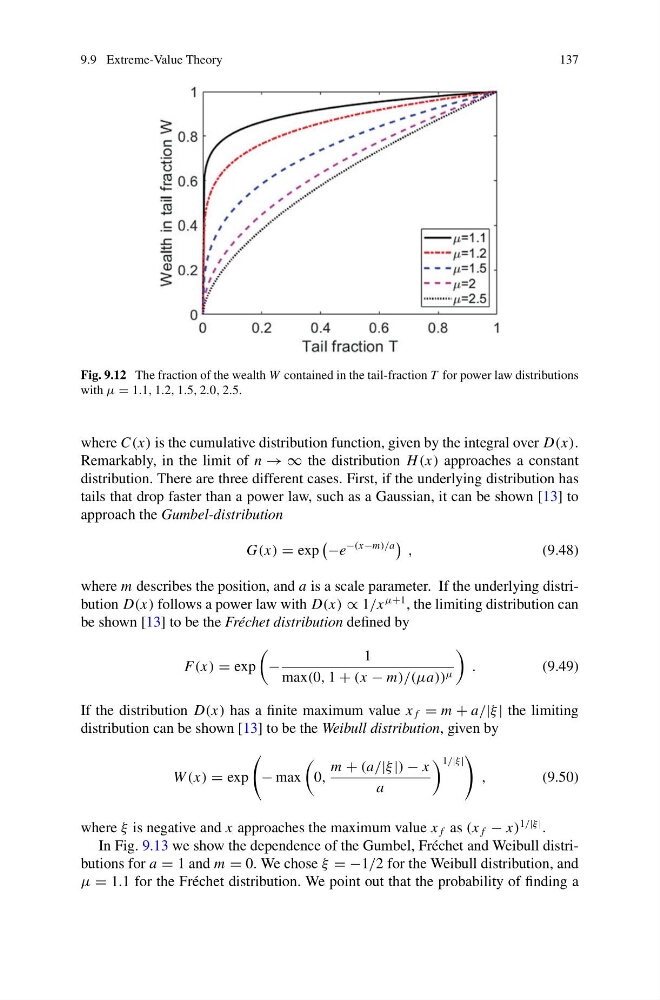
Fig. 9.12 The fraction of the wealth W contained in the tail-fraction T for power law distributions
with μ = 1.1, 1.2, 1.5, 2.0, 2.5.
where C(x) is the cumulative distribution function, given by the integral over D(x).
Remarkably, in the limit of n → ∞ the distribution H (x) approaches a constant
distribution. There are three different cases. First, if the underlying distribution has
tails that drop faster than a power law, such as a Gaussian, it can be shown [13] to
approach the Gumbel-distribution
G(x) = exp
−e
−(x−m)/a
,
(9.48)
where m describes the position, and a is a scale parameter. If the underlying distribution D(x) follows a power law with D(x) ∝ 1/x
μ+1 , the limiting distribution can
be shown [13] to be the Fréchet distribution defined by
F(x) = exp
−
1
max(0, 1 + (x − m)/(μa)) μ
.
(9.49)
If the distribution D(x) has a finite maximum value x f = m + a/|ξ | the limiting
distribution can be shown [13] to be the Weibull distribution, given by
W (x) = exp
− max
0,
m + (a/|ξ |) − x
a
1/|ξ |
,
(9.50)
where ξ is negative and x approaches the maximum value x f as (x f − x)
1/|ξ |
.
In Fig. 9.13 we show the dependence of the Gumbel, Fréchet and Weibull distributions for a = 1 and m = 0. We chose ξ = −1/2 for the Weibull distribution, and
μ = 1.1 for the Fréchet distribution. We point out that the probability of finding a
137
Fig. 9.12 The fraction of the wealth W contained in the tail-fraction T for power law distributions
with μ = 1.1, 1.2, 1.5, 2.0, 2.5.
where C(x) is the cumulative distribution function, given by the integral over D(x).
Remarkably, in the limit of n → ∞ the distribution H (x) approaches a constant
distribution. There are three different cases. First, if the underlying distribution has
tails that drop faster than a power law, such as a Gaussian, it can be shown [13] to
approach the Gumbel-distribution
G(x) = exp
−e
−(x−m)/a
,
(9.48)
where m describes the position, and a is a scale parameter. If the underlying distribution D(x) follows a power law with D(x) ∝ 1/x
μ+1 , the limiting distribution can
be shown [13] to be the Fréchet distribution defined by
F(x) = exp
−
1
max(0, 1 + (x − m)/(μa)) μ
.
(9.49)
If the distribution D(x) has a finite maximum value x f = m + a/|ξ | the limiting
distribution can be shown [13] to be the Weibull distribution, given by
W (x) = exp
− max
0,
m + (a/|ξ |) − x
a
1/|ξ |
,
(9.50)
where ξ is negative and x approaches the maximum value x f as (x f − x)
1/|ξ |
.
In Fig. 9.13 we show the dependence of the Gumbel, Fréchet and Weibull distributions for a = 1 and m = 0. We chose ξ = −1/2 for the Weibull distribution, and
μ = 1.1 for the Fréchet distribution. We point out that the probability of finding a