

118
9 Bubbles, Crashes, Fat Tails and Lévy-Stable Distributions
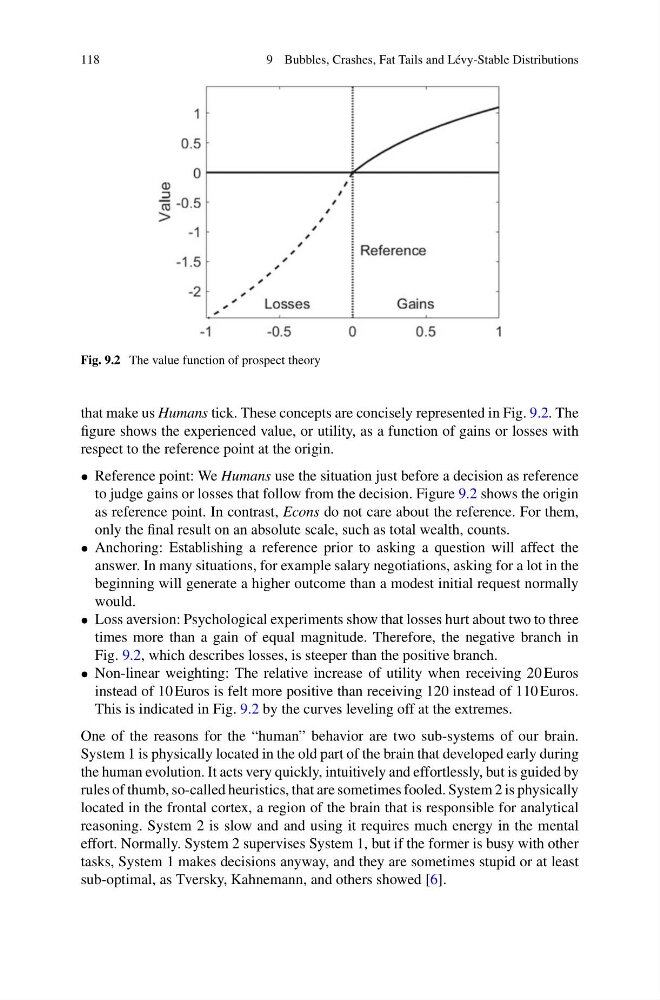
Fig. 9.2 The value function of prospect theory
that make us Humans tick. These concepts are concisely represented in Fig. 9.2. The
figure shows the experienced value, or utility, as a function of gains or losses with
respect to the reference point at the origin.
• Reference point: We Humans use the situation just before a decision as reference
to judge gains or losses that follow from the decision. Figure 9.2 shows the origin
as reference point. In contrast, Econs do not care about the reference. For them,
only the final result on an absolute scale, such as total wealth, counts.
• Anchoring: Establishing a reference prior to asking a question will affect the
answer. In many situations, for example salary negotiations, asking for a lot in the
beginning will generate a higher outcome than a modest initial request normally
would.
• Loss aversion: Psychological experiments show that losses hurt about two to three
times more than a gain of equal magnitude. Therefore, the negative branch in
Fig. 9.2, which describes losses, is steeper than the positive branch.
• Non-linear weighting: The relative increase of utility when receiving 20 Euros
instead of 10 Euros is felt more positive than receiving 120 instead of 110 Euros.
This is indicated in Fig. 9.2 by the curves leveling off at the extremes.
One of the reasons for the “human” behavior are two sub-systems of our brain.
System 1 is physically located in the old part of the brain that developed early during
the human evolution. It acts very quickly, intuitively and effortlessly, but is guided by
rules of thumb, so-called heuristics, that are sometimes fooled. System 2 is physically
located in the frontal cortex, a region of the brain that is responsible for analytical
reasoning. System 2 is slow and and using it requires much energy in the mental
effort. Normally. System 2 supervises System 1, but if the former is busy with other
tasks, System 1 makes decisions anyway, and they are sometimes stupid or at least
sub-optimal, as Tversky, Kahnemann, and others showed [6].
9 Bubbles, Crashes, Fat Tails and Lévy-Stable Distributions
Fig. 9.2 The value function of prospect theory
that make us Humans tick. These concepts are concisely represented in Fig. 9.2. The
figure shows the experienced value, or utility, as a function of gains or losses with
respect to the reference point at the origin.
• Reference point: We Humans use the situation just before a decision as reference
to judge gains or losses that follow from the decision. Figure 9.2 shows the origin
as reference point. In contrast, Econs do not care about the reference. For them,
only the final result on an absolute scale, such as total wealth, counts.
• Anchoring: Establishing a reference prior to asking a question will affect the
answer. In many situations, for example salary negotiations, asking for a lot in the
beginning will generate a higher outcome than a modest initial request normally
would.
• Loss aversion: Psychological experiments show that losses hurt about two to three
times more than a gain of equal magnitude. Therefore, the negative branch in
Fig. 9.2, which describes losses, is steeper than the positive branch.
• Non-linear weighting: The relative increase of utility when receiving 20 Euros
instead of 10 Euros is felt more positive than receiving 120 instead of 110 Euros.
This is indicated in Fig. 9.2 by the curves leveling off at the extremes.
One of the reasons for the “human” behavior are two sub-systems of our brain.
System 1 is physically located in the old part of the brain that developed early during
the human evolution. It acts very quickly, intuitively and effortlessly, but is guided by
rules of thumb, so-called heuristics, that are sometimes fooled. System 2 is physically
located in the frontal cortex, a region of the brain that is responsible for analytical
reasoning. System 2 is slow and and using it requires much energy in the mental
effort. Normally. System 2 supervises System 1, but if the former is busy with other
tasks, System 1 makes decisions anyway, and they are sometimes stupid or at least
sub-optimal, as Tversky, Kahnemann, and others showed [6].