

62
2 Fundamental Properties of Mem-Elements
ϕ = ˆ
ϕ(h(x)) = x
1
3 +
1
3
x
and so the state-dependent Ohm’s law of an ideal generic memristor sibling is
obtained
v = (1 + x
2
3 )i = R(x)i
˙
x = (3x
2
3 )i = f (x)i.
A different choice of the function q = h(x) gives a different state-dependent Ohm’s
law for the ideal generic memristor sibling, but all siblings are equivalent to the
original ideal memristor.
It is easily derived that ˙
x = f (x)i = f (x) ˙
q allows us to derive
q = h(x) =
1
f (x)
dx.
Example 2.21 (Recover an Ideal Memristor from Its Ideal Generic Memristor
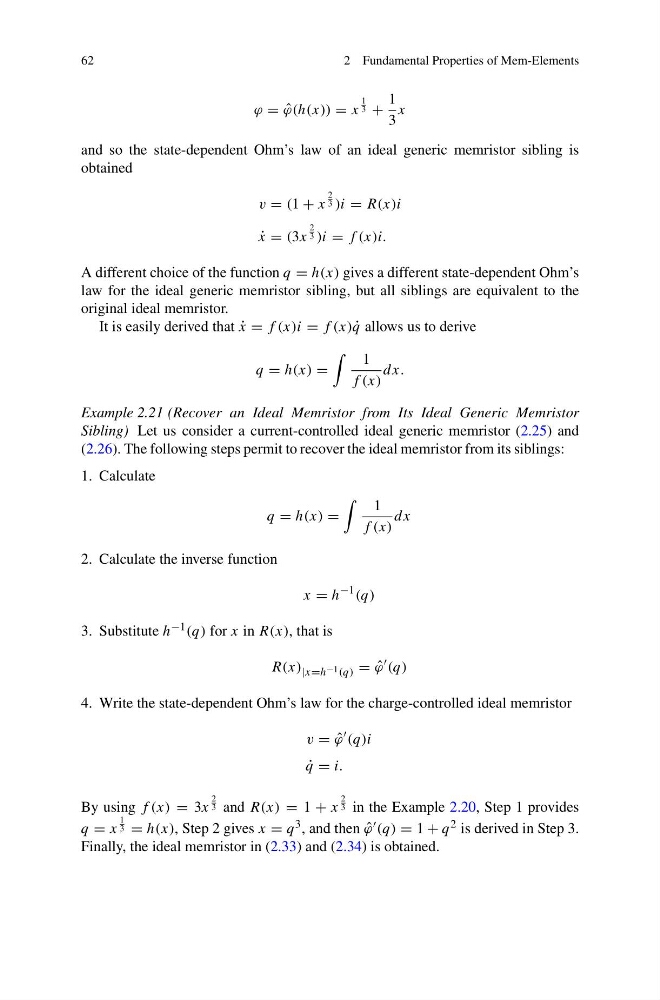
Sibling) Let us consider a current-controlled ideal generic memristor (2.25) and
(2.26). The following steps permit to recover the ideal memristor from its siblings:
1. Calculate
q = h(x) =
1
f (x)
dx
2. Calculate the inverse function
x = h
−1 (q)
3. Substitute h −1 (q) for x in R(x), that is
R(x) |x=h −1 (q) = ˆ
ϕ
(q)
4. Write the state-dependent Ohm’s law for the charge-controlled ideal memristor
v = ˆ
ϕ
(q)i
˙
q = i.
By using f (x) = 3x
2
3 and R(x) = 1 + x
2
3 in the Example 2.20, Step 1 provides
q = x
1
3 = h(x), Step 2 gives x = q 3 , and then ˆ
ϕ (q) = 1 + q 2 is derived in Step 3.
Finally, the ideal memristor in (2.33) and (2.34) is obtained.
2 Fundamental Properties of Mem-Elements
ϕ = ˆ
ϕ(h(x)) = x
1
3 +
1
3
x
and so the state-dependent Ohm’s law of an ideal generic memristor sibling is
obtained
v = (1 + x
2
3 )i = R(x)i
˙
x = (3x
2
3 )i = f (x)i.
A different choice of the function q = h(x) gives a different state-dependent Ohm’s
law for the ideal generic memristor sibling, but all siblings are equivalent to the
original ideal memristor.
It is easily derived that ˙
x = f (x)i = f (x) ˙
q allows us to derive
q = h(x) =
1
f (x)
dx.
Example 2.21 (Recover an Ideal Memristor from Its Ideal Generic Memristor
Sibling) Let us consider a current-controlled ideal generic memristor (2.25) and
(2.26). The following steps permit to recover the ideal memristor from its siblings:
1. Calculate
q = h(x) =
1
f (x)
dx
2. Calculate the inverse function
x = h
−1 (q)
3. Substitute h −1 (q) for x in R(x), that is
R(x) |x=h −1 (q) = ˆ
ϕ
(q)
4. Write the state-dependent Ohm’s law for the charge-controlled ideal memristor
v = ˆ
ϕ
(q)i
˙
q = i.
By using f (x) = 3x
2
3 and R(x) = 1 + x
2
3 in the Example 2.20, Step 1 provides
q = x
1
3 = h(x), Step 2 gives x = q 3 , and then ˆ
ϕ (q) = 1 + q 2 is derived in Step 3.
Finally, the ideal memristor in (2.33) and (2.34) is obtained.