

60
2 Fundamental Properties of Mem-Elements
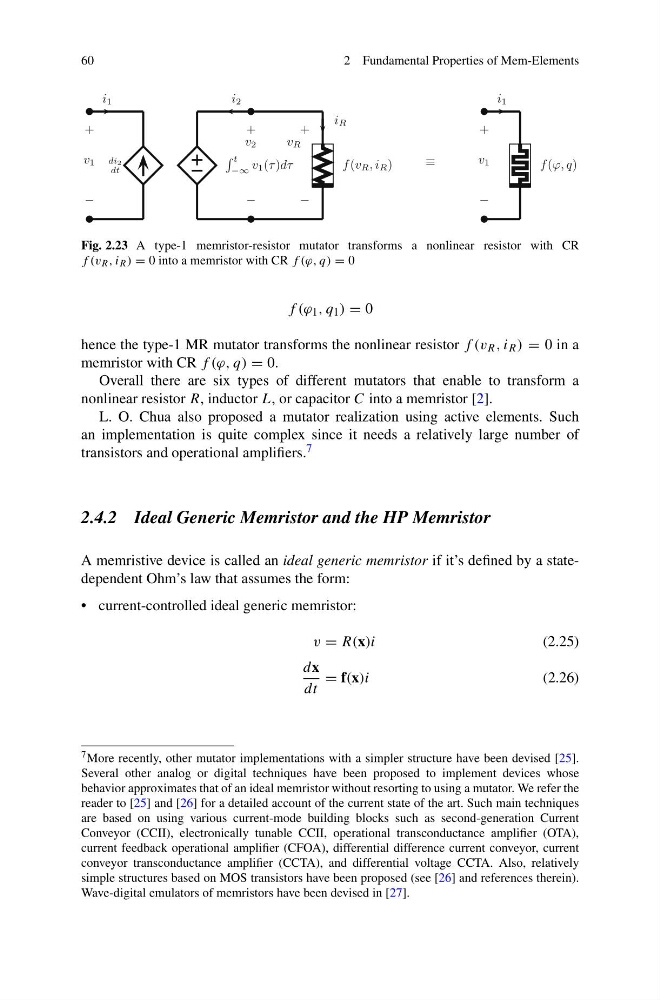
Fig. 2.23 A type-1 memristor-resistor mutator transforms a nonlinear resistor with CR
f (v R , i R ) = 0 into a memristor with CR f (ϕ, q) = 0
f (ϕ 1 , q 1 ) = 0
hence the type-1 MR mutator transforms the nonlinear resistor f (v R , i R ) = 0 in a
memristor with CR f (ϕ, q) = 0.
Overall there are six types of different mutators that enable to transform a
nonlinear resistor R, inductor L, or capacitor C into a memristor [2].
L. O. Chua also proposed a mutator realization using active elements. Such
an implementation is quite complex since it needs a relatively large number of
transistors and operational amplifiers. 7
2.4.2 Ideal Generic Memristor and the HP Memristor
A memristive device is called an ideal generic memristor if it’s defined by a statedependent Ohm’s law that assumes the form:
• current-controlled ideal generic memristor:
v = R(x)i
(2.25)
dx
dt
= f(x)i
(2.26)
7 More recently, other mutator implementations with a simpler structure have been devised [25].
Several other analog or digital techniques have been proposed to implement devices whose
behavior approximates that of an ideal memristor without resorting to using a mutator. We refer the
reader to [25] and [26] for a detailed account of the current state of the art. Such main techniques
are based on using various current-mode building blocks such as second-generation Current
Conveyor (CCII), electronically tunable CCII, operational transconductance amplifier (OTA),
current feedback operational amplifier (CFOA), differential difference current conveyor, current
conveyor transconductance amplifier (CCTA), and differential voltage CCTA. Also, relatively
simple structures based on MOS transistors have been proposed (see [26] and references therein).
Wave-digital emulators of memristors have been devised in [27].
2 Fundamental Properties of Mem-Elements
Fig. 2.23 A type-1 memristor-resistor mutator transforms a nonlinear resistor with CR
f (v R , i R ) = 0 into a memristor with CR f (ϕ, q) = 0
f (ϕ 1 , q 1 ) = 0
hence the type-1 MR mutator transforms the nonlinear resistor f (v R , i R ) = 0 in a
memristor with CR f (ϕ, q) = 0.
Overall there are six types of different mutators that enable to transform a
nonlinear resistor R, inductor L, or capacitor C into a memristor [2].
L. O. Chua also proposed a mutator realization using active elements. Such
an implementation is quite complex since it needs a relatively large number of
transistors and operational amplifiers. 7
2.4.2 Ideal Generic Memristor and the HP Memristor
A memristive device is called an ideal generic memristor if it’s defined by a statedependent Ohm’s law that assumes the form:
• current-controlled ideal generic memristor:
v = R(x)i
(2.25)
dx
dt
= f(x)i
(2.26)
7 More recently, other mutator implementations with a simpler structure have been devised [25].
Several other analog or digital techniques have been proposed to implement devices whose
behavior approximates that of an ideal memristor without resorting to using a mutator. We refer the
reader to [25] and [26] for a detailed account of the current state of the art. Such main techniques
are based on using various current-mode building blocks such as second-generation Current
Conveyor (CCII), electronically tunable CCII, operational transconductance amplifier (OTA),
current feedback operational amplifier (CFOA), differential difference current conveyor, current
conveyor transconductance amplifier (CCTA), and differential voltage CCTA. Also, relatively
simple structures based on MOS transistors have been proposed (see [26] and references therein).
Wave-digital emulators of memristors have been devised in [27].