

16
1 Device Modeling and Circuit Elements
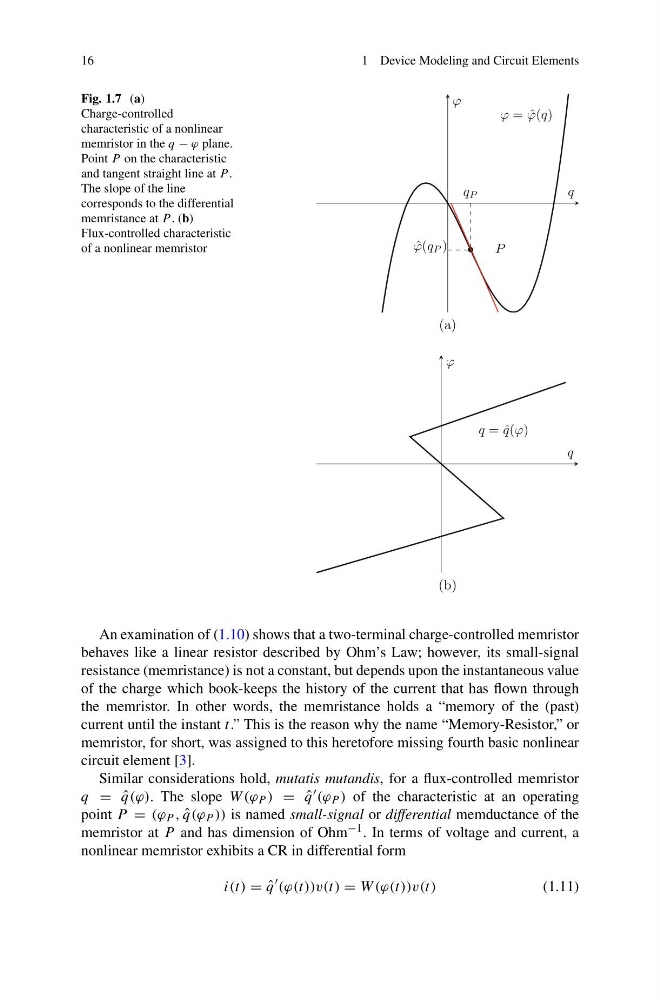
Fig. 1.7 (a)
Charge-controlled
characteristic of a nonlinear
memristor in the q − ϕ plane.
Point P on the characteristic
and tangent straight line at P .
The slope of the line
corresponds to the differential
memristance at P . (b)
Flux-controlled characteristic
of a nonlinear memristor
ϕ = ˆ
ϕ(q)
•
P
q P
ˆ
ϕ(q P )
q
ϕ
(a)
q = ˆ
q(ϕ)
q
ϕ
(b)
An examination of (1.10) shows that a two-terminal charge-controlled memristor
behaves like a linear resistor described by Ohm’s Law; however, its small-signal
resistance (memristance) is not a constant, but depends upon the instantaneous value
of the charge which book-keeps the history of the current that has flown through
the memristor. In other words, the memristance holds a “memory of the (past)
current until the instant t.” This is the reason why the name “Memory-Resistor,” or
memristor, for short, was assigned to this heretofore missing fourth basic nonlinear
circuit element [3].
Similar considerations hold, mutatis mutandis, for a flux-controlled memristor
q = ˆ
q(ϕ). The slope W (ϕ P ) = ˆ
q (ϕ P ) of the characteristic at an operating
point P = (ϕ P , ˆ
q(ϕ P )) is named small-signal or differential memductance of the
memristor at P and has dimension of Ohm −1 . In terms of voltage and current, a
nonlinear memristor exhibits a CR in differential form
i(t) = ˆ
q
(ϕ(t))v(t) = W (ϕ(t))v(t)
(1.11)
1 Device Modeling and Circuit Elements
Fig. 1.7 (a)
Charge-controlled
characteristic of a nonlinear
memristor in the q − ϕ plane.
Point P on the characteristic
and tangent straight line at P .
The slope of the line
corresponds to the differential
memristance at P . (b)
Flux-controlled characteristic
of a nonlinear memristor
ϕ = ˆ
ϕ(q)
•
P
q P
ˆ
ϕ(q P )
q
ϕ
(a)
q = ˆ
q(ϕ)
q
ϕ
(b)
An examination of (1.10) shows that a two-terminal charge-controlled memristor
behaves like a linear resistor described by Ohm’s Law; however, its small-signal
resistance (memristance) is not a constant, but depends upon the instantaneous value
of the charge which book-keeps the history of the current that has flown through
the memristor. In other words, the memristance holds a “memory of the (past)
current until the instant t.” This is the reason why the name “Memory-Resistor,” or
memristor, for short, was assigned to this heretofore missing fourth basic nonlinear
circuit element [3].
Similar considerations hold, mutatis mutandis, for a flux-controlled memristor
q = ˆ
q(ϕ). The slope W (ϕ P ) = ˆ
q (ϕ P ) of the characteristic at an operating
point P = (ϕ P , ˆ
q(ϕ P )) is named small-signal or differential memductance of the
memristor at P and has dimension of Ohm −1 . In terms of voltage and current, a
nonlinear memristor exhibits a CR in differential form
i(t) = ˆ
q
(ϕ(t))v(t) = W (ϕ(t))v(t)
(1.11)