

1.2 Four Basic Two-Terminal Circuit Elements
15
−
+
v
i
i = ˆ i(ϕ)
ϕ
i
)
b
(
)
a
(
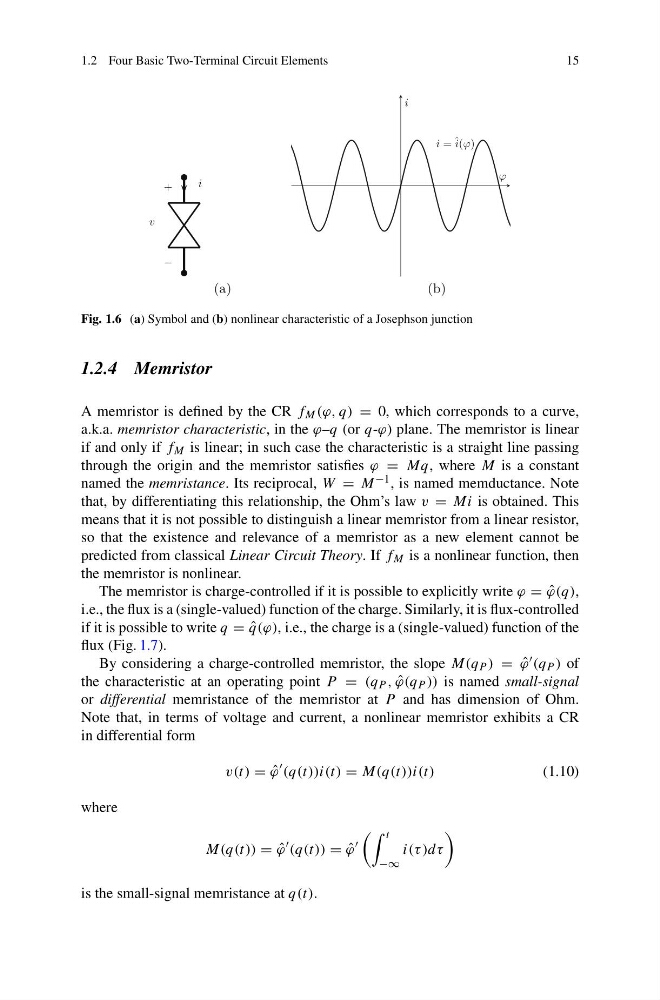
Fig. 1.6 (a) Symbol and (b) nonlinear characteristic of a Josephson junction
1.2.4 Memristor
A memristor is defined by the CR f M (ϕ, q) = 0, which corresponds to a curve,
a.k.a. memristor characteristic, in the ϕ–q (or q-ϕ) plane. The memristor is linear
if and only if f M is linear; in such case the characteristic is a straight line passing
through the origin and the memristor satisfies ϕ = Mq, where M is a constant
named the memristance. Its reciprocal, W = M −1 , is named memductance. Note
that, by differentiating this relationship, the Ohm’s law v = Mi is obtained. This
means that it is not possible to distinguish a linear memristor from a linear resistor,
so that the existence and relevance of a memristor as a new element cannot be
predicted from classical Linear Circuit Theory. If f M is a nonlinear function, then
the memristor is nonlinear.
The memristor is charge-controlled if it is possible to explicitly write ϕ = ˆ
ϕ(q),
i.e., the flux is a (single-valued) function of the charge. Similarly, it is flux-controlled
if it is possible to write q = ˆ
q(ϕ), i.e., the charge is a (single-valued) function of the
flux (Fig. 1.7).
By considering a charge-controlled memristor, the slope M(q P ) = ˆ
ϕ (q P ) of
the characteristic at an operating point P = (q P , ˆ
ϕ(q P )) is named small-signal
or differential memristance of the memristor at P and has dimension of Ohm.
Note that, in terms of voltage and current, a nonlinear memristor exhibits a CR
in differential form
v(t) = ˆ
ϕ
(q(t))i(t) = M(q(t))i(t)
(1.10)
where
M(q(t)) = ˆ
ϕ
(q(t)) = ˆ
ϕ
t
−∞
i(τ )dτ
is the small-signal memristance at q(t).
15
−
+
v
i
i = ˆ i(ϕ)
ϕ
i
)
b
(
)
a
(
Fig. 1.6 (a) Symbol and (b) nonlinear characteristic of a Josephson junction
1.2.4 Memristor
A memristor is defined by the CR f M (ϕ, q) = 0, which corresponds to a curve,
a.k.a. memristor characteristic, in the ϕ–q (or q-ϕ) plane. The memristor is linear
if and only if f M is linear; in such case the characteristic is a straight line passing
through the origin and the memristor satisfies ϕ = Mq, where M is a constant
named the memristance. Its reciprocal, W = M −1 , is named memductance. Note
that, by differentiating this relationship, the Ohm’s law v = Mi is obtained. This
means that it is not possible to distinguish a linear memristor from a linear resistor,
so that the existence and relevance of a memristor as a new element cannot be
predicted from classical Linear Circuit Theory. If f M is a nonlinear function, then
the memristor is nonlinear.
The memristor is charge-controlled if it is possible to explicitly write ϕ = ˆ
ϕ(q),
i.e., the flux is a (single-valued) function of the charge. Similarly, it is flux-controlled
if it is possible to write q = ˆ
q(ϕ), i.e., the charge is a (single-valued) function of the
flux (Fig. 1.7).
By considering a charge-controlled memristor, the slope M(q P ) = ˆ
ϕ (q P ) of
the characteristic at an operating point P = (q P , ˆ
ϕ(q P )) is named small-signal
or differential memristance of the memristor at P and has dimension of Ohm.
Note that, in terms of voltage and current, a nonlinear memristor exhibits a CR
in differential form
v(t) = ˆ
ϕ
(q(t))i(t) = M(q(t))i(t)
(1.10)
where
M(q(t)) = ˆ
ϕ
(q(t)) = ˆ
ϕ
t
−∞
i(τ )dτ
is the small-signal memristance at q(t).