

11.7 Examples Concerning Class LME
423
Since, by assumption, there exists f
−1
L , by substitution we obtain that in the (ϕ, q)domain the circuit satisfies for t ≥ t 0 the first-order SE
˙
q L (t; t 0 ) = (f L )
−1
f M (−q L (t; t 0 ) + q M 0 ) − f M (q M 0 ) + f L (i L 0 )
in the state variable q L (t; t 0 ). The IC is q L (t 0 ; t 0 ) = 0.
Passing from the (v, i)-domain to the (ϕ, q)-domain we have an order reduction
for the SEs equal to 1. Note, however, that the right-hand side of the SE in the (ϕ, q)domain depends upon the ICs i L 0 and q M 0 for the state variable in the (v, i)-domain.
Let us show that the dynamics in the (v, i)-domain is characterized by the
presence of invariant manifolds. From the KϕL ϕ L (t; t 0 ) = ϕ M (t; t 0 ) we obtain
f L (i L (t)) − f M (q M (t)) = f L (i L 0 ) − f M (q M 0 ) = Φ 0 (i L 0 , q M 0 )
for any t ≥ t 0 , i.e., function f L (i L (t)) − f M (q M (t)) is an invariant of motion. This
implies that the two-dimensional state space (i L (t), q M (t)) T ∈ R 2 in the (v, i)domain can be decomposed in ∞ 1 1D manifolds, which are (positively) invariant
for the dynamics in the (v, i)-domain, given by
M(Φ 0 ) = {(i L (t), q M (t))
T
∈ R
2
: f L (i L (t)) − f M (q M (t)) = Φ 0 }
where Φ 0 ∈ R. On each manifold the dynamics is first order and can be described
by the corresponding SE in the (ϕ, q)-domain. This also implies that there coexist
∞ 1 different first-order dynamics, one for each manifold, in the (v, i)-domain.
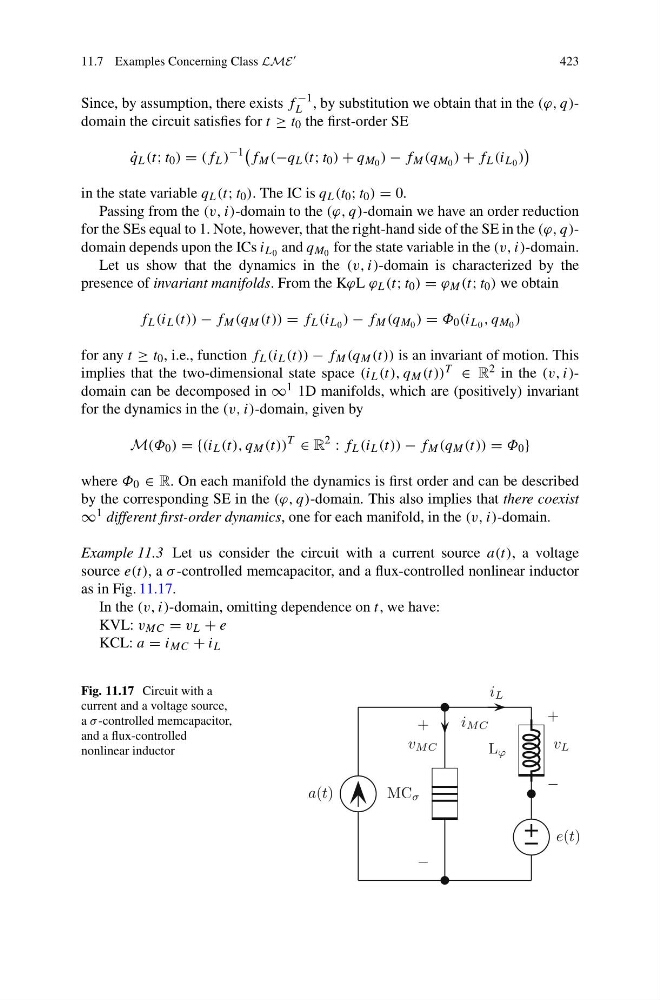
Example 11.3 Let us consider the circuit with a current source a(t), a voltage
source e(t), a σ -controlled memcapacitor, and a flux-controlled nonlinear inductor
as in Fig. 11.17.
In the (v, i)-domain, omitting dependence on t, we have:
KVL: v MC = v L + e
KCL: a = i MC + i L
Fig. 11.17 Circuit with a
current and a voltage source,
a σ -controlled memcapacitor,
and a flux-controlled
nonlinear inductor
423
Since, by assumption, there exists f
−1
L , by substitution we obtain that in the (ϕ, q)domain the circuit satisfies for t ≥ t 0 the first-order SE
˙
q L (t; t 0 ) = (f L )
−1
f M (−q L (t; t 0 ) + q M 0 ) − f M (q M 0 ) + f L (i L 0 )
in the state variable q L (t; t 0 ). The IC is q L (t 0 ; t 0 ) = 0.
Passing from the (v, i)-domain to the (ϕ, q)-domain we have an order reduction
for the SEs equal to 1. Note, however, that the right-hand side of the SE in the (ϕ, q)domain depends upon the ICs i L 0 and q M 0 for the state variable in the (v, i)-domain.
Let us show that the dynamics in the (v, i)-domain is characterized by the
presence of invariant manifolds. From the KϕL ϕ L (t; t 0 ) = ϕ M (t; t 0 ) we obtain
f L (i L (t)) − f M (q M (t)) = f L (i L 0 ) − f M (q M 0 ) = Φ 0 (i L 0 , q M 0 )
for any t ≥ t 0 , i.e., function f L (i L (t)) − f M (q M (t)) is an invariant of motion. This
implies that the two-dimensional state space (i L (t), q M (t)) T ∈ R 2 in the (v, i)domain can be decomposed in ∞ 1 1D manifolds, which are (positively) invariant
for the dynamics in the (v, i)-domain, given by
M(Φ 0 ) = {(i L (t), q M (t))
T
∈ R
2
: f L (i L (t)) − f M (q M (t)) = Φ 0 }
where Φ 0 ∈ R. On each manifold the dynamics is first order and can be described
by the corresponding SE in the (ϕ, q)-domain. This also implies that there coexist
∞ 1 different first-order dynamics, one for each manifold, in the (v, i)-domain.
Example 11.3 Let us consider the circuit with a current source a(t), a voltage
source e(t), a σ -controlled memcapacitor, and a flux-controlled nonlinear inductor
as in Fig. 11.17.
In the (v, i)-domain, omitting dependence on t, we have:
KVL: v MC = v L + e
KCL: a = i MC + i L
Fig. 11.17 Circuit with a
current and a voltage source,
a σ -controlled memcapacitor,
and a flux-controlled
nonlinear inductor