

416
11 Nonlinear Dynamics of Circuits with Mem-Elements
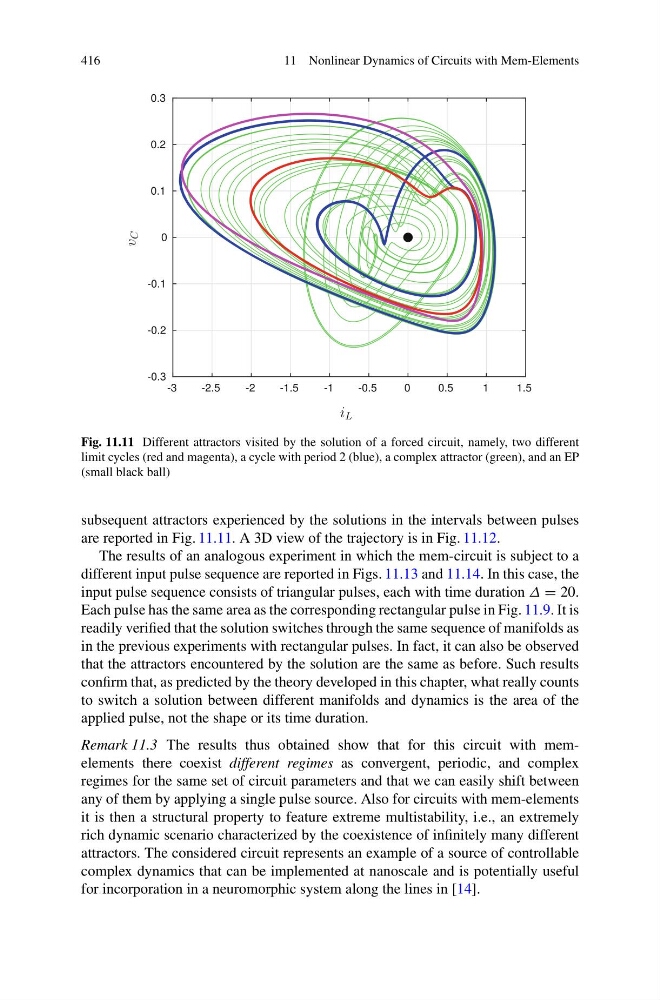
Fig. 11.11 Different attractors visited by the solution of a forced circuit, namely, two different
limit cycles (red and magenta), a cycle with period 2 (blue), a complex attractor (green), and an EP
(small black ball)
subsequent attractors experienced by the solutions in the intervals between pulses
are reported in Fig. 11.11. A 3D view of the trajectory is in Fig. 11.12.
The results of an analogous experiment in which the mem-circuit is subject to a
different input pulse sequence are reported in Figs. 11.13 and 11.14. In this case, the
input pulse sequence consists of triangular pulses, each with time duration Δ = 20.
Each pulse has the same area as the corresponding rectangular pulse in Fig. 11.9. It is
readily verified that the solution switches through the same sequence of manifolds as
in the previous experiments with rectangular pulses. In fact, it can also be observed
that the attractors encountered by the solution are the same as before. Such results
confirm that, as predicted by the theory developed in this chapter, what really counts
to switch a solution between different manifolds and dynamics is the area of the
applied pulse, not the shape or its time duration.
Remark 11.3 The results thus obtained show that for this circuit with memelements there coexist different regimes as convergent, periodic, and complex
regimes for the same set of circuit parameters and that we can easily shift between
any of them by applying a single pulse source. Also for circuits with mem-elements
it is then a structural property to feature extreme multistability, i.e., an extremely
rich dynamic scenario characterized by the coexistence of infinitely many different
attractors. The considered circuit represents an example of a source of controllable
complex dynamics that can be implemented at nanoscale and is potentially useful
for incorporation in a neuromorphic system along the lines in [14].
11 Nonlinear Dynamics of Circuits with Mem-Elements
Fig. 11.11 Different attractors visited by the solution of a forced circuit, namely, two different
limit cycles (red and magenta), a cycle with period 2 (blue), a complex attractor (green), and an EP
(small black ball)
subsequent attractors experienced by the solutions in the intervals between pulses
are reported in Fig. 11.11. A 3D view of the trajectory is in Fig. 11.12.
The results of an analogous experiment in which the mem-circuit is subject to a
different input pulse sequence are reported in Figs. 11.13 and 11.14. In this case, the
input pulse sequence consists of triangular pulses, each with time duration Δ = 20.
Each pulse has the same area as the corresponding rectangular pulse in Fig. 11.9. It is
readily verified that the solution switches through the same sequence of manifolds as
in the previous experiments with rectangular pulses. In fact, it can also be observed
that the attractors encountered by the solution are the same as before. Such results
confirm that, as predicted by the theory developed in this chapter, what really counts
to switch a solution between different manifolds and dynamics is the area of the
applied pulse, not the shape or its time duration.
Remark 11.3 The results thus obtained show that for this circuit with memelements there coexist different regimes as convergent, periodic, and complex
regimes for the same set of circuit parameters and that we can easily shift between
any of them by applying a single pulse source. Also for circuits with mem-elements
it is then a structural property to feature extreme multistability, i.e., an extremely
rich dynamic scenario characterized by the coexistence of infinitely many different
attractors. The considered circuit represents an example of a source of controllable
complex dynamics that can be implemented at nanoscale and is potentially useful
for incorporation in a neuromorphic system along the lines in [14].