

392
11 Nonlinear Dynamics of Circuits with Mem-Elements
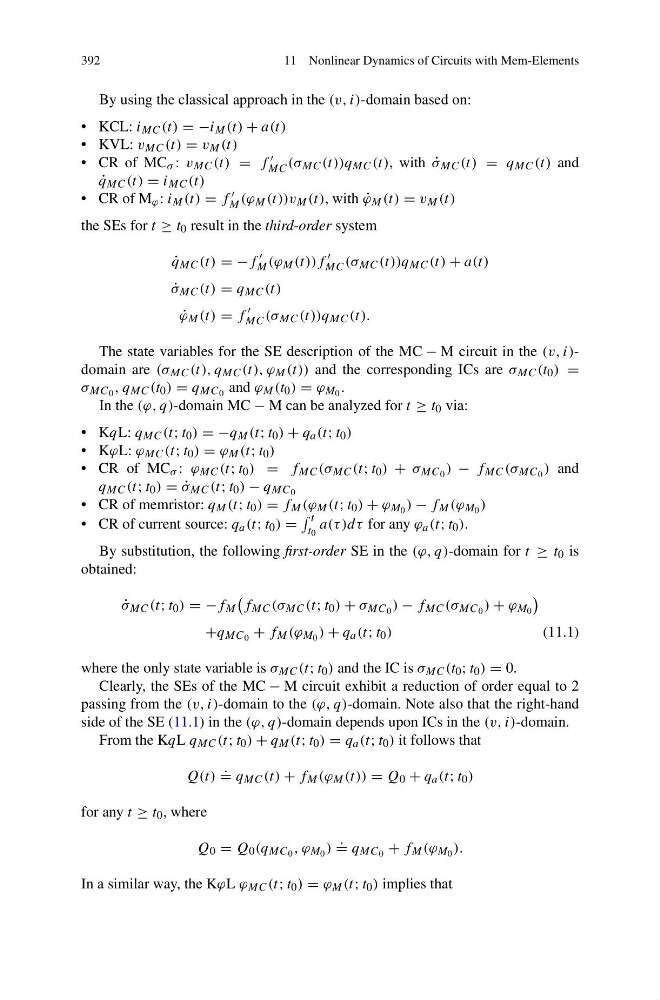
By using the classical approach in the (v, i)-domain based on:
• KCL: i MC (t) = −i M (t) + a(t)
• KVL: v MC (t) = v M (t)
• CR of MC σ : v MC (t) = f
MC (σ MC (t))q MC (t), with ˙
σ MC (t) = q MC (t) and
˙
q MC (t) = i MC (t)
• CR of M ϕ : i M (t) = f
M (ϕ M (t))v M (t), with ˙
ϕ M (t) = v M (t)
the SEs for t ≥ t 0 result in the third-order system
˙
q MC (t) = −f
M (ϕ M (t))f
MC (σ MC (t))q MC (t) + a(t)
˙
σ MC (t) = q MC (t)
˙
ϕ M (t) = f
MC (σ MC (t))q MC (t).
The state variables for the SE description of the MC − M circuit in the (v, i)domain are (σ MC (t), q MC (t), ϕ M (t)) and the corresponding ICs are σ MC (t 0 ) =
σ MC 0 , q MC (t 0 ) = q MC 0 and ϕ M (t 0 ) = ϕ M 0 .
In the (ϕ, q)-domain MC − M can be analyzed for t ≥ t 0 via:
• KqL: q MC (t; t 0 ) = −q M (t; t 0 ) + q a (t; t 0 )
• KϕL: ϕ MC (t; t 0 ) = ϕ M (t; t 0 )
• CR of MC σ : ϕ MC (t; t 0 ) = f MC (σ MC (t; t 0 ) + σ MC 0 ) − f MC (σ MC 0 ) and
q MC (t; t 0 ) = ˙
σ MC (t; t 0 ) − q MC 0
• CR of memristor: q M (t; t 0 ) = f M (ϕ M (t; t 0 ) + ϕ M 0 ) − f M (ϕ M 0 )
• CR of current source: q a (t; t 0 ) =
t
t 0
a(τ )dτ for any ϕ a (t; t 0 ).
By substitution, the following first-order SE in the (ϕ, q)-domain for t ≥ t 0 is
obtained:
˙
σ MC (t; t 0 ) = −f M
f MC (σ MC (t; t 0 ) + σ MC 0 ) − f MC (σ MC 0 ) + ϕ M 0
+q MC 0 + f M (ϕ M 0 ) + q a (t; t 0 )
(11.1)
where the only state variable is σ MC (t; t 0 ) and the IC is σ MC (t 0 ; t 0 ) = 0.
Clearly, the SEs of the MC − M circuit exhibit a reduction of order equal to 2
passing from the (v, i)-domain to the (ϕ, q)-domain. Note also that the right-hand
side of the SE (11.1) in the (ϕ, q)-domain depends upon ICs in the (v, i)-domain.
From the KqL q MC (t; t 0 ) + q M (t; t 0 ) = q a (t; t 0 ) it follows that
Q(t)
.
= q MC (t) + f M (ϕ M (t)) = Q 0 + q a (t; t 0 )
for any t ≥ t 0 , where
Q 0 = Q 0 (q MC 0 , ϕ M 0 )
.
= q MC 0 + f M (ϕ M 0 ).
In a similar way, the KϕL ϕ MC (t; t 0 ) = ϕ M (t; t 0 ) implies that
11 Nonlinear Dynamics of Circuits with Mem-Elements
By using the classical approach in the (v, i)-domain based on:
• KCL: i MC (t) = −i M (t) + a(t)
• KVL: v MC (t) = v M (t)
• CR of MC σ : v MC (t) = f
MC (σ MC (t))q MC (t), with ˙
σ MC (t) = q MC (t) and
˙
q MC (t) = i MC (t)
• CR of M ϕ : i M (t) = f
M (ϕ M (t))v M (t), with ˙
ϕ M (t) = v M (t)
the SEs for t ≥ t 0 result in the third-order system
˙
q MC (t) = −f
M (ϕ M (t))f
MC (σ MC (t))q MC (t) + a(t)
˙
σ MC (t) = q MC (t)
˙
ϕ M (t) = f
MC (σ MC (t))q MC (t).
The state variables for the SE description of the MC − M circuit in the (v, i)domain are (σ MC (t), q MC (t), ϕ M (t)) and the corresponding ICs are σ MC (t 0 ) =
σ MC 0 , q MC (t 0 ) = q MC 0 and ϕ M (t 0 ) = ϕ M 0 .
In the (ϕ, q)-domain MC − M can be analyzed for t ≥ t 0 via:
• KqL: q MC (t; t 0 ) = −q M (t; t 0 ) + q a (t; t 0 )
• KϕL: ϕ MC (t; t 0 ) = ϕ M (t; t 0 )
• CR of MC σ : ϕ MC (t; t 0 ) = f MC (σ MC (t; t 0 ) + σ MC 0 ) − f MC (σ MC 0 ) and
q MC (t; t 0 ) = ˙
σ MC (t; t 0 ) − q MC 0
• CR of memristor: q M (t; t 0 ) = f M (ϕ M (t; t 0 ) + ϕ M 0 ) − f M (ϕ M 0 )
• CR of current source: q a (t; t 0 ) =
t
t 0
a(τ )dτ for any ϕ a (t; t 0 ).
By substitution, the following first-order SE in the (ϕ, q)-domain for t ≥ t 0 is
obtained:
˙
σ MC (t; t 0 ) = −f M
f MC (σ MC (t; t 0 ) + σ MC 0 ) − f MC (σ MC 0 ) + ϕ M 0
+q MC 0 + f M (ϕ M 0 ) + q a (t; t 0 )
(11.1)
where the only state variable is σ MC (t; t 0 ) and the IC is σ MC (t 0 ; t 0 ) = 0.
Clearly, the SEs of the MC − M circuit exhibit a reduction of order equal to 2
passing from the (v, i)-domain to the (ϕ, q)-domain. Note also that the right-hand
side of the SE (11.1) in the (ϕ, q)-domain depends upon ICs in the (v, i)-domain.
From the KqL q MC (t; t 0 ) + q M (t; t 0 ) = q a (t; t 0 ) it follows that
Q(t)
.
= q MC (t) + f M (ϕ M (t)) = Q 0 + q a (t; t 0 )
for any t ≥ t 0 , where
Q 0 = Q 0 (q MC 0 , ϕ M 0 )
.
= q MC 0 + f M (ϕ M 0 ).
In a similar way, the KϕL ϕ MC (t; t 0 ) = ϕ M (t; t 0 ) implies that