

References
371
v M (t) =
R off + R on e 4α(q M (t)− ˜
C)
1 + e 4α(q M (t)− ˜
C)
i M (t).
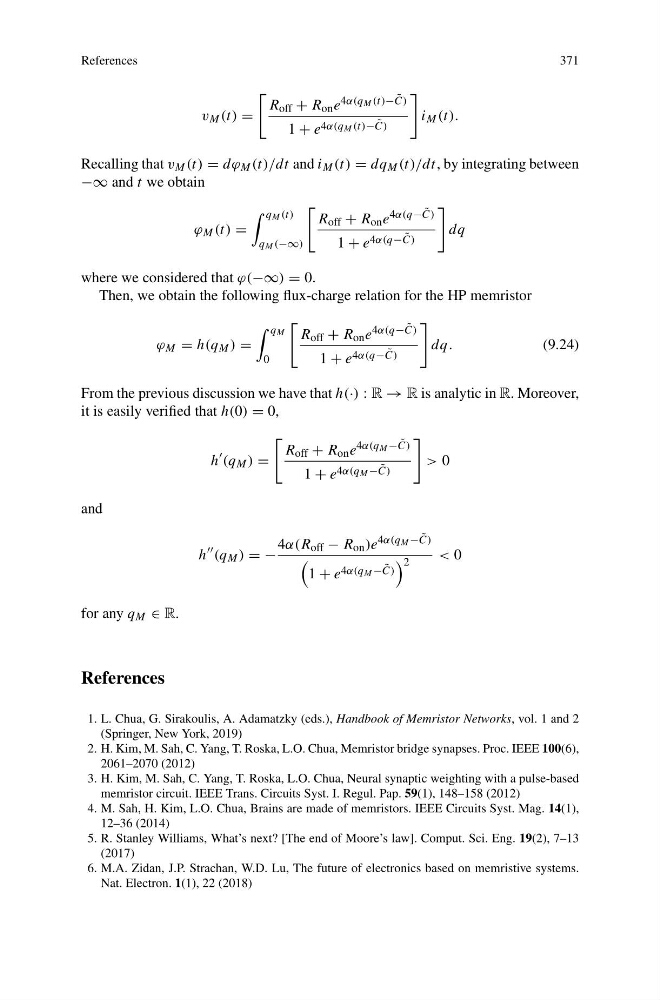
Recalling that v M (t) = dϕ M (t)/dt and i M (t) = dq M (t)/dt, by integrating between
−∞ and t we obtain
ϕ M (t) =
q M (t)
q M (−∞)
R off + R on e 4α(q− ˜
C)
1 + e 4α(q− ˜
C)
dq
where we considered that ϕ(−∞) = 0.
Then, we obtain the following flux-charge relation for the HP memristor
ϕ M = h(q M ) =
q M
0
R off + R on e 4α(q− ˜
C)
1 + e 4α(q− ˜
C)
dq.
(9.24)
From the previous discussion we have that h(·) : R → R is analytic in R. Moreover,
it is easily verified that h(0) = 0,
h
(q M ) =
R off + R on e 4α(q M − ˜
C)
1 + e 4α(q M − ˜
C)
> 0
and
h
(q M ) = −
4α(R off − R on )e 4α(q M − ˜
C)
1 + e 4α(q M − ˜
C)
2
< 0
for any q M ∈ R.
References
1. L. Chua, G. Sirakoulis, A. Adamatzky (eds.), Handbook of Memristor Networks, vol. 1 and 2
(Springer, New York, 2019)
2. H. Kim, M. Sah, C. Yang, T. Roska, L.O. Chua, Memristor bridge synapses. Proc. IEEE 100(6),
2061–2070 (2012)
3. H. Kim, M. Sah, C. Yang, T. Roska, L.O. Chua, Neural synaptic weighting with a pulse-based
memristor circuit. IEEE Trans. Circuits Syst. I. Regul. Pap. 59(1), 148–158 (2012)
4. M. Sah, H. Kim, L.O. Chua, Brains are made of memristors. IEEE Circuits Syst. Mag. 14(1),
12–36 (2014)
5. R. Stanley Williams, What’s next? [The end of Moore’s law]. Comput. Sci. Eng. 19(2), 7–13
(2017)
6. M.A. Zidan, J.P. Strachan, W.D. Lu, The future of electronics based on memristive systems.
Nat. Electron. 1(1), 22 (2018)
371
v M (t) =
R off + R on e 4α(q M (t)− ˜
C)
1 + e 4α(q M (t)− ˜
C)
i M (t).
Recalling that v M (t) = dϕ M (t)/dt and i M (t) = dq M (t)/dt, by integrating between
−∞ and t we obtain
ϕ M (t) =
q M (t)
q M (−∞)
R off + R on e 4α(q− ˜
C)
1 + e 4α(q− ˜
C)
dq
where we considered that ϕ(−∞) = 0.
Then, we obtain the following flux-charge relation for the HP memristor
ϕ M = h(q M ) =
q M
0
R off + R on e 4α(q− ˜
C)
1 + e 4α(q− ˜
C)
dq.
(9.24)
From the previous discussion we have that h(·) : R → R is analytic in R. Moreover,
it is easily verified that h(0) = 0,
h
(q M ) =
R off + R on e 4α(q M − ˜
C)
1 + e 4α(q M − ˜
C)
> 0
and
h
(q M ) = −
4α(R off − R on )e 4α(q M − ˜
C)
1 + e 4α(q M − ˜
C)
2
< 0
for any q M ∈ R.
References
1. L. Chua, G. Sirakoulis, A. Adamatzky (eds.), Handbook of Memristor Networks, vol. 1 and 2
(Springer, New York, 2019)
2. H. Kim, M. Sah, C. Yang, T. Roska, L.O. Chua, Memristor bridge synapses. Proc. IEEE 100(6),
2061–2070 (2012)
3. H. Kim, M. Sah, C. Yang, T. Roska, L.O. Chua, Neural synaptic weighting with a pulse-based
memristor circuit. IEEE Trans. Circuits Syst. I. Regul. Pap. 59(1), 148–158 (2012)
4. M. Sah, H. Kim, L.O. Chua, Brains are made of memristors. IEEE Circuits Syst. Mag. 14(1),
12–36 (2014)
5. R. Stanley Williams, What’s next? [The end of Moore’s law]. Comput. Sci. Eng. 19(2), 7–13
(2017)
6. M.A. Zidan, J.P. Strachan, W.D. Lu, The future of electronics based on memristive systems.
Nat. Electron. 1(1), 22 (2018)