

1.2 Four Basic Two-Terminal Circuit Elements
7
and
i
(−1) (t) = q(t) =
t
−∞
i(τ )dτ =
t 0
−∞
i(τ )dτ +
t
t 0
i(τ )dτ = q(t 0 ) +
t
t 0
i(τ )dτ
(1.5)
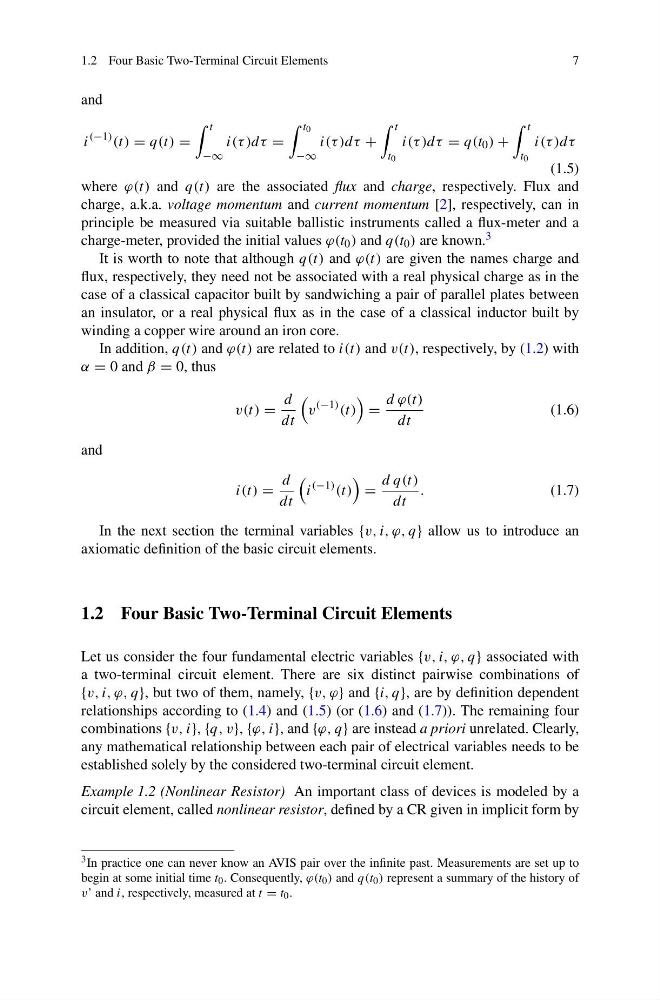
where ϕ(t) and q(t) are the associated flux and charge, respectively. Flux and
charge, a.k.a. voltage momentum and current momentum [2], respectively, can in
principle be measured via suitable ballistic instruments called a flux-meter and a
charge-meter, provided the initial values ϕ(t 0 ) and q(t 0 ) are known. 3
It is worth to note that although q(t) and ϕ(t) are given the names charge and
flux, respectively, they need not be associated with a real physical charge as in the
case of a classical capacitor built by sandwiching a pair of parallel plates between
an insulator, or a real physical flux as in the case of a classical inductor built by
winding a copper wire around an iron core.
In addition, q(t) and ϕ(t) are related to i(t) and v(t), respectively, by (1.2) with
α = 0 and β = 0, thus
v(t) =
d
dt
v
(−1) (t)
=
d ϕ(t)
dt
(1.6)
and
i(t) =
d
dt
i
(−1) (t)
=
d q(t)
dt
.
(1.7)
In the next section the terminal variables {v, i, ϕ, q} allow us to introduce an
axiomatic definition of the basic circuit elements.
1.2 Four Basic Two-Terminal Circuit Elements
Let us consider the four fundamental electric variables {v, i, ϕ, q} associated with
a two-terminal circuit element. There are six distinct pairwise combinations of
{v, i, ϕ, q}, but two of them, namely, {v, ϕ} and {i, q}, are by definition dependent
relationships according to (1.4) and (1.5) (or (1.6) and (1.7)). The remaining four
combinations {v, i}, {q, v}, {ϕ, i}, and {ϕ, q} are instead a priori unrelated. Clearly,
any mathematical relationship between each pair of electrical variables needs to be
established solely by the considered two-terminal circuit element.
Example 1.2 (Nonlinear Resistor) An important class of devices is modeled by a
circuit element, called nonlinear resistor, defined by a CR given in implicit form by
3 In practice one can never know an AVIS pair over the infinite past. Measurements are set up to
begin at some initial time t 0 . Consequently, ϕ(t 0 ) and q(t 0 ) represent a summary of the history of
v’ and i, respectively, measured at t = t 0 .
7
and
i
(−1) (t) = q(t) =
t
−∞
i(τ )dτ =
t 0
−∞
i(τ )dτ +
t
t 0
i(τ )dτ = q(t 0 ) +
t
t 0
i(τ )dτ
(1.5)
where ϕ(t) and q(t) are the associated flux and charge, respectively. Flux and
charge, a.k.a. voltage momentum and current momentum [2], respectively, can in
principle be measured via suitable ballistic instruments called a flux-meter and a
charge-meter, provided the initial values ϕ(t 0 ) and q(t 0 ) are known. 3
It is worth to note that although q(t) and ϕ(t) are given the names charge and
flux, respectively, they need not be associated with a real physical charge as in the
case of a classical capacitor built by sandwiching a pair of parallel plates between
an insulator, or a real physical flux as in the case of a classical inductor built by
winding a copper wire around an iron core.
In addition, q(t) and ϕ(t) are related to i(t) and v(t), respectively, by (1.2) with
α = 0 and β = 0, thus
v(t) =
d
dt
v
(−1) (t)
=
d ϕ(t)
dt
(1.6)
and
i(t) =
d
dt
i
(−1) (t)
=
d q(t)
dt
.
(1.7)
In the next section the terminal variables {v, i, ϕ, q} allow us to introduce an
axiomatic definition of the basic circuit elements.
1.2 Four Basic Two-Terminal Circuit Elements
Let us consider the four fundamental electric variables {v, i, ϕ, q} associated with
a two-terminal circuit element. There are six distinct pairwise combinations of
{v, i, ϕ, q}, but two of them, namely, {v, ϕ} and {i, q}, are by definition dependent
relationships according to (1.4) and (1.5) (or (1.6) and (1.7)). The remaining four
combinations {v, i}, {q, v}, {ϕ, i}, and {ϕ, q} are instead a priori unrelated. Clearly,
any mathematical relationship between each pair of electrical variables needs to be
established solely by the considered two-terminal circuit element.
Example 1.2 (Nonlinear Resistor) An important class of devices is modeled by a
circuit element, called nonlinear resistor, defined by a CR given in implicit form by
3 In practice one can never know an AVIS pair over the infinite past. Measurements are set up to
begin at some initial time t 0 . Consequently, ϕ(t 0 ) and q(t 0 ) represent a summary of the history of
v’ and i, respectively, measured at t = t 0 .