

312
7 Pulse Programming of Memristor Circuits
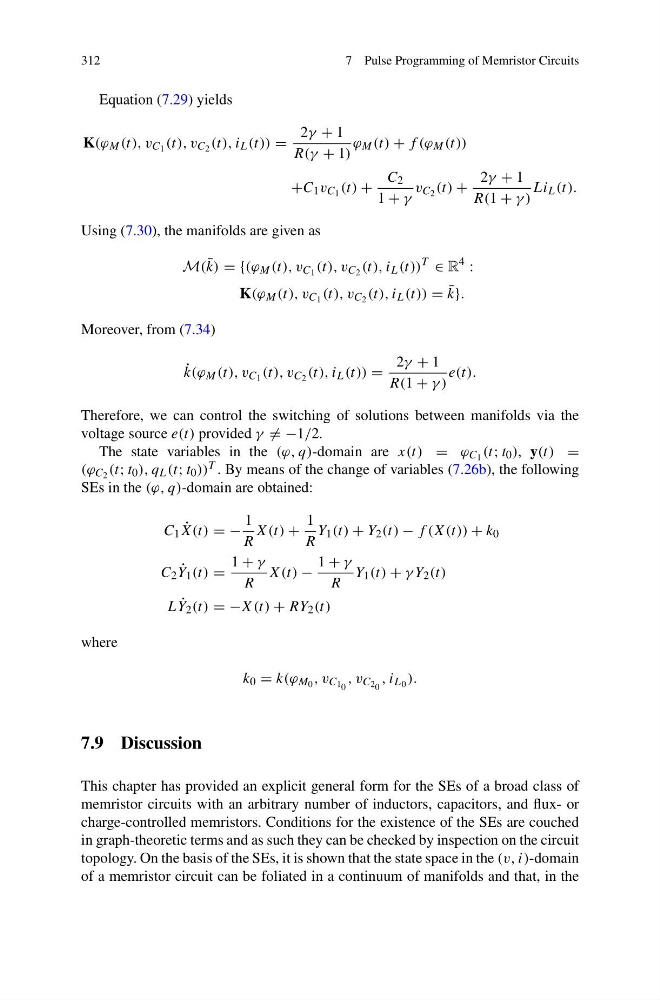
Equation (7.29) yields
K(ϕ M (t), v C 1 (t), v C 2 (t), i L (t)) =
2γ + 1
R(γ + 1)
ϕ M (t) + f (ϕ M (t))
+C 1 v C 1 (t) +
C 2
1 + γ
v C 2 (t) +
2γ + 1
R(1 + γ )
Li L (t).
Using (7.30), the manifolds are given as
M( ¯
k) = {(ϕ M (t), v C 1 (t), v C 2 (t), i L (t))
T
∈ R
4
:
K(ϕ M (t), v C 1 (t), v C 2 (t), i L (t)) = ¯
k}.
Moreover, from (7.34)
˙
k(ϕ M (t), v C 1 (t), v C 2 (t), i L (t)) =
2γ + 1
R(1 + γ )
e(t).
Therefore, we can control the switching of solutions between manifolds via the
voltage source e(t) provided γ = −1/2.
The state variables in the (ϕ, q)-domain are x(t) = ϕ C 1 (t; t 0 ), y(t) =
(ϕ C 2 (t; t 0 ), q L (t; t 0 )) T . By means of the change of variables (7.26b), the following
SEs in the (ϕ, q)-domain are obtained:
C 1 ˙
X(t) = −
1
R
X(t) +
1
R
Y 1 (t) + Y 2 (t) − f (X(t)) + k 0
C 2 ˙
Y 1 (t) =
1 + γ
R
X(t) −
1 + γ
R
Y 1 (t) + γ Y 2 (t)
L ˙
Y 2 (t) = −X(t) + RY 2 (t)
where
k 0 = k(ϕ M 0 , v C 1 0 , v C 2 0 , i L 0 ).
7.9 Discussion
This chapter has provided an explicit general form for the SEs of a broad class of
memristor circuits with an arbitrary number of inductors, capacitors, and flux- or
charge-controlled memristors. Conditions for the existence of the SEs are couched
in graph-theoretic terms and as such they can be checked by inspection on the circuit
topology. On the basis of the SEs, it is shown that the state space in the (v, i)-domain
of a memristor circuit can be foliated in a continuum of manifolds and that, in the
7 Pulse Programming of Memristor Circuits
Equation (7.29) yields
K(ϕ M (t), v C 1 (t), v C 2 (t), i L (t)) =
2γ + 1
R(γ + 1)
ϕ M (t) + f (ϕ M (t))
+C 1 v C 1 (t) +
C 2
1 + γ
v C 2 (t) +
2γ + 1
R(1 + γ )
Li L (t).
Using (7.30), the manifolds are given as
M( ¯
k) = {(ϕ M (t), v C 1 (t), v C 2 (t), i L (t))
T
∈ R
4
:
K(ϕ M (t), v C 1 (t), v C 2 (t), i L (t)) = ¯
k}.
Moreover, from (7.34)
˙
k(ϕ M (t), v C 1 (t), v C 2 (t), i L (t)) =
2γ + 1
R(1 + γ )
e(t).
Therefore, we can control the switching of solutions between manifolds via the
voltage source e(t) provided γ = −1/2.
The state variables in the (ϕ, q)-domain are x(t) = ϕ C 1 (t; t 0 ), y(t) =
(ϕ C 2 (t; t 0 ), q L (t; t 0 )) T . By means of the change of variables (7.26b), the following
SEs in the (ϕ, q)-domain are obtained:
C 1 ˙
X(t) = −
1
R
X(t) +
1
R
Y 1 (t) + Y 2 (t) − f (X(t)) + k 0
C 2 ˙
Y 1 (t) =
1 + γ
R
X(t) −
1 + γ
R
Y 1 (t) + γ Y 2 (t)
L ˙
Y 2 (t) = −X(t) + RY 2 (t)
where
k 0 = k(ϕ M 0 , v C 1 0 , v C 2 0 , i L 0 ).
7.9 Discussion
This chapter has provided an explicit general form for the SEs of a broad class of
memristor circuits with an arbitrary number of inductors, capacitors, and flux- or
charge-controlled memristors. Conditions for the existence of the SEs are couched
in graph-theoretic terms and as such they can be checked by inspection on the circuit
topology. On the basis of the SEs, it is shown that the state space in the (v, i)-domain
of a memristor circuit can be foliated in a continuum of manifolds and that, in the