

7.5 Analysis of Manifolds
295
In Sect. 7.6, the r.h.s. of (7.34) (or equivalently (7.35)) is specified by voltage
and/or current sources exploited in practical applications of memristor circuits.
7.5.3 Manifolds in a Relevant Class of Memristor Circuits
The results derived so far can be rewritten in a simplified form for the relevant
class of memristor circuits N = N D
N R having a capacitor in parallel to any
flux-controlled memristor and/or an inductor in series with any charge-controlled
memristor. This means that N D has only elements D
ϕ
M and D
q
M , i.e., γ G = γ C =
λ R = λ L = μ F = μ Q = ρ G = ρ R = 0. It follows that n y = 0 and that (A2),
(A3) are satisfied. Note that H coincides with H 11 , hence also (A4) is satisfied. In
addition, M x = M and u x (t) = u(t) = B 11 ϕ e (t; t 0 ) + B 12 q a (t; t 0 ).
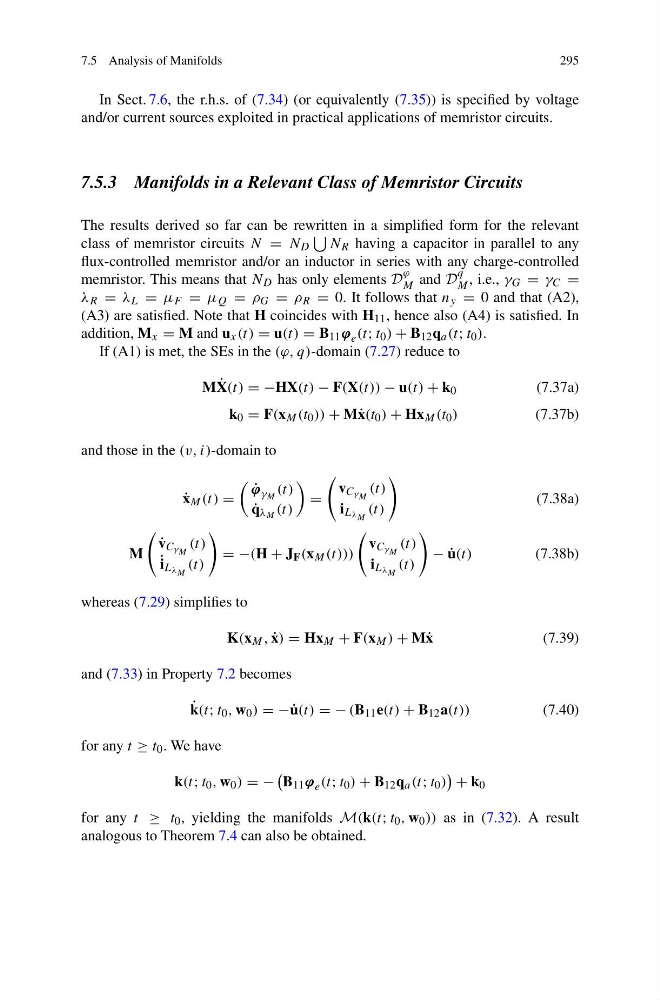
If (A1) is met, the SEs in the (ϕ, q)-domain (7.27) reduce to
M ˙
X(t) = −HX(t) − F(X(t)) − u(t) + k 0
(7.37a)
k 0 = F(x M (t 0 )) + M˙ x(t 0 ) + Hx M (t 0 )
(7.37b)
and those in the (v, i)-domain to
˙
x M (t) =
˙
ϕ γ M (t)
˙
q λ M (t)
=
v C γ M (t)
i L λ M (t)
(7.38a)
M
˙
v C γ M (t)
˙ i L λ M (t)
= −(H + J F (x M (t)))
v C γ M (t)
i L λ M (t)
− ˙
u(t)
(7.38b)
whereas (7.29) simplifies to
K(x M , ˙
x) = Hx M + F(x M ) + M˙ x
(7.39)
and (7.33) in Property 7.2 becomes
˙
k(t; t 0 , w 0 ) = −˙ u(t) = − (B 11 e(t) + B 12 a(t))
(7.40)
for any t ≥ t 0 . We have
k(t; t 0 , w 0 ) = −
B 11 ϕ e (t; t 0 ) + B 12 q a (t; t 0 )
+ k 0
for any t ≥ t 0 , yielding the manifolds M(k(t; t 0 , w 0 )) as in (7.32). A result
analogous to Theorem 7.4 can also be obtained.
295
In Sect. 7.6, the r.h.s. of (7.34) (or equivalently (7.35)) is specified by voltage
and/or current sources exploited in practical applications of memristor circuits.
7.5.3 Manifolds in a Relevant Class of Memristor Circuits
The results derived so far can be rewritten in a simplified form for the relevant
class of memristor circuits N = N D
N R having a capacitor in parallel to any
flux-controlled memristor and/or an inductor in series with any charge-controlled
memristor. This means that N D has only elements D
ϕ
M and D
q
M , i.e., γ G = γ C =
λ R = λ L = μ F = μ Q = ρ G = ρ R = 0. It follows that n y = 0 and that (A2),
(A3) are satisfied. Note that H coincides with H 11 , hence also (A4) is satisfied. In
addition, M x = M and u x (t) = u(t) = B 11 ϕ e (t; t 0 ) + B 12 q a (t; t 0 ).
If (A1) is met, the SEs in the (ϕ, q)-domain (7.27) reduce to
M ˙
X(t) = −HX(t) − F(X(t)) − u(t) + k 0
(7.37a)
k 0 = F(x M (t 0 )) + M˙ x(t 0 ) + Hx M (t 0 )
(7.37b)
and those in the (v, i)-domain to
˙
x M (t) =
˙
ϕ γ M (t)
˙
q λ M (t)
=
v C γ M (t)
i L λ M (t)
(7.38a)
M
˙
v C γ M (t)
˙ i L λ M (t)
= −(H + J F (x M (t)))
v C γ M (t)
i L λ M (t)
− ˙
u(t)
(7.38b)
whereas (7.29) simplifies to
K(x M , ˙
x) = Hx M + F(x M ) + M˙ x
(7.39)
and (7.33) in Property 7.2 becomes
˙
k(t; t 0 , w 0 ) = −˙ u(t) = − (B 11 e(t) + B 12 a(t))
(7.40)
for any t ≥ t 0 . We have
k(t; t 0 , w 0 ) = −
B 11 ϕ e (t; t 0 ) + B 12 q a (t; t 0 )
+ k 0
for any t ≥ t 0 , yielding the manifolds M(k(t; t 0 , w 0 )) as in (7.32). A result
analogous to Theorem 7.4 can also be obtained.