

282
7 Pulse Programming of Memristor Circuits
⎛
⎜
⎜
⎜
⎜
⎜
⎜
⎜
⎜
⎜
⎜
⎜
⎜
⎜
⎜
⎜
⎜
⎝
q γ M (t; t 0 )
ϕ λ M (t; t 0 )
q γ G (t; t 0 )
ϕ λ R (t; t 0 )
q γ C (t; t 0 )
ϕ λ L (t; t 0 )
ϕ μ Q (t; t 0 )
q μ F (t; t 0 )
ϕ ρ R (t; t 0 )
q ρ G (t; t 0 )
⎞
⎟
⎟
⎟
⎟
⎟
⎟
⎟
⎟
⎟
⎟
⎟
⎟
⎟
⎟
⎟
⎟
⎠
= H R
⎛
⎜
⎜
⎜
⎜
⎜
⎜
⎜
⎜
⎜
⎜
⎜
⎜
⎜
⎜
⎜
⎜
⎝
ϕ γ M (t; t 0 )
q λ M (t; t 0 )
ϕ γ G (t; t 0 )
q λ R (t; t 0 )
ϕ γ C (t; t 0 )
q λ L (t; t 0 )
q μ Q (t; t 0 )
ϕ μ F (t; t 0 )
q ρ R (t; t 0 )
ϕ ρ G (t; t 0 )
⎞
⎟
⎟
⎟
⎟
⎟
⎟
⎟
⎟
⎟
⎟
⎟
⎟
⎟
⎟
⎟
⎟
⎠
+ u(t; t 0 )
(7.12)
where
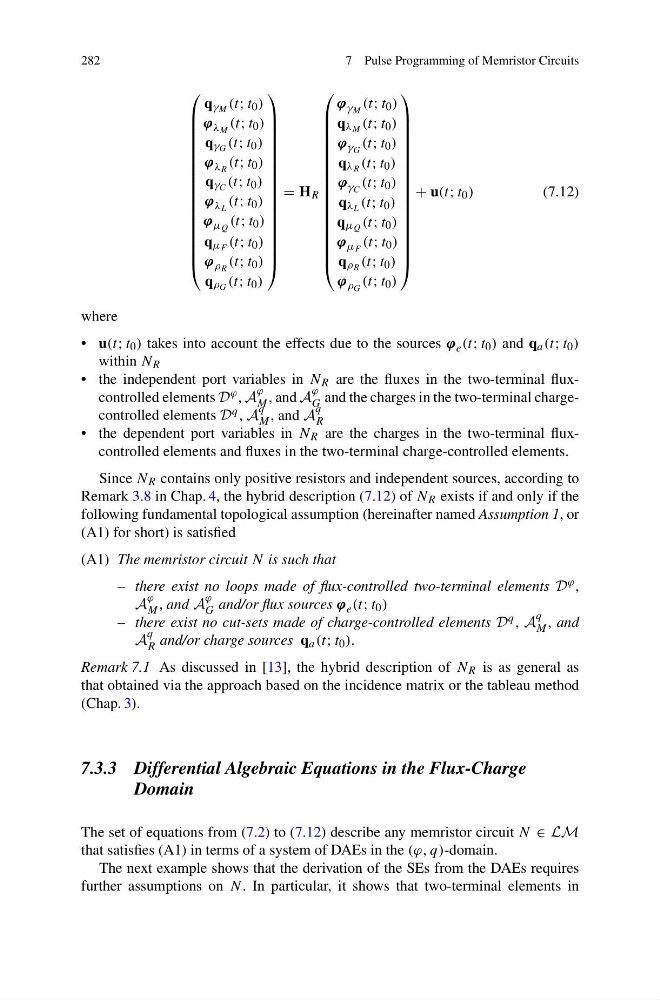
• u(t; t 0 ) takes into account the effects due to the sources ϕ e (t; t 0 ) and q a (t; t 0 )
within N R
• the independent port variables in N R are the fluxes in the two-terminal fluxcontrolled elements D ϕ , A
ϕ
M , and A
ϕ
G and the charges in the two-terminal chargecontrolled elements D q , A
q
M , and A
q
R
• the dependent port variables in N R are the charges in the two-terminal fluxcontrolled elements and fluxes in the two-terminal charge-controlled elements.
Since N R contains only positive resistors and independent sources, according to
Remark 3.8 in Chap. 4, the hybrid description (7.12) of N R exists if and only if the
following fundamental topological assumption (hereinafter named Assumption 1, or
(A1) for short) is satisfied
(A1) The memristor circuit N is such that
– there exist no loops made of flux-controlled two-terminal elements D ϕ ,
A
ϕ
M , and A
ϕ
G and/or flux sources ϕ e (t; t 0 )
– there exist no cut-sets made of charge-controlled elements D q , A
q
M , and
A
q
R and/or charge sources q a (t; t 0 ).
Remark 7.1 As discussed in [13], the hybrid description of N R is as general as
that obtained via the approach based on the incidence matrix or the tableau method
(Chap. 3).
7.3.3 Differential Algebraic Equations in the Flux-Charge
Domain
The set of equations from (7.2) to (7.12) describe any memristor circuit N ∈ LM
that satisfies (A1) in terms of a system of DAEs in the (ϕ, q)-domain.
The next example shows that the derivation of the SEs from the DAEs requires
further assumptions on N. In particular, it shows that two-terminal elements in
7 Pulse Programming of Memristor Circuits
⎛
⎜
⎜
⎜
⎜
⎜
⎜
⎜
⎜
⎜
⎜
⎜
⎜
⎜
⎜
⎜
⎜
⎝
q γ M (t; t 0 )
ϕ λ M (t; t 0 )
q γ G (t; t 0 )
ϕ λ R (t; t 0 )
q γ C (t; t 0 )
ϕ λ L (t; t 0 )
ϕ μ Q (t; t 0 )
q μ F (t; t 0 )
ϕ ρ R (t; t 0 )
q ρ G (t; t 0 )
⎞
⎟
⎟
⎟
⎟
⎟
⎟
⎟
⎟
⎟
⎟
⎟
⎟
⎟
⎟
⎟
⎟
⎠
= H R
⎛
⎜
⎜
⎜
⎜
⎜
⎜
⎜
⎜
⎜
⎜
⎜
⎜
⎜
⎜
⎜
⎜
⎝
ϕ γ M (t; t 0 )
q λ M (t; t 0 )
ϕ γ G (t; t 0 )
q λ R (t; t 0 )
ϕ γ C (t; t 0 )
q λ L (t; t 0 )
q μ Q (t; t 0 )
ϕ μ F (t; t 0 )
q ρ R (t; t 0 )
ϕ ρ G (t; t 0 )
⎞
⎟
⎟
⎟
⎟
⎟
⎟
⎟
⎟
⎟
⎟
⎟
⎟
⎟
⎟
⎟
⎟
⎠
+ u(t; t 0 )
(7.12)
where
• u(t; t 0 ) takes into account the effects due to the sources ϕ e (t; t 0 ) and q a (t; t 0 )
within N R
• the independent port variables in N R are the fluxes in the two-terminal fluxcontrolled elements D ϕ , A
ϕ
M , and A
ϕ
G and the charges in the two-terminal chargecontrolled elements D q , A
q
M , and A
q
R
• the dependent port variables in N R are the charges in the two-terminal fluxcontrolled elements and fluxes in the two-terminal charge-controlled elements.
Since N R contains only positive resistors and independent sources, according to
Remark 3.8 in Chap. 4, the hybrid description (7.12) of N R exists if and only if the
following fundamental topological assumption (hereinafter named Assumption 1, or
(A1) for short) is satisfied
(A1) The memristor circuit N is such that
– there exist no loops made of flux-controlled two-terminal elements D ϕ ,
A
ϕ
M , and A
ϕ
G and/or flux sources ϕ e (t; t 0 )
– there exist no cut-sets made of charge-controlled elements D q , A
q
M , and
A
q
R and/or charge sources q a (t; t 0 ).
Remark 7.1 As discussed in [13], the hybrid description of N R is as general as
that obtained via the approach based on the incidence matrix or the tableau method
(Chap. 3).
7.3.3 Differential Algebraic Equations in the Flux-Charge
Domain
The set of equations from (7.2) to (7.12) describe any memristor circuit N ∈ LM
that satisfies (A1) in terms of a system of DAEs in the (ϕ, q)-domain.
The next example shows that the derivation of the SEs from the DAEs requires
further assumptions on N. In particular, it shows that two-terminal elements in