

250
6 Memristor Circuits: Invariant Manifolds, Coexisting Attractors, Extreme. . .
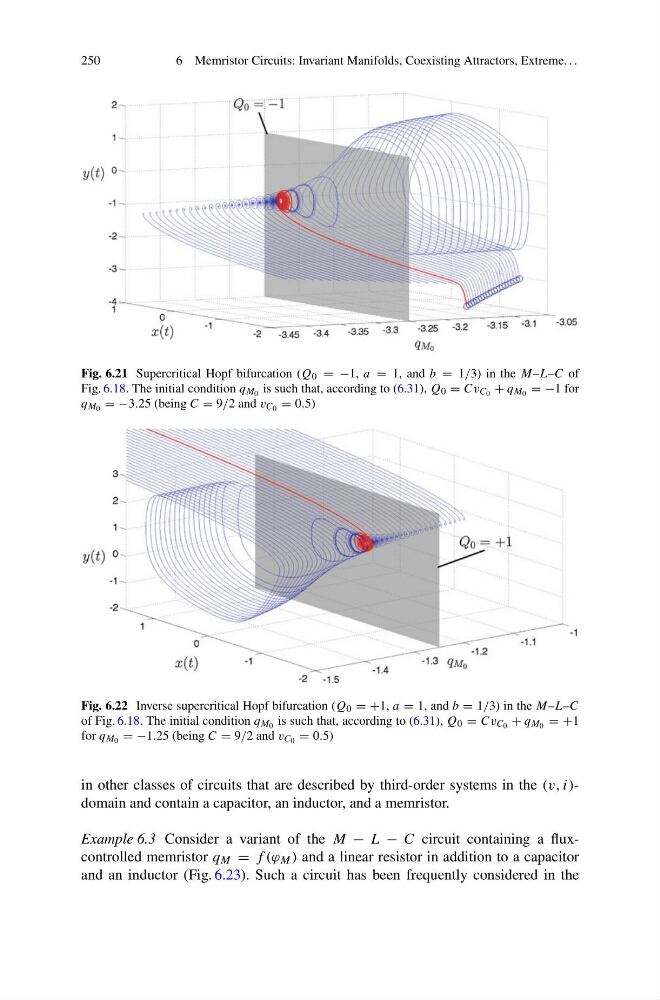
Fig. 6.21 Supercritical Hopf bifurcation (Q 0 = −1, a = 1, and b = 1/3) in the M–L–C of
Fig. 6.18. The initial condition q M 0 is such that, according to (6.31), Q 0 = Cv C 0 + q M 0 = −1 for
q M 0 = −3.25 (being C = 9/2 and v C 0 = 0.5)
Fig. 6.22 Inverse supercritical Hopf bifurcation (Q 0 = +1, a = 1, and b = 1/3) in the M–L–C
of Fig. 6.18. The initial condition q M 0 is such that, according to (6.31), Q 0 = Cv C 0 + q M 0 = +1
for q M 0 = −1.25 (being C = 9/2 and v C 0 = 0.5)
in other classes of circuits that are described by third-order systems in the (v, i)domain and contain a capacitor, an inductor, and a memristor.
Example 6.3 Consider a variant of the M − L − C circuit containing a fluxcontrolled memristor q M = f (ϕ M ) and a linear resistor in addition to a capacitor
and an inductor (Fig. 6.23). Such a circuit has been frequently considered in the
6 Memristor Circuits: Invariant Manifolds, Coexisting Attractors, Extreme. . .
Fig. 6.21 Supercritical Hopf bifurcation (Q 0 = −1, a = 1, and b = 1/3) in the M–L–C of
Fig. 6.18. The initial condition q M 0 is such that, according to (6.31), Q 0 = Cv C 0 + q M 0 = −1 for
q M 0 = −3.25 (being C = 9/2 and v C 0 = 0.5)
Fig. 6.22 Inverse supercritical Hopf bifurcation (Q 0 = +1, a = 1, and b = 1/3) in the M–L–C
of Fig. 6.18. The initial condition q M 0 is such that, according to (6.31), Q 0 = Cv C 0 + q M 0 = +1
for q M 0 = −1.25 (being C = 9/2 and v C 0 = 0.5)
in other classes of circuits that are described by third-order systems in the (v, i)domain and contain a capacitor, an inductor, and a memristor.
Example 6.3 Consider a variant of the M − L − C circuit containing a fluxcontrolled memristor q M = f (ϕ M ) and a linear resistor in addition to a capacitor
and an inductor (Fig. 6.23). Such a circuit has been frequently considered in the