

226
6 Memristor Circuits: Invariant Manifolds, Coexisting Attractors, Extreme. . .
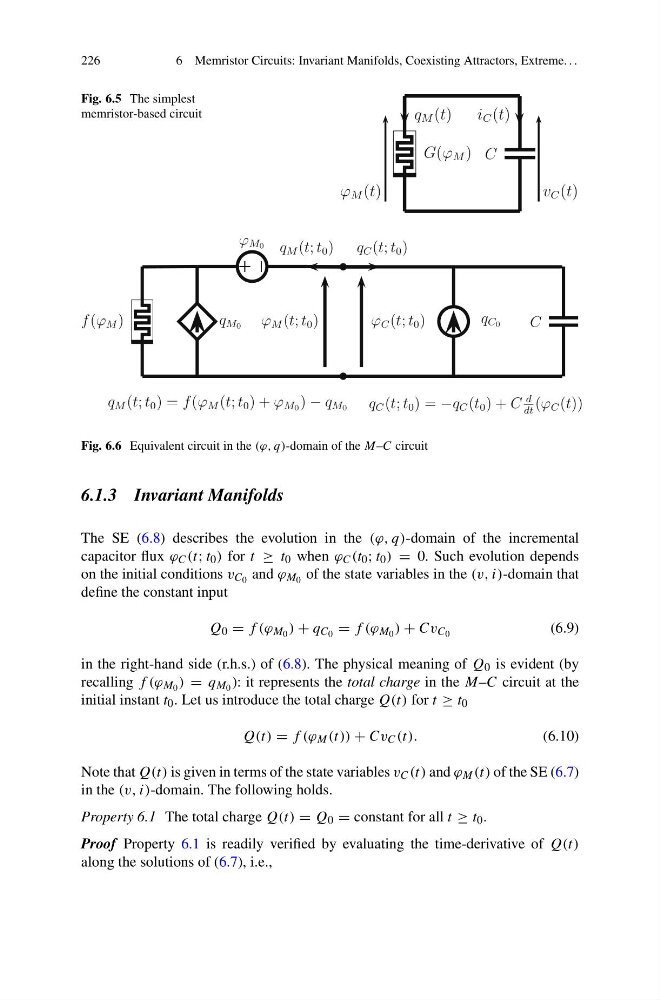
Fig. 6.5 The simplest
memristor-based circuit
G(ϕ M ) C
i C (t)
q M (t)
v C (t)
ϕ M (t)
q M0
ϕ M0
f (ϕ M )
q M (t; t 0 )
ϕ M (t; t 0 )
q C0
C
q C (t; t 0 )
ϕ C (t; t 0 )
q M (t; t 0 ) = f (ϕ M (t; t 0 ) + ϕ M0 ) − q M0 q C (t; t 0 ) = −q C (t 0 ) + C
d
dt
(ϕ C (t))
Fig. 6.6 Equivalent circuit in the (ϕ, q)-domain of the M–C circuit
6.1.3 Invariant Manifolds
The SE (6.8) describes the evolution in the (ϕ, q)-domain of the incremental
capacitor flux ϕ C (t; t 0 ) for t ≥ t 0 when ϕ C (t 0 ; t 0 ) = 0. Such evolution depends
on the initial conditions v C 0 and ϕ M 0 of the state variables in the (v, i)-domain that
define the constant input
Q 0 = f (ϕ M 0 ) + q C 0 = f (ϕ M 0 ) + Cv C 0
(6.9)
in the right-hand side (r.h.s.) of (6.8). The physical meaning of Q 0 is evident (by
recalling f (ϕ M 0 ) = q M 0 ): it represents the total charge in the M–C circuit at the
initial instant t 0 . Let us introduce the total charge Q(t) for t ≥ t 0
Q(t) = f (ϕ M (t)) + Cv C (t).
(6.10)
Note that Q(t) is given in terms of the state variables v C (t) and ϕ M (t) of the SE (6.7)
in the (v, i)-domain. The following holds.
Property 6.1 The total charge Q(t) = Q 0 = constant for all t ≥ t 0 .
Proof Property 6.1 is readily verified by evaluating the time-derivative of Q(t)
along the solutions of (6.7), i.e.,
6 Memristor Circuits: Invariant Manifolds, Coexisting Attractors, Extreme. . .
Fig. 6.5 The simplest
memristor-based circuit
G(ϕ M ) C
i C (t)
q M (t)
v C (t)
ϕ M (t)
q M0
ϕ M0
f (ϕ M )
q M (t; t 0 )
ϕ M (t; t 0 )
q C0
C
q C (t; t 0 )
ϕ C (t; t 0 )
q M (t; t 0 ) = f (ϕ M (t; t 0 ) + ϕ M0 ) − q M0 q C (t; t 0 ) = −q C (t 0 ) + C
d
dt
(ϕ C (t))
Fig. 6.6 Equivalent circuit in the (ϕ, q)-domain of the M–C circuit
6.1.3 Invariant Manifolds
The SE (6.8) describes the evolution in the (ϕ, q)-domain of the incremental
capacitor flux ϕ C (t; t 0 ) for t ≥ t 0 when ϕ C (t 0 ; t 0 ) = 0. Such evolution depends
on the initial conditions v C 0 and ϕ M 0 of the state variables in the (v, i)-domain that
define the constant input
Q 0 = f (ϕ M 0 ) + q C 0 = f (ϕ M 0 ) + Cv C 0
(6.9)
in the right-hand side (r.h.s.) of (6.8). The physical meaning of Q 0 is evident (by
recalling f (ϕ M 0 ) = q M 0 ): it represents the total charge in the M–C circuit at the
initial instant t 0 . Let us introduce the total charge Q(t) for t ≥ t 0
Q(t) = f (ϕ M (t)) + Cv C (t).
(6.10)
Note that Q(t) is given in terms of the state variables v C (t) and ϕ M (t) of the SE (6.7)
in the (v, i)-domain. The following holds.
Property 6.1 The total charge Q(t) = Q 0 = constant for all t ≥ t 0 .
Proof Property 6.1 is readily verified by evaluating the time-derivative of Q(t)
along the solutions of (6.7), i.e.,