

216
5 Flux-Charge Analysis Method of Memristor Circuits
and
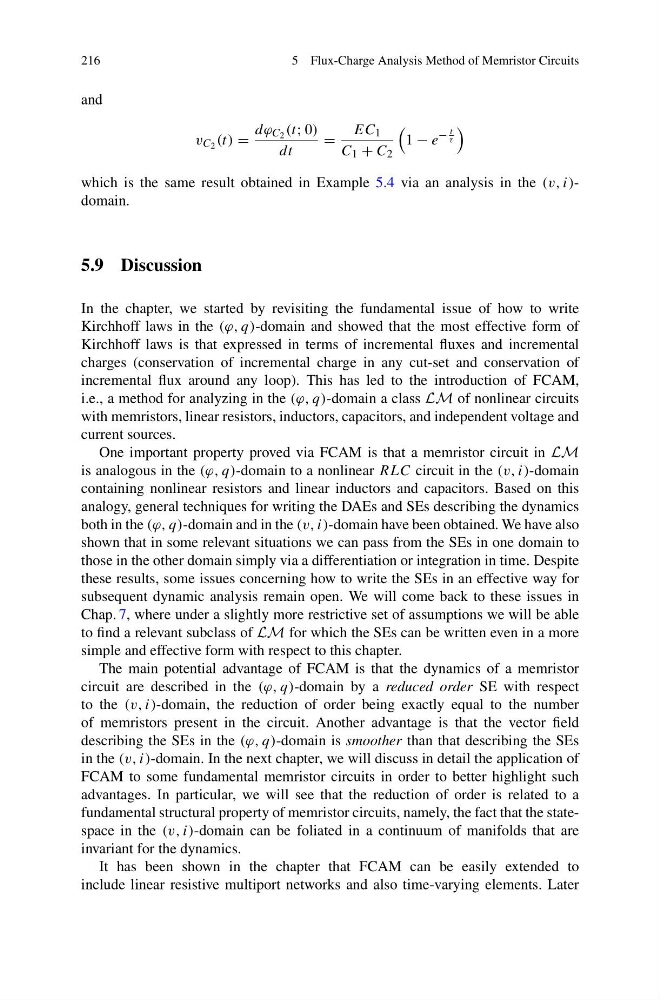
v C 2 (t) =
dϕ C 2 (t; 0)
dt
=
EC 1
C 1 + C 2
1 − e
−
t
τ
which is the same result obtained in Example 5.4 via an analysis in the (v, i)domain.
5.9 Discussion
In the chapter, we started by revisiting the fundamental issue of how to write
Kirchhoff laws in the (ϕ, q)-domain and showed that the most effective form of
Kirchhoff laws is that expressed in terms of incremental fluxes and incremental
charges (conservation of incremental charge in any cut-set and conservation of
incremental flux around any loop). This has led to the introduction of FCAM,
i.e., a method for analyzing in the (ϕ, q)-domain a class LM of nonlinear circuits
with memristors, linear resistors, inductors, capacitors, and independent voltage and
current sources.
One important property proved via FCAM is that a memristor circuit in LM
is analogous in the (ϕ, q)-domain to a nonlinear RLC circuit in the (v, i)-domain
containing nonlinear resistors and linear inductors and capacitors. Based on this
analogy, general techniques for writing the DAEs and SEs describing the dynamics
both in the (ϕ, q)-domain and in the (v, i)-domain have been obtained. We have also
shown that in some relevant situations we can pass from the SEs in one domain to
those in the other domain simply via a differentiation or integration in time. Despite
these results, some issues concerning how to write the SEs in an effective way for
subsequent dynamic analysis remain open. We will come back to these issues in
Chap. 7, where under a slightly more restrictive set of assumptions we will be able
to find a relevant subclass of LM for which the SEs can be written even in a more
simple and effective form with respect to this chapter.
The main potential advantage of FCAM is that the dynamics of a memristor
circuit are described in the (ϕ, q)-domain by a reduced order SE with respect
to the (v, i)-domain, the reduction of order being exactly equal to the number
of memristors present in the circuit. Another advantage is that the vector field
describing the SEs in the (ϕ, q)-domain is smoother than that describing the SEs
in the (v, i)-domain. In the next chapter, we will discuss in detail the application of
FCAM to some fundamental memristor circuits in order to better highlight such
advantages. In particular, we will see that the reduction of order is related to a
fundamental structural property of memristor circuits, namely, the fact that the statespace in the (v, i)-domain can be foliated in a continuum of manifolds that are
invariant for the dynamics.
It has been shown in the chapter that FCAM can be easily extended to
include linear resistive multiport networks and also time-varying elements. Later
5 Flux-Charge Analysis Method of Memristor Circuits
and
v C 2 (t) =
dϕ C 2 (t; 0)
dt
=
EC 1
C 1 + C 2
1 − e
−
t
τ
which is the same result obtained in Example 5.4 via an analysis in the (v, i)domain.
5.9 Discussion
In the chapter, we started by revisiting the fundamental issue of how to write
Kirchhoff laws in the (ϕ, q)-domain and showed that the most effective form of
Kirchhoff laws is that expressed in terms of incremental fluxes and incremental
charges (conservation of incremental charge in any cut-set and conservation of
incremental flux around any loop). This has led to the introduction of FCAM,
i.e., a method for analyzing in the (ϕ, q)-domain a class LM of nonlinear circuits
with memristors, linear resistors, inductors, capacitors, and independent voltage and
current sources.
One important property proved via FCAM is that a memristor circuit in LM
is analogous in the (ϕ, q)-domain to a nonlinear RLC circuit in the (v, i)-domain
containing nonlinear resistors and linear inductors and capacitors. Based on this
analogy, general techniques for writing the DAEs and SEs describing the dynamics
both in the (ϕ, q)-domain and in the (v, i)-domain have been obtained. We have also
shown that in some relevant situations we can pass from the SEs in one domain to
those in the other domain simply via a differentiation or integration in time. Despite
these results, some issues concerning how to write the SEs in an effective way for
subsequent dynamic analysis remain open. We will come back to these issues in
Chap. 7, where under a slightly more restrictive set of assumptions we will be able
to find a relevant subclass of LM for which the SEs can be written even in a more
simple and effective form with respect to this chapter.
The main potential advantage of FCAM is that the dynamics of a memristor
circuit are described in the (ϕ, q)-domain by a reduced order SE with respect
to the (v, i)-domain, the reduction of order being exactly equal to the number
of memristors present in the circuit. Another advantage is that the vector field
describing the SEs in the (ϕ, q)-domain is smoother than that describing the SEs
in the (v, i)-domain. In the next chapter, we will discuss in detail the application of
FCAM to some fundamental memristor circuits in order to better highlight such
advantages. In particular, we will see that the reduction of order is related to a
fundamental structural property of memristor circuits, namely, the fact that the statespace in the (v, i)-domain can be foliated in a continuum of manifolds that are
invariant for the dynamics.
It has been shown in the chapter that FCAM can be easily extended to
include linear resistive multiport networks and also time-varying elements. Later