

212
5 Flux-Charge Analysis Method of Memristor Circuits
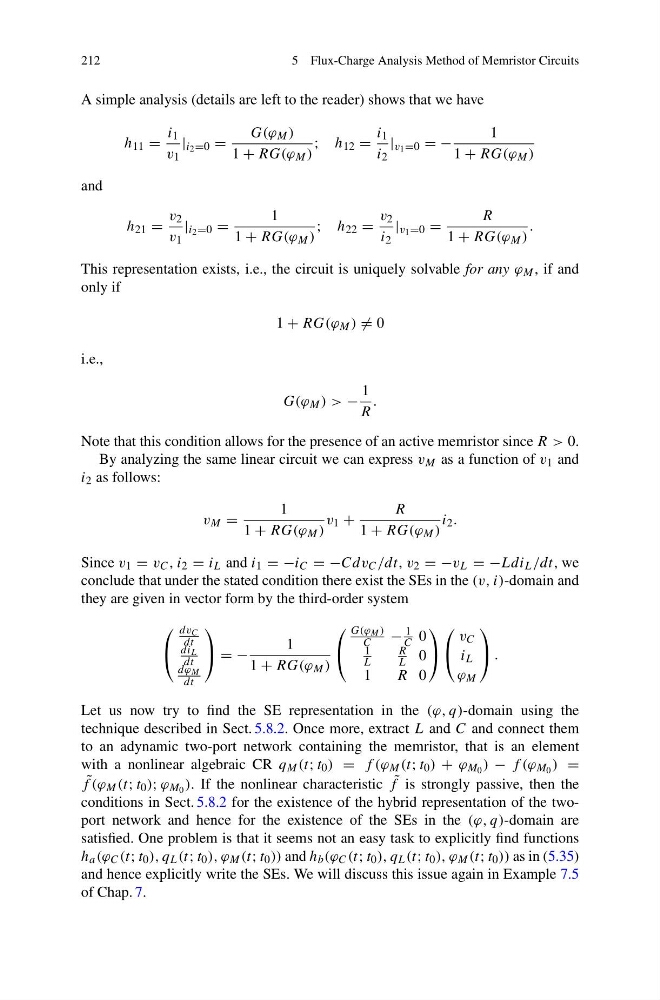
A simple analysis (details are left to the reader) shows that we have
h 11 =
i 1
v 1
| i 2 =0 =
G(ϕ M )
1 + RG(ϕ M )
; h 12 =
i 1
i 2
| v 1 =0 = −
1
1 + RG(ϕ M )
and
h 21 =
v 2
v 1
| i 2 =0 =
1
1 + RG(ϕ M )
; h 22 =
v 2
i 2
| v 1 =0 =
R
1 + RG(ϕ M )
.
This representation exists, i.e., the circuit is uniquely solvable for any ϕ M , if and
only if
1 + RG(ϕ M ) = 0
i.e.,
G(ϕ M ) > −
1
R
.
Note that this condition allows for the presence of an active memristor since R > 0.
By analyzing the same linear circuit we can express v M as a function of v 1 and
i 2 as follows:
v M =
1
1 + RG(ϕ M )
v 1 +
R
1 + RG(ϕ M )
i 2 .
Since v 1 = v C , i 2 = i L and i 1 = −i C = −Cdv C /dt, v 2 = −v L = −Ldi L /dt, we
conclude that under the stated condition there exist the SEs in the (v, i)-domain and
they are given in vector form by the third-order system
⎛
⎝
dv C
dt
di L
dt
dϕ M
dt
⎞
⎠ = −
1
1 + RG(ϕ M )
⎛
⎝
G(ϕ M )
C
−
1
C 0
1
L
R
L 0
1
R 0
⎞
⎠
⎛
⎝
v C
i L
ϕ M
⎞
⎠ .
Let us now try to find the SE representation in the (ϕ, q)-domain using the
technique described in Sect. 5.8.2. Once more, extract L and C and connect them
to an adynamic two-port network containing the memristor, that is an element
with a nonlinear algebraic CR q M (t; t 0 ) = f (ϕ M (t; t 0 ) + ϕ M 0 ) − f (ϕ M 0 ) =
˜
f (ϕ M (t; t 0 ); ϕ M 0 ). If the nonlinear characteristic ˜
f is strongly passive, then the
conditions in Sect. 5.8.2 for the existence of the hybrid representation of the twoport network and hence for the existence of the SEs in the (ϕ, q)-domain are
satisfied. One problem is that it seems not an easy task to explicitly find functions
h a (ϕ C (t; t 0 ), q L (t; t 0 ), ϕ M (t; t 0 )) and h b (ϕ C (t; t 0 ), q L (t; t 0 ), ϕ M (t; t 0 )) as in (5.35)
and hence explicitly write the SEs. We will discuss this issue again in Example 7.5
of Chap. 7.
5 Flux-Charge Analysis Method of Memristor Circuits
A simple analysis (details are left to the reader) shows that we have
h 11 =
i 1
v 1
| i 2 =0 =
G(ϕ M )
1 + RG(ϕ M )
; h 12 =
i 1
i 2
| v 1 =0 = −
1
1 + RG(ϕ M )
and
h 21 =
v 2
v 1
| i 2 =0 =
1
1 + RG(ϕ M )
; h 22 =
v 2
i 2
| v 1 =0 =
R
1 + RG(ϕ M )
.
This representation exists, i.e., the circuit is uniquely solvable for any ϕ M , if and
only if
1 + RG(ϕ M ) = 0
i.e.,
G(ϕ M ) > −
1
R
.
Note that this condition allows for the presence of an active memristor since R > 0.
By analyzing the same linear circuit we can express v M as a function of v 1 and
i 2 as follows:
v M =
1
1 + RG(ϕ M )
v 1 +
R
1 + RG(ϕ M )
i 2 .
Since v 1 = v C , i 2 = i L and i 1 = −i C = −Cdv C /dt, v 2 = −v L = −Ldi L /dt, we
conclude that under the stated condition there exist the SEs in the (v, i)-domain and
they are given in vector form by the third-order system
⎛
⎝
dv C
dt
di L
dt
dϕ M
dt
⎞
⎠ = −
1
1 + RG(ϕ M )
⎛
⎝
G(ϕ M )
C
−
1
C 0
1
L
R
L 0
1
R 0
⎞
⎠
⎛
⎝
v C
i L
ϕ M
⎞
⎠ .
Let us now try to find the SE representation in the (ϕ, q)-domain using the
technique described in Sect. 5.8.2. Once more, extract L and C and connect them
to an adynamic two-port network containing the memristor, that is an element
with a nonlinear algebraic CR q M (t; t 0 ) = f (ϕ M (t; t 0 ) + ϕ M 0 ) − f (ϕ M 0 ) =
˜
f (ϕ M (t; t 0 ); ϕ M 0 ). If the nonlinear characteristic ˜
f is strongly passive, then the
conditions in Sect. 5.8.2 for the existence of the hybrid representation of the twoport network and hence for the existence of the SEs in the (ϕ, q)-domain are
satisfied. One problem is that it seems not an easy task to explicitly find functions
h a (ϕ C (t; t 0 ), q L (t; t 0 ), ϕ M (t; t 0 )) and h b (ϕ C (t; t 0 ), q L (t; t 0 ), ϕ M (t; t 0 )) as in (5.35)
and hence explicitly write the SEs. We will discuss this issue again in Example 7.5
of Chap. 7.