

5.6 Extension of FCAM
191
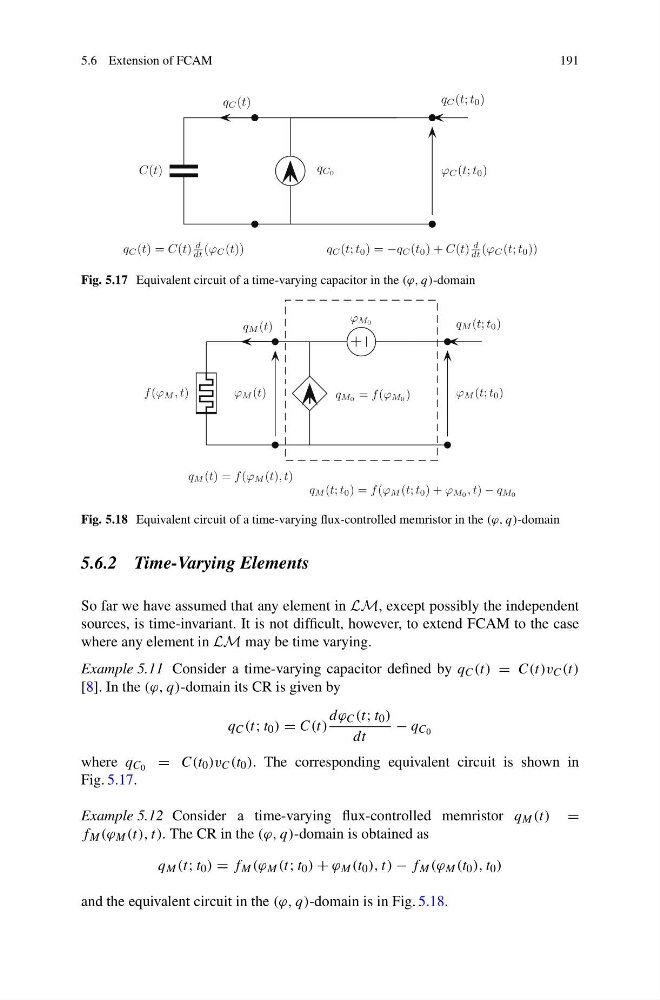
Fig. 5.17 Equivalent circuit of a time-varying capacitor in the (ϕ, q)-domain
Fig. 5.18 Equivalent circuit of a time-varying flux-controlled memristor in the (ϕ, q)-domain
5.6.2 Time-Varying Elements
So far we have assumed that any element in LM, except possibly the independent
sources, is time-invariant. It is not difficult, however, to extend FCAM to the case
where any element in LM may be time varying.
Example 5.11 Consider a time-varying capacitor defined by q C (t) = C(t)v C (t)
[8]. In the (ϕ, q)-domain its CR is given by
q C (t; t 0 ) = C(t)
dϕ C (t; t 0 )
dt
− q C 0
where q C 0 = C(t 0 )v C (t 0 ). The corresponding equivalent circuit is shown in
Fig. 5.17.
Example 5.12 Consider a time-varying flux-controlled memristor q M (t) =
f M (ϕ M (t), t). The CR in the (ϕ, q)-domain is obtained as
q M (t; t 0 ) = f M (ϕ M (t; t 0 ) + ϕ M (t 0 ), t) − f M (ϕ M (t 0 ), t 0 )
and the equivalent circuit in the (ϕ, q)-domain is in Fig. 5.18.
191
Fig. 5.17 Equivalent circuit of a time-varying capacitor in the (ϕ, q)-domain
Fig. 5.18 Equivalent circuit of a time-varying flux-controlled memristor in the (ϕ, q)-domain
5.6.2 Time-Varying Elements
So far we have assumed that any element in LM, except possibly the independent
sources, is time-invariant. It is not difficult, however, to extend FCAM to the case
where any element in LM may be time varying.
Example 5.11 Consider a time-varying capacitor defined by q C (t) = C(t)v C (t)
[8]. In the (ϕ, q)-domain its CR is given by
q C (t; t 0 ) = C(t)
dϕ C (t; t 0 )
dt
− q C 0
where q C 0 = C(t 0 )v C (t 0 ). The corresponding equivalent circuit is shown in
Fig. 5.17.
Example 5.12 Consider a time-varying flux-controlled memristor q M (t) =
f M (ϕ M (t), t). The CR in the (ϕ, q)-domain is obtained as
q M (t; t 0 ) = f M (ϕ M (t; t 0 ) + ϕ M (t 0 ), t) − f M (ϕ M (t 0 ), t 0 )
and the equivalent circuit in the (ϕ, q)-domain is in Fig. 5.18.