

174
5 Flux-Charge Analysis Method of Memristor Circuits
any possible value of ϕ C (0). To see this, suppose to disconnect C from R for t ≤ 0
and use a current source connected to C such that i a (t) = I 0 , −T ≤ t ≤ 0, and
i a (t) = 0 for t < −T . If we choose I 0 = Cv C 0 /T , then v C (0 − ) = v C 0 . However,
we have ϕ C (0) = v C 0 T /2 and, clearly, by varying T , ϕ C (0) may assume any value.
The same holds for ϕ R (0) and q R (0). Instead, q C (0) = v C 0 /C is known, since it is
proportional to a state variable in the (v, i)-domain.
In general, it can be seen that working with the initial values q k (0) (resp., ϕ k (0))
for elements such that q k (t) (resp., ϕ k (t)) is not a state variable in the (v, i)-domain
may be problematic.
This discussion shows that there are problems also in using the second form of
Kirchhoff laws in the (ϕ, q)-domain, since these laws involve the initial quantities
q k (t 0 ) and ϕ k (t 0 ) that are not necessarily known. Again, the problem can be
overcome via the use of the third form of Kirchhoff laws (5.7) and (5.8) in the
(ϕ, q)-domain since this form with incremental charge and flux no longer involves
the initial quantities q k (t 0 ) and ϕ k (t 0 ).
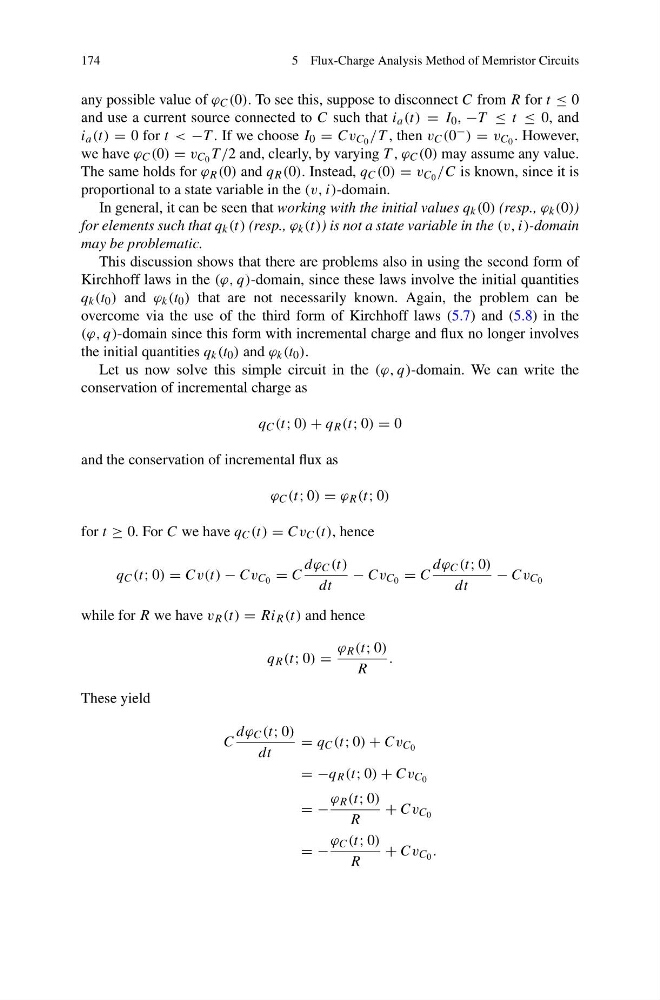
Let us now solve this simple circuit in the (ϕ, q)-domain. We can write the
conservation of incremental charge as
q C (t; 0) + q R (t; 0) = 0
and the conservation of incremental flux as
ϕ C (t; 0) = ϕ R (t; 0)
for t ≥ 0. For C we have q C (t) = Cv C (t), hence
q C (t; 0) = Cv(t) − Cv C 0 = C
dϕ C (t)
dt
− Cv C 0 = C
dϕ C (t; 0)
dt
− Cv C 0
while for R we have v R (t) = Ri R (t) and hence
q R (t; 0) =
ϕ R (t; 0)
R
.
These yield
C
dϕ C (t; 0)
dt
= q C (t; 0) + Cv C 0
= −q R (t; 0) + Cv C 0
= −
ϕ R (t; 0)
R
+ Cv C 0
= −
ϕ C (t; 0)
R
+ Cv C 0 .
5 Flux-Charge Analysis Method of Memristor Circuits
any possible value of ϕ C (0). To see this, suppose to disconnect C from R for t ≤ 0
and use a current source connected to C such that i a (t) = I 0 , −T ≤ t ≤ 0, and
i a (t) = 0 for t < −T . If we choose I 0 = Cv C 0 /T , then v C (0 − ) = v C 0 . However,
we have ϕ C (0) = v C 0 T /2 and, clearly, by varying T , ϕ C (0) may assume any value.
The same holds for ϕ R (0) and q R (0). Instead, q C (0) = v C 0 /C is known, since it is
proportional to a state variable in the (v, i)-domain.
In general, it can be seen that working with the initial values q k (0) (resp., ϕ k (0))
for elements such that q k (t) (resp., ϕ k (t)) is not a state variable in the (v, i)-domain
may be problematic.
This discussion shows that there are problems also in using the second form of
Kirchhoff laws in the (ϕ, q)-domain, since these laws involve the initial quantities
q k (t 0 ) and ϕ k (t 0 ) that are not necessarily known. Again, the problem can be
overcome via the use of the third form of Kirchhoff laws (5.7) and (5.8) in the
(ϕ, q)-domain since this form with incremental charge and flux no longer involves
the initial quantities q k (t 0 ) and ϕ k (t 0 ).
Let us now solve this simple circuit in the (ϕ, q)-domain. We can write the
conservation of incremental charge as
q C (t; 0) + q R (t; 0) = 0
and the conservation of incremental flux as
ϕ C (t; 0) = ϕ R (t; 0)
for t ≥ 0. For C we have q C (t) = Cv C (t), hence
q C (t; 0) = Cv(t) − Cv C 0 = C
dϕ C (t)
dt
− Cv C 0 = C
dϕ C (t; 0)
dt
− Cv C 0
while for R we have v R (t) = Ri R (t) and hence
q R (t; 0) =
ϕ R (t; 0)
R
.
These yield
C
dϕ C (t; 0)
dt
= q C (t; 0) + Cv C 0
= −q R (t; 0) + Cv C 0
= −
ϕ R (t; 0)
R
+ Cv C 0
= −
ϕ C (t; 0)
R
+ Cv C 0 .