

4.2 Second-Order Circuits
139
4.2 Second-Order Circuits
The dynamics of a first-order autonomous nonlinear circuit are quite limited. In
fact, it can be proved that any solution is either unbounded or otherwise it converges
monotonically to an EP (see, e.g., [3]). We encountered a case in point in Example 4.1. The situation is more interesting for second-order nonlinear autonomous
circuits, since such circuits can in general display persistent oscillations. Next,
we discuss a basic class of second-order oscillators, named negative resistance
oscillators, which includes the famous Van der Pol oscillator as a special case. We
also discuss how to break impasse points in the first-order circuit in Example 4.2
by adding a suitable parasitic element and thus obtaining a special case of negativeresistance oscillators named relaxation oscillators.
4.2.1 Negative Resistance Oscillators
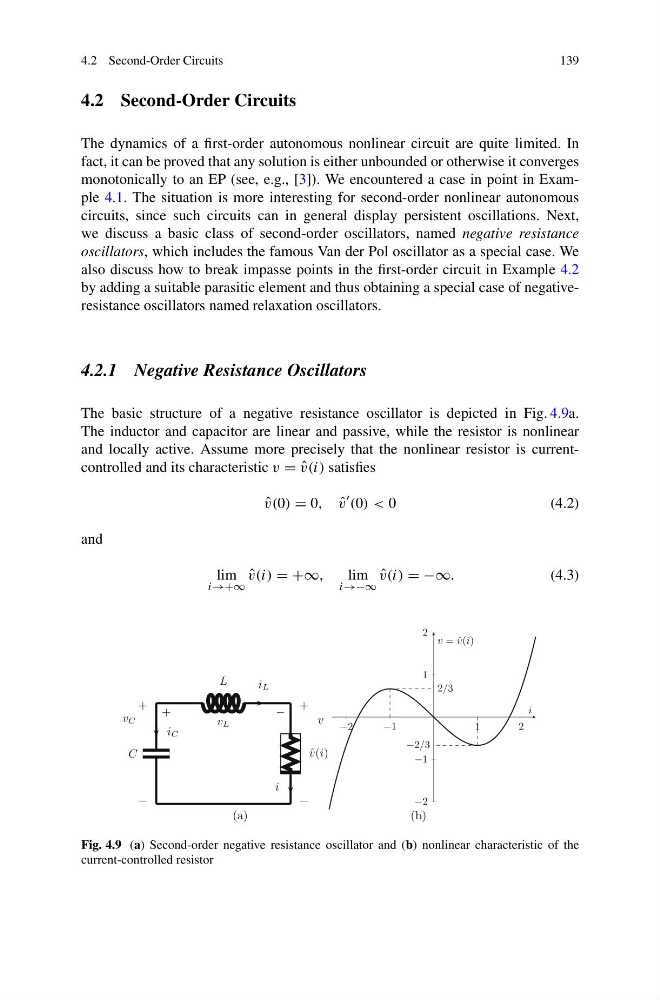
The basic structure of a negative resistance oscillator is depicted in Fig. 4.9a.
The inductor and capacitor are linear and passive, while the resistor is nonlinear
and locally active. Assume more precisely that the nonlinear resistor is currentcontrolled and its characteristic v = ˆ
v(i) satisfies
ˆ
v(0) = 0, ˆ
v
(0) < 0
(4.2)
and
lim
i→+∞
ˆ
v(i) = +∞,
lim
i→−∞
ˆ
v(i) = −∞.
(4.3)
Fig. 4.9 (a) Second-order negative resistance oscillator and (b) nonlinear characteristic of the
current-controlled resistor
139
4.2 Second-Order Circuits
The dynamics of a first-order autonomous nonlinear circuit are quite limited. In
fact, it can be proved that any solution is either unbounded or otherwise it converges
monotonically to an EP (see, e.g., [3]). We encountered a case in point in Example 4.1. The situation is more interesting for second-order nonlinear autonomous
circuits, since such circuits can in general display persistent oscillations. Next,
we discuss a basic class of second-order oscillators, named negative resistance
oscillators, which includes the famous Van der Pol oscillator as a special case. We
also discuss how to break impasse points in the first-order circuit in Example 4.2
by adding a suitable parasitic element and thus obtaining a special case of negativeresistance oscillators named relaxation oscillators.
4.2.1 Negative Resistance Oscillators
The basic structure of a negative resistance oscillator is depicted in Fig. 4.9a.
The inductor and capacitor are linear and passive, while the resistor is nonlinear
and locally active. Assume more precisely that the nonlinear resistor is currentcontrolled and its characteristic v = ˆ
v(i) satisfies
ˆ
v(0) = 0, ˆ
v
(0) < 0
(4.2)
and
lim
i→+∞
ˆ
v(i) = +∞,
lim
i→−∞
ˆ
v(i) = −∞.
(4.3)
Fig. 4.9 (a) Second-order negative resistance oscillator and (b) nonlinear characteristic of the
current-controlled resistor