

136
4 Nonlinear Dynamics and Bifurcations in Autonomous RLC Circuits
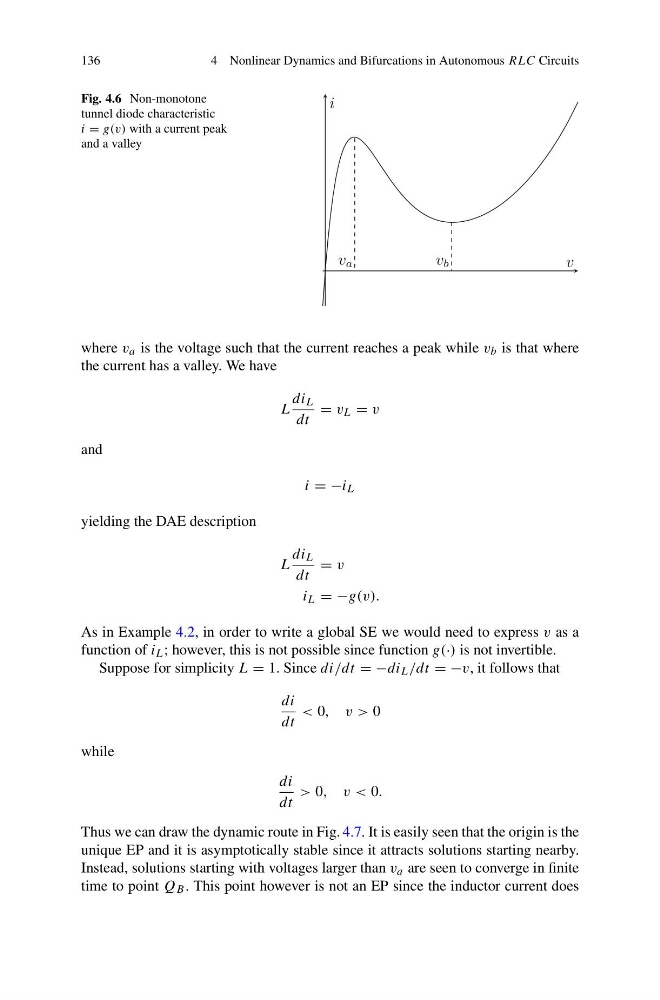
Fig. 4.6 Non-monotone
tunnel diode characteristic
i = g(v) with a current peak
and a valley
where v a is the voltage such that the current reaches a peak while v b is that where
the current has a valley. We have
L
di L
dt
= v L = v
and
i = −i L
yielding the DAE description
L
di L
dt
= v
i L = −g(v).
As in Example 4.2, in order to write a global SE we would need to express v as a
function of i L ; however, this is not possible since function g(·) is not invertible.
Suppose for simplicity L = 1. Since di/dt = −di L /dt = −v, it follows that
di
dt
< 0, v > 0
while
di
dt
> 0, v < 0.
Thus we can draw the dynamic route in Fig. 4.7. It is easily seen that the origin is the
unique EP and it is asymptotically stable since it attracts solutions starting nearby.
Instead, solutions starting with voltages larger than v a are seen to converge in finite
time to point Q B . This point however is not an EP since the inductor current does
4 Nonlinear Dynamics and Bifurcations in Autonomous RLC Circuits
Fig. 4.6 Non-monotone
tunnel diode characteristic
i = g(v) with a current peak
and a valley
where v a is the voltage such that the current reaches a peak while v b is that where
the current has a valley. We have
L
di L
dt
= v L = v
and
i = −i L
yielding the DAE description
L
di L
dt
= v
i L = −g(v).
As in Example 4.2, in order to write a global SE we would need to express v as a
function of i L ; however, this is not possible since function g(·) is not invertible.
Suppose for simplicity L = 1. Since di/dt = −di L /dt = −v, it follows that
di
dt
< 0, v > 0
while
di
dt
> 0, v < 0.
Thus we can draw the dynamic route in Fig. 4.7. It is easily seen that the origin is the
unique EP and it is asymptotically stable since it attracts solutions starting nearby.
Instead, solutions starting with voltages larger than v a are seen to converge in finite
time to point Q B . This point however is not an EP since the inductor current does