

3.3 State Equations
117
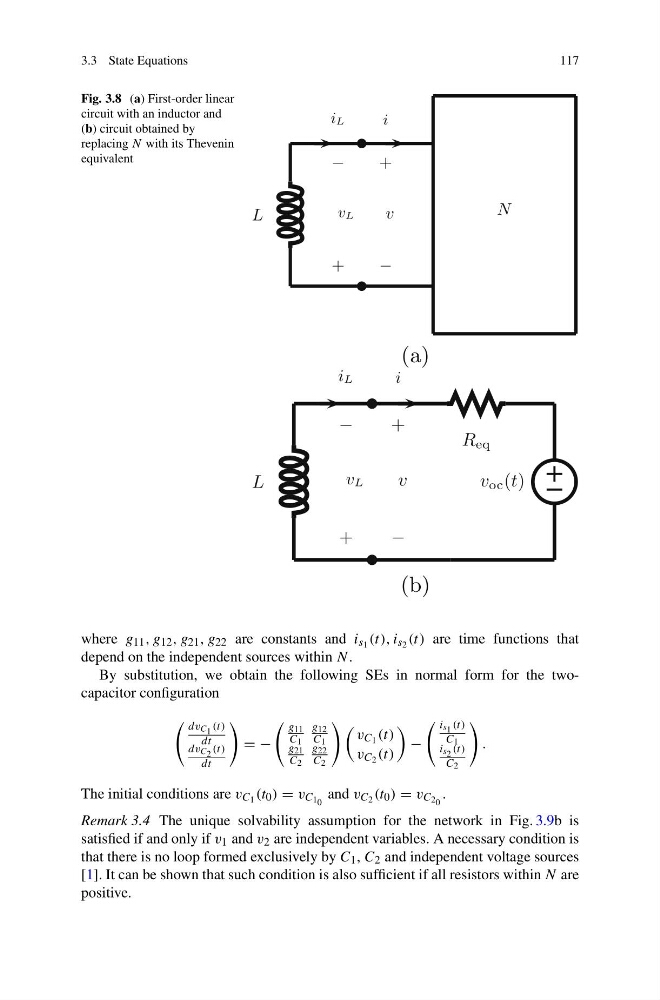
Fig. 3.8 (a) First-order linear
circuit with an inductor and
(b) circuit obtained by
replacing N with its Thevenin
equivalent
L
+
−
v
i
N
v L
i L
−
+
(a)
L
+
−
v
i
v L
i L
−
+
v oc (t)
R eq
(b)
where g 11 , g 12 , g 21 , g 22 are constants and i s 1 (t), i s 2 (t) are time functions that
depend on the independent sources within N.
By substitution, we obtain the following SEs in normal form for the twocapacitor configuration
dv C 1 (t)
dt
dv C 2 (t)
dt
= −
g 11
C 1
g 12
C 1
g 21
C 2
g 22
C 2
v C 1 (t)
v C 2 (t)
−
i s 1 (t)
C 1
i s 2 (t)
C 2
.
The initial conditions are v C 1 (t 0 ) = v C 1 0 and v C 2 (t 0 ) = v C 2 0 .
Remark 3.4 The unique solvability assumption for the network in Fig. 3.9b is
satisfied if and only if v 1 and v 2 are independent variables. A necessary condition is
that there is no loop formed exclusively by C 1 , C 2 and independent voltage sources
[1]. It can be shown that such condition is also sufficient if all resistors within N are
positive.
117
Fig. 3.8 (a) First-order linear
circuit with an inductor and
(b) circuit obtained by
replacing N with its Thevenin
equivalent
L
+
−
v
i
N
v L
i L
−
+
(a)
L
+
−
v
i
v L
i L
−
+
v oc (t)
R eq
(b)
where g 11 , g 12 , g 21 , g 22 are constants and i s 1 (t), i s 2 (t) are time functions that
depend on the independent sources within N.
By substitution, we obtain the following SEs in normal form for the twocapacitor configuration
dv C 1 (t)
dt
dv C 2 (t)
dt
= −
g 11
C 1
g 12
C 1
g 21
C 2
g 22
C 2
v C 1 (t)
v C 2 (t)
−
i s 1 (t)
C 1
i s 2 (t)
C 2
.
The initial conditions are v C 1 (t 0 ) = v C 1 0 and v C 2 (t 0 ) = v C 2 0 .
Remark 3.4 The unique solvability assumption for the network in Fig. 3.9b is
satisfied if and only if v 1 and v 2 are independent variables. A necessary condition is
that there is no loop formed exclusively by C 1 , C 2 and independent voltage sources
[1]. It can be shown that such condition is also sufficient if all resistors within N are
positive.