

112
3 RLC Networks Equations and Analysis Methods
Hence, the resistive nonlinear circuit in Fig. 3.5 is described by a set of nonlinear
algebraic equations given by (3.14), (3.17), and (3.38). A comprehensive
discussion of algorithms and numerical methods for solving nonlinear algebraic
equations is available in [2].
• When the resistor R 3 of the resistive nonlinear circuit in Fig. 3.5 is substituted by
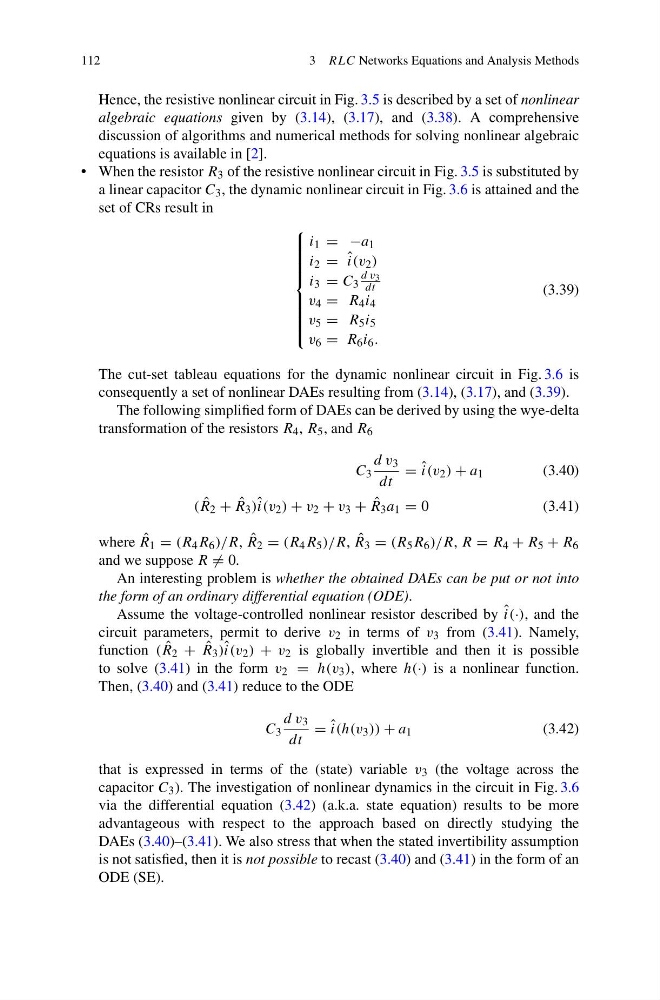
a linear capacitor C 3 , the dynamic nonlinear circuit in Fig. 3.6 is attained and the
set of CRs result in
⎧
⎪ ⎪ ⎪ ⎪ ⎪ ⎪ ⎪ ⎨
⎪ ⎪ ⎪ ⎪ ⎪ ⎪ ⎪ ⎩
i 1 = −a 1
i 2 = ˆ
i(v 2 )
i 3 = C 3
d v 3
dt
v 4 = R 4 i 4
v 5 = R 5 i 5
v 6 = R 6 i 6 .
(3.39)
The cut-set tableau equations for the dynamic nonlinear circuit in Fig. 3.6 is
consequently a set of nonlinear DAEs resulting from (3.14), (3.17), and (3.39).
The following simplified form of DAEs can be derived by using the wye-delta
transformation of the resistors R 4 , R 5 , and R 6
C 3
d v 3
dt
= ˆ
i(v 2 ) + a 1
(3.40)
( ˆ
R 2 + ˆ
R 3 ) ˆ
i(v 2 ) + v 2 + v 3 + ˆ
R 3 a 1 = 0
(3.41)
where ˆ
R 1 = (R 4 R 6 )/R, ˆ
R 2 = (R 4 R 5 )/R, ˆ
R 3 = (R 5 R 6 )/R, R = R 4 + R 5 + R 6
and we suppose R = 0.
An interesting problem is whether the obtained DAEs can be put or not into
the form of an ordinary differential equation (ODE).
Assume the voltage-controlled nonlinear resistor described by ˆ
i(·), and the
circuit parameters, permit to derive v 2 in terms of v 3 from (3.41). Namely,
function ( ˆ
R 2 + ˆ
R 3 ) ˆ
i(v 2 ) + v 2 is globally invertible and then it is possible
to solve (3.41) in the form v 2 = h(v 3 ), where h(·) is a nonlinear function.
Then, (3.40) and (3.41) reduce to the ODE
C 3
d v 3
dt
= ˆ
i(h(v 3 )) + a 1
(3.42)
that is expressed in terms of the (state) variable v 3 (the voltage across the
capacitor C 3 ). The investigation of nonlinear dynamics in the circuit in Fig. 3.6
via the differential equation (3.42) (a.k.a. state equation) results to be more
advantageous with respect to the approach based on directly studying the
DAEs (3.40)–(3.41). We also stress that when the stated invertibility assumption
is not satisfied, then it is not possible to recast (3.40) and (3.41) in the form of an
ODE (SE).
3 RLC Networks Equations and Analysis Methods
Hence, the resistive nonlinear circuit in Fig. 3.5 is described by a set of nonlinear
algebraic equations given by (3.14), (3.17), and (3.38). A comprehensive
discussion of algorithms and numerical methods for solving nonlinear algebraic
equations is available in [2].
• When the resistor R 3 of the resistive nonlinear circuit in Fig. 3.5 is substituted by
a linear capacitor C 3 , the dynamic nonlinear circuit in Fig. 3.6 is attained and the
set of CRs result in
⎧
⎪ ⎪ ⎪ ⎪ ⎪ ⎪ ⎪ ⎨
⎪ ⎪ ⎪ ⎪ ⎪ ⎪ ⎪ ⎩
i 1 = −a 1
i 2 = ˆ
i(v 2 )
i 3 = C 3
d v 3
dt
v 4 = R 4 i 4
v 5 = R 5 i 5
v 6 = R 6 i 6 .
(3.39)
The cut-set tableau equations for the dynamic nonlinear circuit in Fig. 3.6 is
consequently a set of nonlinear DAEs resulting from (3.14), (3.17), and (3.39).
The following simplified form of DAEs can be derived by using the wye-delta
transformation of the resistors R 4 , R 5 , and R 6
C 3
d v 3
dt
= ˆ
i(v 2 ) + a 1
(3.40)
( ˆ
R 2 + ˆ
R 3 ) ˆ
i(v 2 ) + v 2 + v 3 + ˆ
R 3 a 1 = 0
(3.41)
where ˆ
R 1 = (R 4 R 6 )/R, ˆ
R 2 = (R 4 R 5 )/R, ˆ
R 3 = (R 5 R 6 )/R, R = R 4 + R 5 + R 6
and we suppose R = 0.
An interesting problem is whether the obtained DAEs can be put or not into
the form of an ordinary differential equation (ODE).
Assume the voltage-controlled nonlinear resistor described by ˆ
i(·), and the
circuit parameters, permit to derive v 2 in terms of v 3 from (3.41). Namely,
function ( ˆ
R 2 + ˆ
R 3 ) ˆ
i(v 2 ) + v 2 is globally invertible and then it is possible
to solve (3.41) in the form v 2 = h(v 3 ), where h(·) is a nonlinear function.
Then, (3.40) and (3.41) reduce to the ODE
C 3
d v 3
dt
= ˆ
i(h(v 3 )) + a 1
(3.42)
that is expressed in terms of the (state) variable v 3 (the voltage across the
capacitor C 3 ). The investigation of nonlinear dynamics in the circuit in Fig. 3.6
via the differential equation (3.42) (a.k.a. state equation) results to be more
advantageous with respect to the approach based on directly studying the
DAEs (3.40)–(3.41). We also stress that when the stated invertibility assumption
is not satisfied, then it is not possible to recast (3.40) and (3.41) in the form of an
ODE (SE).