

70
2 Fundamental Properties of Mem-Elements
i k = I S
exp
v k
nV T
− 1
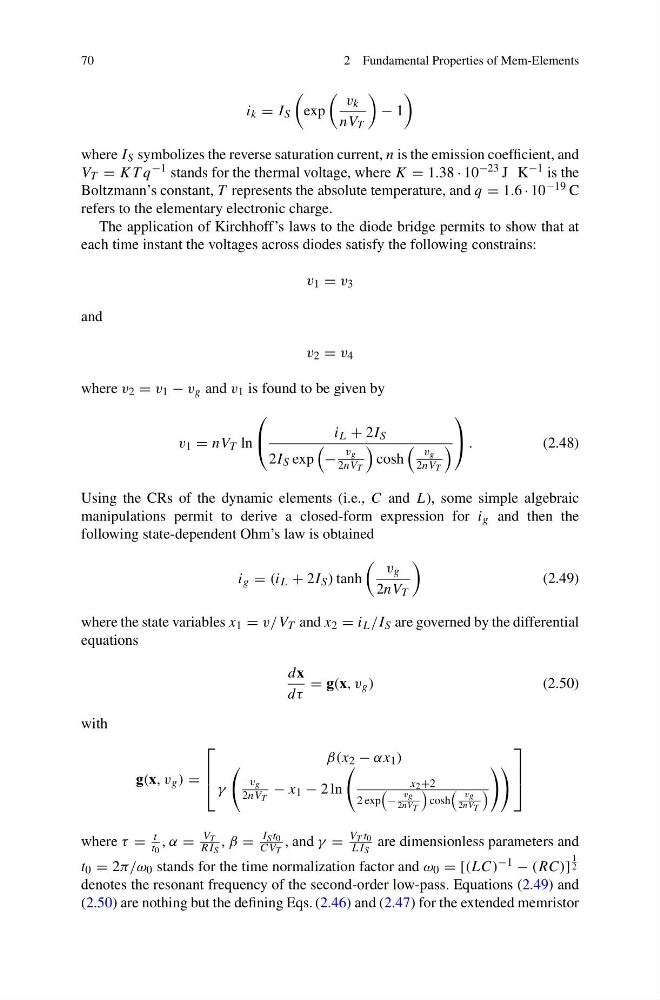
where I S symbolizes the reverse saturation current, n is the emission coefficient, and
V T = KT q −1 stands for the thermal voltage, where K = 1.38 · 10 −23 J K −1 is the
Boltzmann’s constant, T represents the absolute temperature, and q = 1.6 · 10 −19 C
refers to the elementary electronic charge.
The application of Kirchhoff’s laws to the diode bridge permits to show that at
each time instant the voltages across diodes satisfy the following constrains:
v 1 = v 3
and
v 2 = v 4
where v 2 = v 1 − v g and v 1 is found to be given by
v 1 = nV T ln
⎛
⎝
i L + 2I S
2I S exp
−
v g
2nV T
cosh
v g
2nV T
⎞
⎠ .
(2.48)
Using the CRs of the dynamic elements (i.e., C and L), some simple algebraic
manipulations permit to derive a closed-form expression for i g and then the
following state-dependent Ohm’s law is obtained
i g = (i L + 2I S ) tanh
v g
2nV T
(2.49)
where the state variables x 1 = v/V T and x 2 = i L /I S are governed by the differential
equations
dx
dτ
= g(x, v g )
(2.50)
with
g(x, v g ) =
⎡
⎢
⎣
β(x 2 − αx 1 )
γ
v g
2nV T
− x 1 − 2 ln
x 2 +2
2 exp
−
vg
2nV T
cosh
vg
2nV T
⎤
⎥
⎦
where τ =
t
t 0
, α =
V T
RI S
, β =
I S t 0
CV T
, and γ =
V T t 0
LI S
are dimensionless parameters and
t 0 = 2π/ω 0 stands for the time normalization factor and ω 0 = [(LC) −1 − (RC)]
1
2
denotes the resonant frequency of the second-order low-pass. Equations (2.49) and
(2.50) are nothing but the defining Eqs. (2.46) and (2.47) for the extended memristor
2 Fundamental Properties of Mem-Elements
i k = I S
exp
v k
nV T
− 1
where I S symbolizes the reverse saturation current, n is the emission coefficient, and
V T = KT q −1 stands for the thermal voltage, where K = 1.38 · 10 −23 J K −1 is the
Boltzmann’s constant, T represents the absolute temperature, and q = 1.6 · 10 −19 C
refers to the elementary electronic charge.
The application of Kirchhoff’s laws to the diode bridge permits to show that at
each time instant the voltages across diodes satisfy the following constrains:
v 1 = v 3
and
v 2 = v 4
where v 2 = v 1 − v g and v 1 is found to be given by
v 1 = nV T ln
⎛
⎝
i L + 2I S
2I S exp
−
v g
2nV T
cosh
v g
2nV T
⎞
⎠ .
(2.48)
Using the CRs of the dynamic elements (i.e., C and L), some simple algebraic
manipulations permit to derive a closed-form expression for i g and then the
following state-dependent Ohm’s law is obtained
i g = (i L + 2I S ) tanh
v g
2nV T
(2.49)
where the state variables x 1 = v/V T and x 2 = i L /I S are governed by the differential
equations
dx
dτ
= g(x, v g )
(2.50)
with
g(x, v g ) =
⎡
⎢
⎣
β(x 2 − αx 1 )
γ
v g
2nV T
− x 1 − 2 ln
x 2 +2
2 exp
−
vg
2nV T
cosh
vg
2nV T
⎤
⎥
⎦
where τ =
t
t 0
, α =
V T
RI S
, β =
I S t 0
CV T
, and γ =
V T t 0
LI S
are dimensionless parameters and
t 0 = 2π/ω 0 stands for the time normalization factor and ω 0 = [(LC) −1 − (RC)]
1
2
denotes the resonant frequency of the second-order low-pass. Equations (2.49) and
(2.50) are nothing but the defining Eqs. (2.46) and (2.47) for the extended memristor