

Assessing Water Demand of Green Roofs Under Variants of Climate …
379
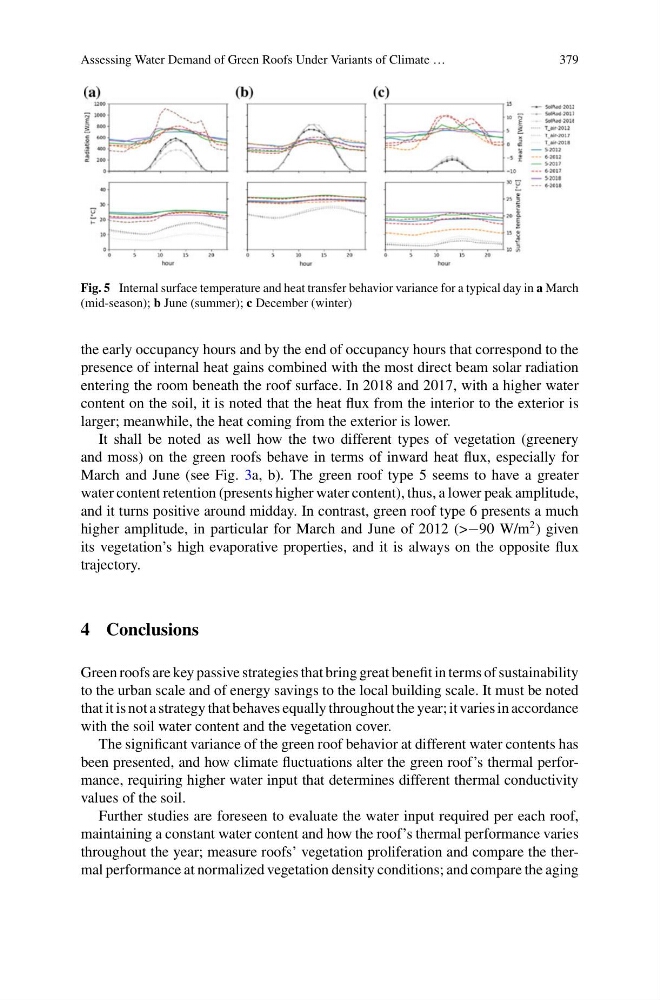
Fig. 5 Internal surface temperature and heat transfer behavior variance for a typical day in a March
(mid-season); b June (summer); c December (winter)
the early occupancy hours and by the end of occupancy hours that correspond to the
presence of internal heat gains combined with the most direct beam solar radiation
entering the room beneath the roof surface. In 2018 and 2017, with a higher water
content on the soil, it is noted that the heat flux from the interior to the exterior is
larger; meanwhile, the heat coming from the exterior is lower.
It shall be noted as well how the two different types of vegetation (greenery
and moss) on the green roofs behave in terms of inward heat flux, especially for
March and June (see Fig. 3a, b). The green roof type 5 seems to have a greater
water content retention (presents higher water content), thus, a lower peak amplitude,
and it turns positive around midday. In contrast, green roof type 6 presents a much
higher amplitude, in particular for March and June of 2012 (>−90 W/m
2 ) given
its vegetation’s high evaporative properties, and it is always on the opposite flux
trajectory.
4 Conclusions
Green roofs are key passive strategies that bring great benefit in terms of sustainability
to the urban scale and of energy savings to the local building scale. It must be noted
that it is not a strategy that behaves equally throughout the year; it varies in accordance
with the soil water content and the vegetation cover.
The significant variance of the green roof behavior at different water contents has
been presented, and how climate fluctuations alter the green roof’s thermal performance, requiring higher water input that determines different thermal conductivity
values of the soil.
Further studies are foreseen to evaluate the water input required per each roof,
maintaining a constant water content and how the roof’s thermal performance varies
throughout the year; measure roofs’ vegetation proliferation and compare the thermal performance at normalized vegetation density conditions; and compare the aging
379
Fig. 5 Internal surface temperature and heat transfer behavior variance for a typical day in a March
(mid-season); b June (summer); c December (winter)
the early occupancy hours and by the end of occupancy hours that correspond to the
presence of internal heat gains combined with the most direct beam solar radiation
entering the room beneath the roof surface. In 2018 and 2017, with a higher water
content on the soil, it is noted that the heat flux from the interior to the exterior is
larger; meanwhile, the heat coming from the exterior is lower.
It shall be noted as well how the two different types of vegetation (greenery
and moss) on the green roofs behave in terms of inward heat flux, especially for
March and June (see Fig. 3a, b). The green roof type 5 seems to have a greater
water content retention (presents higher water content), thus, a lower peak amplitude,
and it turns positive around midday. In contrast, green roof type 6 presents a much
higher amplitude, in particular for March and June of 2012 (>−90 W/m
2 ) given
its vegetation’s high evaporative properties, and it is always on the opposite flux
trajectory.
4 Conclusions
Green roofs are key passive strategies that bring great benefit in terms of sustainability
to the urban scale and of energy savings to the local building scale. It must be noted
that it is not a strategy that behaves equally throughout the year; it varies in accordance
with the soil water content and the vegetation cover.
The significant variance of the green roof behavior at different water contents has
been presented, and how climate fluctuations alter the green roof’s thermal performance, requiring higher water input that determines different thermal conductivity
values of the soil.
Further studies are foreseen to evaluate the water input required per each roof,
maintaining a constant water content and how the roof’s thermal performance varies
throughout the year; measure roofs’ vegetation proliferation and compare the thermal performance at normalized vegetation density conditions; and compare the aging