

358
A. G. Mainini et al.
economy scheme, that is, the decision to share spaces in exchange for additional services that can be integrated and shared within locals and/or condominiums. This new
paradigm is in fact, possible thanks to the introduction of newly available, scalable
and modular technologies that meet the user demands (safety, security, monitoring
and management).
The research project INCASe, funded by Regione Lombardia, makes part of
this reference scenario. Its primary objective is to integrate modular shared charging
points for light electric vehicles and within façades and/or enclosure systems in order
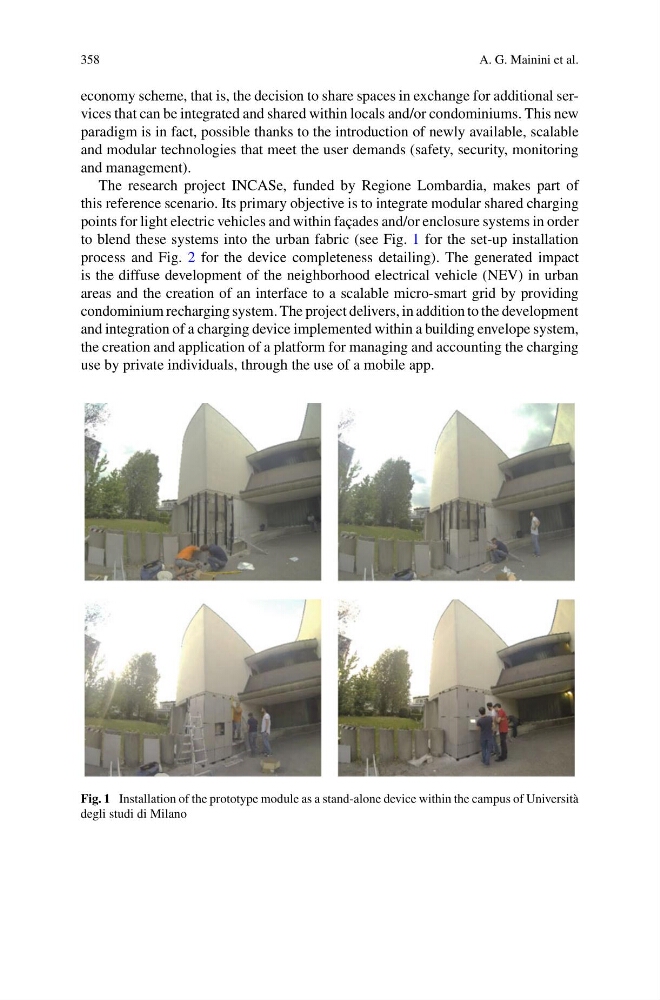
to blend these systems into the urban fabric (see Fig. 1 for the set-up installation
process and Fig. 2 for the device completeness detailing). The generated impact
is the diffuse development of the neighborhood electrical vehicle (NEV) in urban
areas and the creation of an interface to a scalable micro-smart grid by providing
condominium recharging system. The project delivers, in addition to the development
and integration of a charging device implemented within a building envelope system,
the creation and application of a platform for managing and accounting the charging
use by private individuals, through the use of a mobile app.
Fig. 1 Installation of the prototype module as a stand-alone device within the campus of Università
degli studi di Milano
A. G. Mainini et al.
economy scheme, that is, the decision to share spaces in exchange for additional services that can be integrated and shared within locals and/or condominiums. This new
paradigm is in fact, possible thanks to the introduction of newly available, scalable
and modular technologies that meet the user demands (safety, security, monitoring
and management).
The research project INCASe, funded by Regione Lombardia, makes part of
this reference scenario. Its primary objective is to integrate modular shared charging
points for light electric vehicles and within façades and/or enclosure systems in order
to blend these systems into the urban fabric (see Fig. 1 for the set-up installation
process and Fig. 2 for the device completeness detailing). The generated impact
is the diffuse development of the neighborhood electrical vehicle (NEV) in urban
areas and the creation of an interface to a scalable micro-smart grid by providing
condominium recharging system. The project delivers, in addition to the development
and integration of a charging device implemented within a building envelope system,
the creation and application of a platform for managing and accounting the charging
use by private individuals, through the use of a mobile app.
Fig. 1 Installation of the prototype module as a stand-alone device within the campus of Università
degli studi di Milano