

350
E. Ginelli et al.
Table 1 Main resilience requirements for the project, as keywords
Resilience requirements for the project
Technological-functional requirements Examples of object requirements
Flexibility (Ginelli 2010)
Convertibility (Bologna 2002)
Predictive and adaptive project
Smart object
Reactive project
Durability (Jourda 2010), re-functionalization
Redundancy of systems
Multi-functionality reliability fault-tolerant design
Replicability
Industrialization and prefabrication (Ginelli and Pozzi
2017)
Sharing
Communication guarantee
Technological flexibility
Accessibility, maintainability, substitutability and
transformability
(Ginelli and Pozzi 2017). The greater the intrinsic capacity of a building to accept
changes and modifications to achieve a new given performance picture, the lower
the cost of this upgrading and thus the greater its active resilience.
The same applies to embodied energy: the project has the intrinsic capacity to
make energy available for time t(0 + x)—a time in future—whose conditions are
still unknown, but which mandatorily require the right strategy (active resilience) to
afford changes.
This active resilience generates invariants and requirements for the project. Such
requirements are a priori strategies valid for each project and can be used so that the
building, regardless of individual materials and specific products, can be resilient
and thus actively respond to physiological changes or unforeseen events.
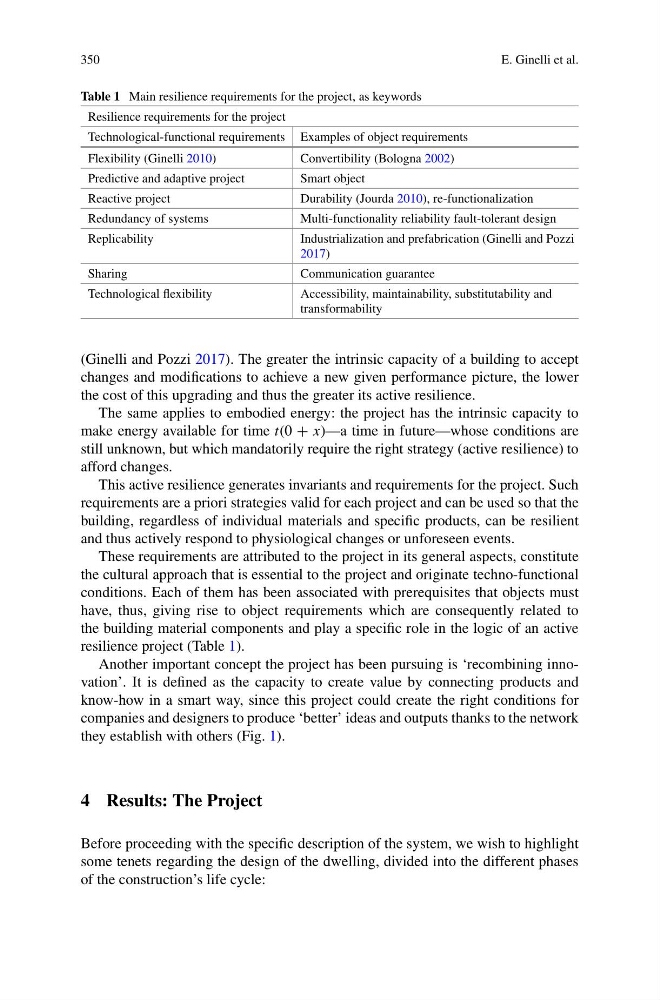
These requirements are attributed to the project in its general aspects, constitute
the cultural approach that is essential to the project and originate techno-functional
conditions. Each of them has been associated with prerequisites that objects must
have, thus, giving rise to object requirements which are consequently related to
the building material components and play a specific role in the logic of an active
resilience project (Table 1).
Another important concept the project has been pursuing is ‘recombining innovation’. It is defined as the capacity to create value by connecting products and
know-how in a smart way, since this project could create the right conditions for
companies and designers to produce ‘better’ ideas and outputs thanks to the network
they establish with others (Fig. 1).
4 Results: The Project
Before proceeding with the specific description of the system, we wish to highlight
some tenets regarding the design of the dwelling, divided into the different phases
of the construction’s life cycle:
E. Ginelli et al.
Table 1 Main resilience requirements for the project, as keywords
Resilience requirements for the project
Technological-functional requirements Examples of object requirements
Flexibility (Ginelli 2010)
Convertibility (Bologna 2002)
Predictive and adaptive project
Smart object
Reactive project
Durability (Jourda 2010), re-functionalization
Redundancy of systems
Multi-functionality reliability fault-tolerant design
Replicability
Industrialization and prefabrication (Ginelli and Pozzi
2017)
Sharing
Communication guarantee
Technological flexibility
Accessibility, maintainability, substitutability and
transformability
(Ginelli and Pozzi 2017). The greater the intrinsic capacity of a building to accept
changes and modifications to achieve a new given performance picture, the lower
the cost of this upgrading and thus the greater its active resilience.
The same applies to embodied energy: the project has the intrinsic capacity to
make energy available for time t(0 + x)—a time in future—whose conditions are
still unknown, but which mandatorily require the right strategy (active resilience) to
afford changes.
This active resilience generates invariants and requirements for the project. Such
requirements are a priori strategies valid for each project and can be used so that the
building, regardless of individual materials and specific products, can be resilient
and thus actively respond to physiological changes or unforeseen events.
These requirements are attributed to the project in its general aspects, constitute
the cultural approach that is essential to the project and originate techno-functional
conditions. Each of them has been associated with prerequisites that objects must
have, thus, giving rise to object requirements which are consequently related to
the building material components and play a specific role in the logic of an active
resilience project (Table 1).
Another important concept the project has been pursuing is ‘recombining innovation’. It is defined as the capacity to create value by connecting products and
know-how in a smart way, since this project could create the right conditions for
companies and designers to produce ‘better’ ideas and outputs thanks to the network
they establish with others (Fig. 1).
4 Results: The Project
Before proceeding with the specific description of the system, we wish to highlight
some tenets regarding the design of the dwelling, divided into the different phases
of the construction’s life cycle: