

116
G. Masera et al.
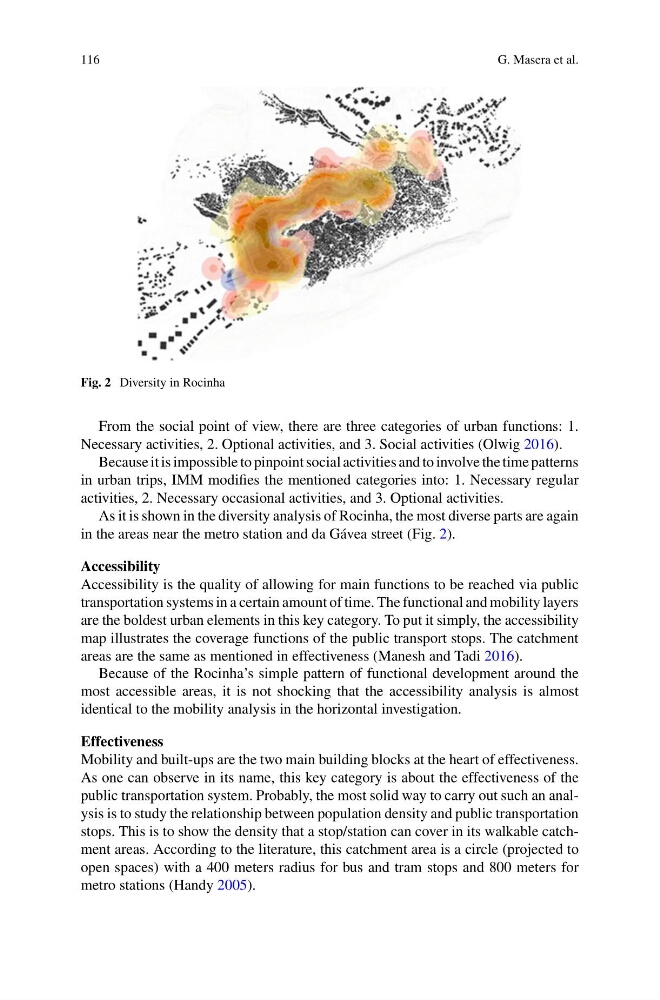
Fig. 2 Diversity in Rocinha
From the social point of view, there are three categories of urban functions: 1.
Necessary activities, 2. Optional activities, and 3. Social activities (Olwig 2016).
Because it is impossible to pinpoint social activities and to involve the time patterns
in urban trips, IMM modifies the mentioned categories into: 1. Necessary regular
activities, 2. Necessary occasional activities, and 3. Optional activities.
As it is shown in the diversity analysis of Rocinha, the most diverse parts are again
in the areas near the metro station and da Gávea street (Fig. 2).
Accessibility
Accessibility is the quality of allowing for main functions to be reached via public
transportation systems in a certain amount of time. The functional and mobility layers
are the boldest urban elements in this key category. To put it simply, the accessibility
map illustrates the coverage functions of the public transport stops. The catchment
areas are the same as mentioned in effectiveness (Manesh and Tadi 2016).
Because of the Rocinha’s simple pattern of functional development around the
most accessible areas, it is not shocking that the accessibility analysis is almost
identical to the mobility analysis in the horizontal investigation.
Effectiveness
Mobility and built-ups are the two main building blocks at the heart of effectiveness.
As one can observe in its name, this key category is about the effectiveness of the
public transportation system. Probably, the most solid way to carry out such an analysis is to study the relationship between population density and public transportation
stops. This is to show the density that a stop/station can cover in its walkable catchment areas. According to the literature, this catchment area is a circle (projected to
open spaces) with a 400 meters radius for bus and tram stops and 800 meters for
metro stations (Handy 2005).
G. Masera et al.
Fig. 2 Diversity in Rocinha
From the social point of view, there are three categories of urban functions: 1.
Necessary activities, 2. Optional activities, and 3. Social activities (Olwig 2016).
Because it is impossible to pinpoint social activities and to involve the time patterns
in urban trips, IMM modifies the mentioned categories into: 1. Necessary regular
activities, 2. Necessary occasional activities, and 3. Optional activities.
As it is shown in the diversity analysis of Rocinha, the most diverse parts are again
in the areas near the metro station and da Gávea street (Fig. 2).
Accessibility
Accessibility is the quality of allowing for main functions to be reached via public
transportation systems in a certain amount of time. The functional and mobility layers
are the boldest urban elements in this key category. To put it simply, the accessibility
map illustrates the coverage functions of the public transport stops. The catchment
areas are the same as mentioned in effectiveness (Manesh and Tadi 2016).
Because of the Rocinha’s simple pattern of functional development around the
most accessible areas, it is not shocking that the accessibility analysis is almost
identical to the mobility analysis in the horizontal investigation.
Effectiveness
Mobility and built-ups are the two main building blocks at the heart of effectiveness.
As one can observe in its name, this key category is about the effectiveness of the
public transportation system. Probably, the most solid way to carry out such an analysis is to study the relationship between population density and public transportation
stops. This is to show the density that a stop/station can cover in its walkable catchment areas. According to the literature, this catchment area is a circle (projected to
open spaces) with a 400 meters radius for bus and tram stops and 800 meters for
metro stations (Handy 2005).