

PolimiparaRocinha: Environmental Performances and Social …
115
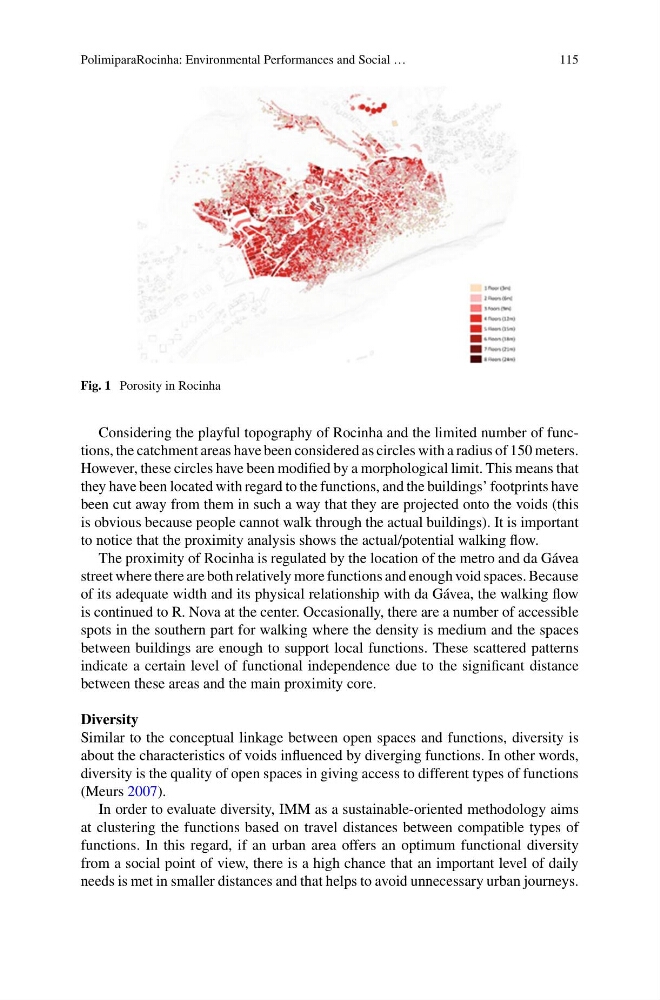
Fig. 1 Porosity in Rocinha
Considering the playful topography of Rocinha and the limited number of functions, the catchment areas have been considered as circles with a radius of 150 meters.
However, these circles have been modified by a morphological limit. This means that
they have been located with regard to the functions, and the buildings’ footprints have
been cut away from them in such a way that they are projected onto the voids (this
is obvious because people cannot walk through the actual buildings). It is important
to notice that the proximity analysis shows the actual/potential walking flow.
The proximity of Rocinha is regulated by the location of the metro and da Gávea
street where there are both relatively more functions and enough void spaces. Because
of its adequate width and its physical relationship with da Gávea, the walking flow
is continued to R. Nova at the center. Occasionally, there are a number of accessible
spots in the southern part for walking where the density is medium and the spaces
between buildings are enough to support local functions. These scattered patterns
indicate a certain level of functional independence due to the significant distance
between these areas and the main proximity core.
Diversity
Similar to the conceptual linkage between open spaces and functions, diversity is
about the characteristics of voids influenced by diverging functions. In other words,
diversity is the quality of open spaces in giving access to different types of functions
(Meurs 2007).
In order to evaluate diversity, IMM as a sustainable-oriented methodology aims
at clustering the functions based on travel distances between compatible types of
functions. In this regard, if an urban area offers an optimum functional diversity
from a social point of view, there is a high chance that an important level of daily
needs is met in smaller distances and that helps to avoid unnecessary urban journeys.
115
Fig. 1 Porosity in Rocinha
Considering the playful topography of Rocinha and the limited number of functions, the catchment areas have been considered as circles with a radius of 150 meters.
However, these circles have been modified by a morphological limit. This means that
they have been located with regard to the functions, and the buildings’ footprints have
been cut away from them in such a way that they are projected onto the voids (this
is obvious because people cannot walk through the actual buildings). It is important
to notice that the proximity analysis shows the actual/potential walking flow.
The proximity of Rocinha is regulated by the location of the metro and da Gávea
street where there are both relatively more functions and enough void spaces. Because
of its adequate width and its physical relationship with da Gávea, the walking flow
is continued to R. Nova at the center. Occasionally, there are a number of accessible
spots in the southern part for walking where the density is medium and the spaces
between buildings are enough to support local functions. These scattered patterns
indicate a certain level of functional independence due to the significant distance
between these areas and the main proximity core.
Diversity
Similar to the conceptual linkage between open spaces and functions, diversity is
about the characteristics of voids influenced by diverging functions. In other words,
diversity is the quality of open spaces in giving access to different types of functions
(Meurs 2007).
In order to evaluate diversity, IMM as a sustainable-oriented methodology aims
at clustering the functions based on travel distances between compatible types of
functions. In this regard, if an urban area offers an optimum functional diversity
from a social point of view, there is a high chance that an important level of daily
needs is met in smaller distances and that helps to avoid unnecessary urban journeys.