

4.4 Bacterial Suspensions
77
this in turn is apt to reduce their chemotactic velocity and make them lag behind a
traveling band. However, this does not actually happen. And while human society
has instituted social services that help those less able or less fortunate to keep up,
bacteria do it in a simpler way.
Experiments by Fu et al (2018), supported by simulations, show self-organized
sorting of bacteria in traveling bands, with the average TB increasing from front to
back (Fig. 4.16b). This has a simple explanation. As an attracting chemical is not
only perceived but consumed by the bacteria, its gradient increases from front to
back before flattening down. Bacteria with a higher TB, which don’t run fast enough
in a shallow gradient, lag behind, until they fall into the region where their velocity
equalizes with that of individuals with the lowest TB at the front. Only those with
the highest TB unable to sustain the collective velocity at the maximal gradient, fall
into the gray area in Fig. 4.16b and drop out of the band as weaklings out of a herd.
Moreover, bacterial chemical communications are far more sophisticated than in
active colloids. They are capable of producing a full repertoire of signals and respond
to a wide variety of chemicals in their environment. Rather than moving to reduce
free energy as Janus particles do or even just running towards a source of food as the
Keller–Segel model assumes, they react to signals sent by other bacteria of the same
or different species. This quorum sensing enables organisms to measure their local
population density and to regulate their response accordingly, as well as to exchange
information about environmental conditions. Warnings of adverse circumstances
may trigger aggregation in bacterial suspensions, independently of either cell division
or hydrodynamic interactions. This enables a multicellular community to defend
against predators or harmful environmental factors.
Bacteria emit and detect signaling molecules called autoinducers. At a low cell
density, when the autoinducer concentration is below a certain threshold, gene expression programs that benefit individual bacteria are active, but exceeding this
limit switches on gene expression programs beneficial for the community and drives
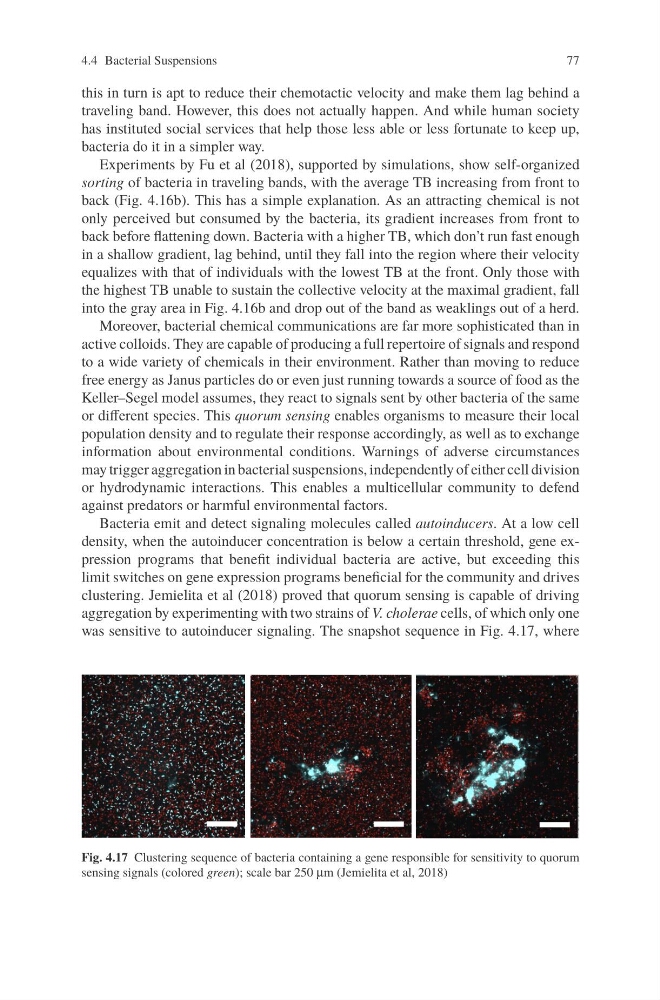
clustering. Jemielita et al (2018) proved that quorum sensing is capable of driving
aggregation by experimenting with two strains of V. cholerae cells, of which only one
was sensitive to autoinducer signaling. The snapshot sequence in Fig. 4.17, where
Fig. 4.17 Clustering sequence of bacteria containing a gene responsible for sensitivity to quorum
sensing signals (colored green); scale bar 250 μm (Jemielita et al, 2018)
77
this in turn is apt to reduce their chemotactic velocity and make them lag behind a
traveling band. However, this does not actually happen. And while human society
has instituted social services that help those less able or less fortunate to keep up,
bacteria do it in a simpler way.
Experiments by Fu et al (2018), supported by simulations, show self-organized
sorting of bacteria in traveling bands, with the average TB increasing from front to
back (Fig. 4.16b). This has a simple explanation. As an attracting chemical is not
only perceived but consumed by the bacteria, its gradient increases from front to
back before flattening down. Bacteria with a higher TB, which don’t run fast enough
in a shallow gradient, lag behind, until they fall into the region where their velocity
equalizes with that of individuals with the lowest TB at the front. Only those with
the highest TB unable to sustain the collective velocity at the maximal gradient, fall
into the gray area in Fig. 4.16b and drop out of the band as weaklings out of a herd.
Moreover, bacterial chemical communications are far more sophisticated than in
active colloids. They are capable of producing a full repertoire of signals and respond
to a wide variety of chemicals in their environment. Rather than moving to reduce
free energy as Janus particles do or even just running towards a source of food as the
Keller–Segel model assumes, they react to signals sent by other bacteria of the same
or different species. This quorum sensing enables organisms to measure their local
population density and to regulate their response accordingly, as well as to exchange
information about environmental conditions. Warnings of adverse circumstances
may trigger aggregation in bacterial suspensions, independently of either cell division
or hydrodynamic interactions. This enables a multicellular community to defend
against predators or harmful environmental factors.
Bacteria emit and detect signaling molecules called autoinducers. At a low cell
density, when the autoinducer concentration is below a certain threshold, gene expression programs that benefit individual bacteria are active, but exceeding this
limit switches on gene expression programs beneficial for the community and drives
clustering. Jemielita et al (2018) proved that quorum sensing is capable of driving
aggregation by experimenting with two strains of V. cholerae cells, of which only one
was sensitive to autoinducer signaling. The snapshot sequence in Fig. 4.17, where
Fig. 4.17 Clustering sequence of bacteria containing a gene responsible for sensitivity to quorum
sensing signals (colored green); scale bar 250 μm (Jemielita et al, 2018)