

68
4 Motion of Microorganisms
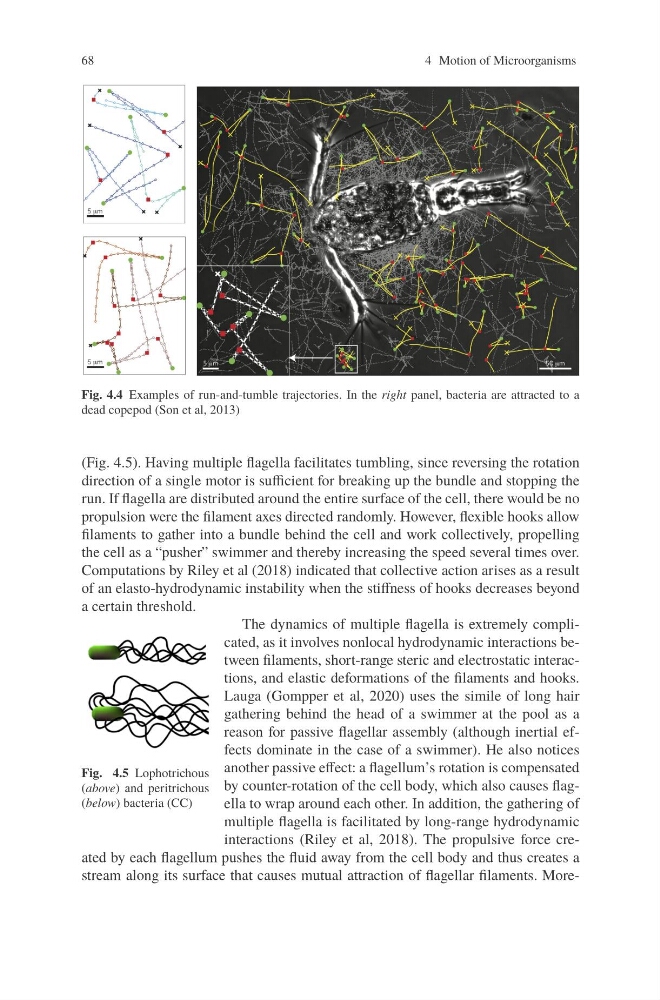
Fig. 4.4 Examples of run-and-tumble trajectories. In the right panel, bacteria are attracted to a
dead copepod (Son et al, 2013)
(Fig. 4.5). Having multiple flagella facilitates tumbling, since reversing the rotation
direction of a single motor is sufficient for breaking up the bundle and stopping the
run. If flagella are distributed around the entire surface of the cell, there would be no
propulsion were the filament axes directed randomly. However, flexible hooks allow
filaments to gather into a bundle behind the cell and work collectively, propelling
the cell as a “pusher” swimmer and thereby increasing the speed several times over.
Computations by Riley et al (2018) indicated that collective action arises as a result
of an elasto-hydrodynamic instability when the stiffness of hooks decreases beyond
a certain threshold.
Fig. 4.5 Lophotrichous
(above) and peritrichous
(below) bacteria (CC)
The dynamics of multiple flagella is extremely complicated, as it involves nonlocal hydrodynamic interactions between filaments, short-range steric and electrostatic interactions, and elastic deformations of the filaments and hooks.
Lauga (Gompper et al, 2020) uses the simile of long hair
gathering behind the head of a swimmer at the pool as a
reason for passive flagellar assembly (although inertial effects dominate in the case of a swimmer). He also notices
another passive effect: a flagellum’s rotation is compensated
by counter-rotation of the cell body, which also causes flagella to wrap around each other. In addition, the gathering of
multiple flagella is facilitated by long-range hydrodynamic
interactions (Riley et al, 2018). The propulsive force created by each flagellum pushes the fluid away from the cell body and thus creates a
stream along its surface that causes mutual attraction of flagellar filaments. More-
4 Motion of Microorganisms
Fig. 4.4 Examples of run-and-tumble trajectories. In the right panel, bacteria are attracted to a
dead copepod (Son et al, 2013)
(Fig. 4.5). Having multiple flagella facilitates tumbling, since reversing the rotation
direction of a single motor is sufficient for breaking up the bundle and stopping the
run. If flagella are distributed around the entire surface of the cell, there would be no
propulsion were the filament axes directed randomly. However, flexible hooks allow
filaments to gather into a bundle behind the cell and work collectively, propelling
the cell as a “pusher” swimmer and thereby increasing the speed several times over.
Computations by Riley et al (2018) indicated that collective action arises as a result
of an elasto-hydrodynamic instability when the stiffness of hooks decreases beyond
a certain threshold.
Fig. 4.5 Lophotrichous
(above) and peritrichous
(below) bacteria (CC)
The dynamics of multiple flagella is extremely complicated, as it involves nonlocal hydrodynamic interactions between filaments, short-range steric and electrostatic interactions, and elastic deformations of the filaments and hooks.
Lauga (Gompper et al, 2020) uses the simile of long hair
gathering behind the head of a swimmer at the pool as a
reason for passive flagellar assembly (although inertial effects dominate in the case of a swimmer). He also notices
another passive effect: a flagellum’s rotation is compensated
by counter-rotation of the cell body, which also causes flagella to wrap around each other. In addition, the gathering of
multiple flagella is facilitated by long-range hydrodynamic
interactions (Riley et al, 2018). The propulsive force created by each flagellum pushes the fluid away from the cell body and thus creates a
stream along its surface that causes mutual attraction of flagellar filaments. More-