

26
2 Active Nematics
al (2006) adopted this interaction rule in their simulations. Rather than averaging the
orientation angle of a particle at each interaction step over the propagation directions
of the particles within a metric neighborhood, as in a polar flock, they inverted these
directions when they were at an obtuse angle to the direction of motion of the test
particle.
This rule allows the particles to reverse their propagation direction, while always
moving at constant speed. The conservation of momentum, dubious for Vicsek’s
vector particles, makes no sense whatsoever in this case. Therefore, the continuous
model of Peruani et al (2008) imitating the particle-based computations was restricted
to a sole equation for the orientation distribution function. Its solution implied
evolution to two peaks of alignment angles, as can be seen in the left panel of Fig. 2.3,
in contrast to the single peak for vectorial particles. Agent-based computations arrive
at a qualitatively similar distribution, as shown in the right panel of Fig. 2.3, but with
the smooth alignment peaks made rugged by noise.
Simulations of self-propelled rod-like particles have to take into account steric
interactions that prevent particle self-intersections. This makes observed patterns
dependent on the particles’ aspect ratio, in addition to their density, propulsion
velocity, and the level of noise. Rod-like particles, similar to polar ones (Sect. 1.2),
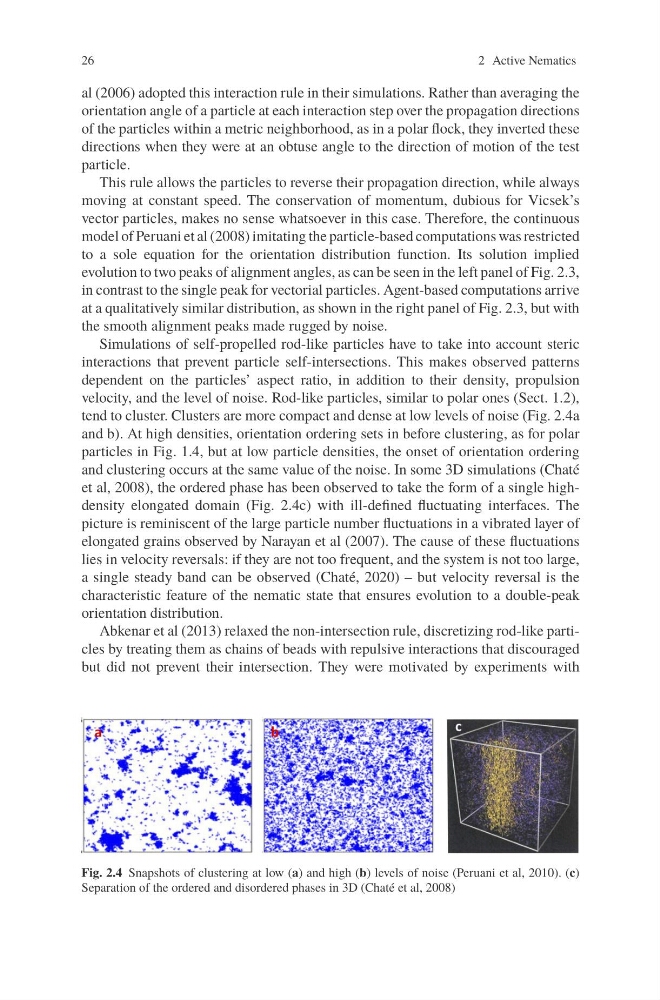
tend to cluster. Clusters are more compact and dense at low levels of noise (Fig. 2.4a
and b). At high densities, orientation ordering sets in before clustering, as for polar
particles in Fig. 1.4, but at low particle densities, the onset of orientation ordering
and clustering occurs at the same value of the noise. In some 3D simulations (Chaté
et al, 2008), the ordered phase has been observed to take the form of a single highdensity elongated domain (Fig. 2.4c) with ill-defined fluctuating interfaces. The
picture is reminiscent of the large particle number fluctuations in a vibrated layer of
elongated grains observed by Narayan et al (2007). The cause of these fluctuations
lies in velocity reversals: if they are not too frequent, and the system is not too large,
a single steady band can be observed (Chaté, 2020) – but velocity reversal is the
characteristic feature of the nematic state that ensures evolution to a double-peak
orientation distribution.
Abkenar et al (2013) relaxed the non-intersection rule, discretizing rod-like particles by treating them as chains of beads with repulsive interactions that discouraged
but did not prevent their intersection. They were motivated by experiments with
Fig. 2.4 Snapshots of clustering at low (a) and high (b) levels of noise (Peruani et al, 2010). (c)
Separation of the ordered and disordered phases in 3D (Chaté et al, 2008)
2 Active Nematics
al (2006) adopted this interaction rule in their simulations. Rather than averaging the
orientation angle of a particle at each interaction step over the propagation directions
of the particles within a metric neighborhood, as in a polar flock, they inverted these
directions when they were at an obtuse angle to the direction of motion of the test
particle.
This rule allows the particles to reverse their propagation direction, while always
moving at constant speed. The conservation of momentum, dubious for Vicsek’s
vector particles, makes no sense whatsoever in this case. Therefore, the continuous
model of Peruani et al (2008) imitating the particle-based computations was restricted
to a sole equation for the orientation distribution function. Its solution implied
evolution to two peaks of alignment angles, as can be seen in the left panel of Fig. 2.3,
in contrast to the single peak for vectorial particles. Agent-based computations arrive
at a qualitatively similar distribution, as shown in the right panel of Fig. 2.3, but with
the smooth alignment peaks made rugged by noise.
Simulations of self-propelled rod-like particles have to take into account steric
interactions that prevent particle self-intersections. This makes observed patterns
dependent on the particles’ aspect ratio, in addition to their density, propulsion
velocity, and the level of noise. Rod-like particles, similar to polar ones (Sect. 1.2),
tend to cluster. Clusters are more compact and dense at low levels of noise (Fig. 2.4a
and b). At high densities, orientation ordering sets in before clustering, as for polar
particles in Fig. 1.4, but at low particle densities, the onset of orientation ordering
and clustering occurs at the same value of the noise. In some 3D simulations (Chaté
et al, 2008), the ordered phase has been observed to take the form of a single highdensity elongated domain (Fig. 2.4c) with ill-defined fluctuating interfaces. The
picture is reminiscent of the large particle number fluctuations in a vibrated layer of
elongated grains observed by Narayan et al (2007). The cause of these fluctuations
lies in velocity reversals: if they are not too frequent, and the system is not too large,
a single steady band can be observed (Chaté, 2020) – but velocity reversal is the
characteristic feature of the nematic state that ensures evolution to a double-peak
orientation distribution.
Abkenar et al (2013) relaxed the non-intersection rule, discretizing rod-like particles by treating them as chains of beads with repulsive interactions that discouraged
but did not prevent their intersection. They were motivated by experiments with
Fig. 2.4 Snapshots of clustering at low (a) and high (b) levels of noise (Peruani et al, 2010). (c)
Separation of the ordered and disordered phases in 3D (Chaté et al, 2008)