

2.2 Rod-like Particles
25
Since the fluid is anisotropic, so are viscosities, which, similar to elasticities, have
to be defined by a fourth-order symmetric tensor rather than a single scalar coefficient
as for isotropic fluids. The hydrodynamic equations of motion of nematic liquid crystals are well established in the Ericksen–Leslie theory (Kleman and Lavrentovich,
2003), but are hardly ever used in their full form due to their complexity and lack of
data on their numerous parameters. Activity brings about additional complications,
and ingenuity in model building is required to arrive at realistic results without
getting bogged down in technicalities.
2.2 Rod-like Particles
Liquid-crystalline order can be reproduced on a larger scale in assemblies of active
particles. Nematic alignment arises when particles are stiff and elongated. These
might be macroscopic rods in a vibrating granular layer, or rod-like bacteria or
viruses, or stiff filaments in the cellular cytoskeleton, or migrating cells, what Gruler
et al (1995) called “living liquid crystals”. In this chapter, we restrict to two approaches to active nematics, parallel to the approaches to “dry” polar active media
in Chap. 1: dynamics of discrete rod-like particles and of active nematic continua.
“Wet” active media, comprising particles interacting with their surroundings, will be
discussed in later chapters dedicated to the motion of self-driven colloids and living
matter.
The most straightforward way to model “flocks” of self-propelled rod-like particles is similar to Vicsek’s approach, in which velocity is identified with alignment
and the magnitude of the velocity is constant. However, the interaction rules have to
be modified, since the connection between velocity, which is a vector, and nematic
alignment is not as straightforward as between two vectors in a polar medium. Mobile rod-like particles colliding at an obtuse angle tend to anti-align, and Peruani et
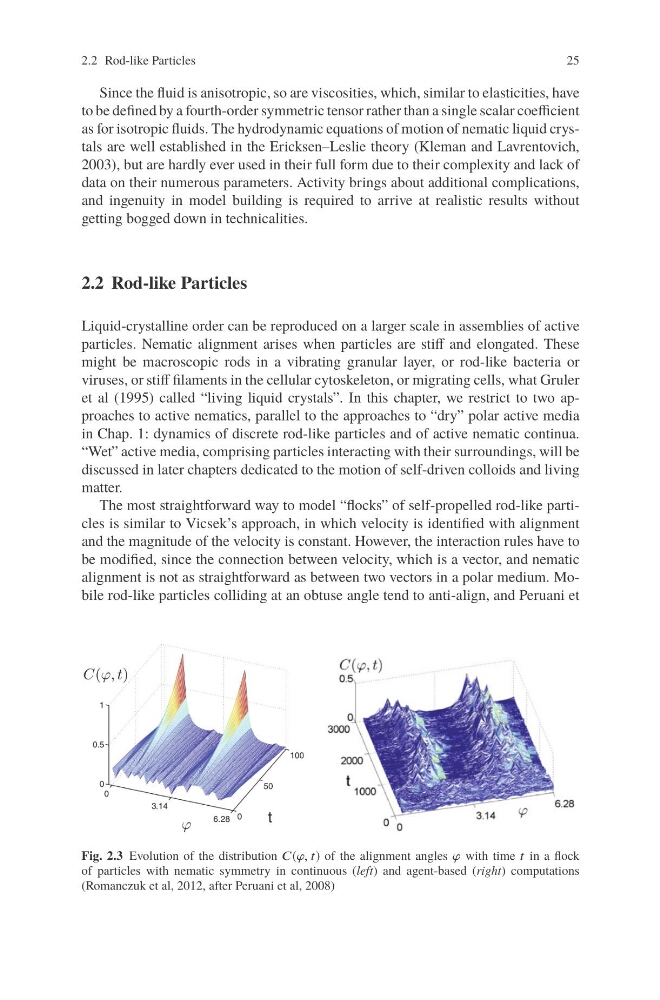
Fig. 2.3 Evolution of the distribution C(ϕ, t) of the alignment angles ϕ with time t in a flock
of particles with nematic symmetry in continuous (left) and agent-based (right) computations
(Romanczuk et al, 2012, after Peruani et al, 2008)
25
Since the fluid is anisotropic, so are viscosities, which, similar to elasticities, have
to be defined by a fourth-order symmetric tensor rather than a single scalar coefficient
as for isotropic fluids. The hydrodynamic equations of motion of nematic liquid crystals are well established in the Ericksen–Leslie theory (Kleman and Lavrentovich,
2003), but are hardly ever used in their full form due to their complexity and lack of
data on their numerous parameters. Activity brings about additional complications,
and ingenuity in model building is required to arrive at realistic results without
getting bogged down in technicalities.
2.2 Rod-like Particles
Liquid-crystalline order can be reproduced on a larger scale in assemblies of active
particles. Nematic alignment arises when particles are stiff and elongated. These
might be macroscopic rods in a vibrating granular layer, or rod-like bacteria or
viruses, or stiff filaments in the cellular cytoskeleton, or migrating cells, what Gruler
et al (1995) called “living liquid crystals”. In this chapter, we restrict to two approaches to active nematics, parallel to the approaches to “dry” polar active media
in Chap. 1: dynamics of discrete rod-like particles and of active nematic continua.
“Wet” active media, comprising particles interacting with their surroundings, will be
discussed in later chapters dedicated to the motion of self-driven colloids and living
matter.
The most straightforward way to model “flocks” of self-propelled rod-like particles is similar to Vicsek’s approach, in which velocity is identified with alignment
and the magnitude of the velocity is constant. However, the interaction rules have to
be modified, since the connection between velocity, which is a vector, and nematic
alignment is not as straightforward as between two vectors in a polar medium. Mobile rod-like particles colliding at an obtuse angle tend to anti-align, and Peruani et
Fig. 2.3 Evolution of the distribution C(ϕ, t) of the alignment angles ϕ with time t in a flock
of particles with nematic symmetry in continuous (left) and agent-based (right) computations
(Romanczuk et al, 2012, after Peruani et al, 2008)